

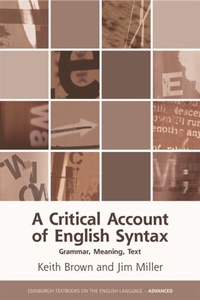
A Critical Account of English Syntax
Grammar, Meaning, Text
1st Edition
Published on 21. November 2016
312 pages
978-0-7486-9611-6 (ISBN)
Description

A descriptive and comprehensive account of English syntax and grammar
Tackling the role of syntactic constructions in text, this companion brings out the connections between syntactic structures and semantics/pragmatics and the function of different clausal structures in written and spoken texts. It also draws attention to variation in standard written English, to the grammatical structures and discourse devices in spoken English, and to ongoing changes in English grammar. It focuses on the concepts of descriptive grammar as extended and refined over the last fifty years.
- Encyclopedic format gives immediate access the most relevant topic
- Cross-referencing allows students to follow a thread and explore the interrelationships between syntactic structures
- Innovative structure of the volume enables lecturers to decide the order in which they wish to discuss topics and to prescribe reading
This is a practical yet flexible reference that you can return to again and again, whether it be for learning, research or teaching.
More details
Series
Language
English
Place of publication
Edinburgh
United Kingdom
Target group
Professional and scholarly
Illustrations
18 black and white illustrations
File size
0,94 MB
ISBN-13
978-0-7486-9611-6 (9780748696116)
Copyright in bibliographic data and cover images is held by Nielsen Book Services Limited or by the publishers or by their respective licensors: all rights reserved.
Schweitzer Classification
Other editions
Additional editions
Book
11/2016
Edinburgh University Press
€141.50
Shipment within 15-20 days
Book
11/2016
Edinburgh University Press
€50.94
Shipment within 15-20 days
Persons
Content
- Cover
- A Critical Account of English Syntax
- Contents
- Introduction
- Organisation and content
- Why study the grammar of English
- What counts as the grammar of English
- The data
- Grammaticality
- Grammaticality and acceptability
- Grammaticality and intuition
- Grammaticality and power
- Grammaticality: descriptive and prescriptive grammar
- Grammaticality and language change
- Adjectives and adjective phrases
- Adjectives and adjective phrases: introduction
- Adjectives and adjective phrases: adjectives and denotation
- Adjectives and adjective phrases: adjectives and gradability
- Adjectives and adjective phrases: adjectives as heads of noun phrases
- Adjectives and adjective phrases: adjectives as a word class
- Adjectives and adjective phrases: adjective positions in noun phrases
- Adjectives and adjective phrases: reduplication
- Adverbs and adverb phrases
- Adverbs and adverb phrases: introduction
- Adverbs and adverb phrases: adverbs and adjectives
- Adverbs and adverb phrases: structure of adverb phrases
- Adverbial clauses
- Adverbial clauses: introduction
- Adverbial clauses: time, condition, reason, concession
- Adverbial clauses: less common types
- Adverbial clauses: position in clauses and sentences
- Adverbial clauses: spoken English
- Adverbial clauses: subordinate clause or main clause
- Clause and text
- Clause and text: introduction
- Clause and text: clefts
- IT clefts
- WH clefts
- Reverse WH clefts
- TH clefts
- Clause and text: cohesion
- Cohesion: orientation
- Cohesion: orientation in place
- Cohesion: orientation in time
- Cohesion: orientation in time: tense and aspect
- Cohesion: co-reference and referent tracking
- Cohesion: coordination and subordination
- Cohesion: adverbials and conjunctions
- Clause and text: cohesion - active, passive, middle
- Clause and text: discourse markers
- Clause and text: ellipsis
- Clause and text: focus
- Clause and text: focus: special syntactic constructions
- Clause and text: focus: word order
- Clause and text: given and new
- Clause and text: non-finite clauses
- Clause and text: spoken and written text
- Clause and text: theme
- Clause structure
- Clause structure: introduction
- Clause structure: constituents
- Transposition
- Substitution
- Coordination
- Clause structure: dependency relations
- Clause structure: hierarchical structure
- Clause structure: linearity and predicate-argument structure
- Clause structure: linearity and grammatical functions
- Clause structure: verb phrases
- Clause structure: integrated and unintegrated syntax
- Clefts
- Clauses: clefts
- Complement clauses
- Complement clauses: complementisers
- Complement clauses: embedded interrogatives
- Complement clauses: mood and modality
- Complement clauses: gerunds, infinitives and meaning
- Complement clauses: noun complement clauses
- Constructions
- Constructions: overview
- Non-finite clauses
- Non-finite clauses: introduction
- Non-finite clauses: infinitives
- Non-finite clauses: free participles
- Non-finite clauses: gerunds (Type 1)
- Non-finite clauses: gerunds (Type 2)
- Non-finite clauses: reduced adverbials
- Non-finite clauses: reduced relatives
- Non-finite clauses: verb stem
- Non-finite clauses: with + NP
- Non-finite clauses: eight types or four
- Nouns and noun phrases
- Nouns and noun phrases: introduction
- Nouns and noun phrases: common and proper
- Nouns and noun phrases: count and mass
- Countability: individuals and substances
- Partitives
- Number and agreement
- Nouns and noun phrases: determinatives
- Nouns and noun phrases: pronouns
- Prepositions and prepositional phrases
- Prepositions and prepositional phrases: introduction
- Prepositions and prepositional phrases: prepositions and particles
- Prepositions and prepositional phrases: prepositions, transitive and intransitive
- Prepositions and prepositional phrases: prepositional phrases, their distribution
- Complements of verbs
- Complements (or postmodifiers) of nouns
- Complements (or postmodifiers) of adjectives
- Complements of prepositions
- Prepositions and prepositional phrases: prepositions and meaning
- Prepositions and prepositional phrases: prepositional verbs
- Relative clauses
- Relative clauses: introduction
- Relative clauses: contact
- Relative clauses: free
- Relative clauses: infinitival
- Relative clauses: non-standard
- Relative clauses: propositional
- Relative clauses: restrictive and non-restrictive
- Relative clauses: shadow pronouns
- Relative clauses: th
- Relative clauses: unattached
- Relative clauses: unintegrated
- Relative clauses: wh
- Relative clauses: wh words as deictics
- Relative clauses: which as discourse connective
- Sentences and clauses
- Sentences and clauses: introduction
- Sentences and clauses: clauses
- Sentences and clauses: complex sentences
- Sentences and clauses: compound sentences
- Sentences and clauses: main and subordinate clauses
- Sentences and clauses: sentence fragments
- Sentences and clauses: simple sentences
- Sentences and clauses: subordinate clauses: preposition or complementiser
- Sentences and clauses: system sentence and text sentence
- Verbs and verb phrases
- Verbs and verb phrases: tense and aspect: introduction
- Verbs and verb phrases: tense and aspect in English
- Verbs and verb phrases: future tense
- Verbs and verb phrases: middle construction
- Verbs and verb phrases: mood and modality
- Verbs and verb phrases: passive voice
- Verbs and verb phrases: present perfect and adverbs
- Verbs and verb phrases: present perfect and resultative
- Verbs and verb phrases: present perfect and simple past
- Verbs and verb phrases: progressive aspect
- Verbs and verb phrases: simple present
- Verbs and verb phrases: situation (lexical) aspect
- Word classes
- Word classes: introduction
- Word classes: major and minor
- Word classes: gradience
- Word classes: criteria
- Word classes: semantics
- Word classes: syntactic criteria and sub-classes
- Notes
- Bibliography
- Index
