

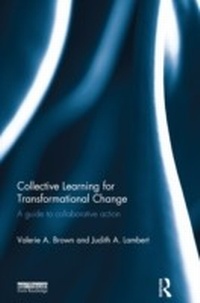
Collective Learning for Transformational Change
A Guide to Collaborative Action
1st Edition
Published on 12. November 2012
304 pages
978-1-136-25471-0 (ISBN)
Description

The drive for change has informed human endeavour throughout history. From fields to factories to offices, people have always asked how to make things better. This innovative book offers a step by step guide for recognising the need for transformational change and kick-starting a course of implementation that leads to the creation of a productive, just and sustainable future for the given community. Drawing on over 300 cases of transformational change planned-for and supported through the process of collective learning, the book shows how a collective learning model based on open learning among diverse interests can improve communication and achieve lasting system change.
Part one of the book outlines the theory and practice of collective learning, drawing on the experiential learning cycle developed by David Kolb. The practice follows the rules of open space learning, dialogue and valuing diversity and is flexible, allowing adaptation to different situations. Case studies in Part two provide examples of collective learning leading to transformational change in a wide range of contexts, from cities to councils to organisations. Part three offers thirty-three activities on which the programme designers can draw in the course of guiding transformational change, from team building, to community development, monitoring, evaluation and cross-cultural learning
This guidebook differs from the traditional management of change. Not only does the process begin with sharing ideals, only later proceeding to implementation, but it also actively harnesses the full set of interests in planning direct action, seeking constructive collaboration not consensus. This groundbreaking guidebook is designed to be fun, accessible and engaging for both students and professionals in the fields of administration and governance.
Part one of the book outlines the theory and practice of collective learning, drawing on the experiential learning cycle developed by David Kolb. The practice follows the rules of open space learning, dialogue and valuing diversity and is flexible, allowing adaptation to different situations. Case studies in Part two provide examples of collective learning leading to transformational change in a wide range of contexts, from cities to councils to organisations. Part three offers thirty-three activities on which the programme designers can draw in the course of guiding transformational change, from team building, to community development, monitoring, evaluation and cross-cultural learning
This guidebook differs from the traditional management of change. Not only does the process begin with sharing ideals, only later proceeding to implementation, but it also actively harnesses the full set of interests in planning direct action, seeking constructive collaboration not consensus. This groundbreaking guidebook is designed to be fun, accessible and engaging for both students and professionals in the fields of administration and governance.
Reviews / Votes
'This "Guide to Collaborative Action" is a systematic and accessible resource - providing direction and inspiration for current and future change agents. Decades of experience have been synthesized in an innovative, integrative and invaluable guide that opens new and creative pathways toward transformational change.' - Margot Parkes, Professor, University of Northern British Columbia, Canada and President, International Association for Ecology & Health'The Collective Social Learning process is simply outstanding. We have found that the framework energises participants, leads to individual and collective action and is transformative. Collective learning has become one of our key change processes in our city's sustainability journey. We have also used the guide to conduct collective learning programs around Australia, and in the USA, New Guinea and Ethiopia.' - Greg Bruce, Executive Manager, Integrated Sustainability Services, Townsville City Council, Queensland, Australia
'As a consultant in the field of international development, I highly recommend this book for everyone who is facilitating intentional transformational change. Based on concepts of collective learning, it brings together clear exercises and an A-Z of essential tools. The many case studies demonstrate how the collective learning spiral can be a vehicle for transformational change in a wide range of cultures.' - Sara Cummings, International consultant, Integrated Knowledge Management Emergent, a European Aid Development Initiative and Editor, Knowledge Management for Development Journal
More details
Language
English
Place of publication
London
United Kingdom
Publishing group
Taylor & Francis Ltd
Target group
College/higher education
Product notice
Reflowable
Illustrations
51 s/w Abbildungen, 4 s/w Tabellen, 47 s/w Zeichnungen
4 Tables, black and white; 47 Line drawings, black and white; 51 Illustrations, black and white
File size
19,92 MB
ISBN-13
978-1-136-25471-0 (9781136254710)
Copyright in bibliographic data and cover images is held by Nielsen Book Services Limited or by the publishers or by their respective licensors: all rights reserved.
Schweitzer Classification
Other editions
Additional editions
Valerie A. Brown | Judith A. Lambert
Collective Learning for Transformational Change
A Guide to Collaborative Action
Book
05/2013
1st Edition
Routledge
€77.30
Shipment within 15-20 days
Valerie A. Brown | Judith A. Lambert
Collective Learning for Transformational Change
A Guide to Collaborative Action
Book
10/2012
1st Edition
Routledge
€232.10
Shipment within 15-20 days
Persons
Valerie A. Brown is Director of the Local Sustainability Project, Human Ecology Program, Fenner School of Environment and Society, The Australian National University.
Judith A. Lambert is Director of Community Solutions, and works in the interface between the social and environmental aspects of sustainable living.
Judith A. Lambert is Director of Community Solutions, and works in the interface between the social and environmental aspects of sustainable living.
Content
Part 1: Instructions: Collective Learning for Transformational Change 1. The Theory: Collective Social Learning 2. The Practice: Party Time 3. Following the Collective Learning Spiral 4. Step 1. Setting the Scene: Who to Invite? 5. Step 2. Collective Ideals: What should be? 6. Step 3. Collective Facts: What is? 7. Step 4. Collective Ideas: What could be? 8. Step 5. Collective Action: What can be? 9. Step 6. Following on 10. Guiding Transformational Change Part 2: Case Studies: Celebrations of Collective Learning 11. Holding the Party 12. Managing Whole-of-Community Change: Bon Voyage 13. Introducing New Ideas: Cocktail Party 14. Initiating Long-Term Change: Opening Night 15. Changing Problem Communities: Housewarming 16. Achieving Collective Thinking: Coming of Age 17. Monitoring and Evaluation: Street Party 18. Teamwork: Bring a Plate 19. Working from the Guidebook: Going it Alone 20. Summing Up Part 3: Resources: The A-Z of Collective Learning
