

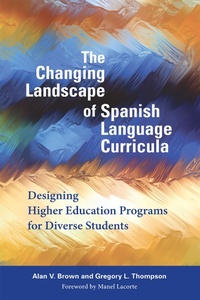
The Changing Landscape of Spanish Language Curricula
Description

Spanish remains a large and constant fixture in the foreign language learning landscape in the United States. As Spanish language study has grown, so too has the diversity of students and contexts of use, placing the field in the midst of a curricular identity crisis. Spanish has become a second, rather than a foreign, language in the US, which leads to unique opportunities and challenges for curriculum and syllabus design, materials development, individual and program assessment, and classroom pedagogy. In their book, Brown and Thompson address these challenges and provide a vision of Spanish language education for the twenty-first century.
Using data from the College Board, ETS, and the authors' own institutions, as well as responses to their national survey of almost seven hundred Spanish language educators, the authors argue that the field needs to evolve to reflect changes in the sociocultural, socioeducational, and sociopolitical landscape of the US. The authors provide coherent and compelling discussion of the most pressing issues facing Spanish post-secondary education and strategies for converting these challenges into opportunities. Topics that are addressed in the book include: Heritage learners, service learning in Spanish-speaking communities, Spanish for specific purposes, assessment, unique needs for Spanish teacher training, online and hybrid teaching, and the relevance of ACTFL's national standards for Spanish post-secondary education. An essential read for Spanish language scholars, especially those interested in curriculum design and pedagogy, that includes supporting reflection questions and pedagogical activities for use in upper-level undergraduate and graduate-level courses.
More details
Other editions
Additional editions
Persons
Alan V. Brown is Associate Professor at the University of Kentucky, where he focuses on Spanish pedagogy and assessment. He has published in Foreign Language Annals, Modern Language Journal, and Hispania, among others.
Gregory L. Thompson is Associate Professor at Brigham Young University, where he focuses on Spanish pedagogy and assessment. He has published in the Foreign Language Annals and Hispania, among others. He also has published two books titled Intersection of Service and Learning: Research and Practice in the Second Language Classroom and Spanish in Bilingual and Multilingual Settings around the World.
Content
List of Illustrations
Foreword by Manel Lacorte
Acknowledgments
1. The Changing Landscape of Spanish Language Education
2. The History and Evolution of Postsecondary Spanish Language Education in the United States
3. Helping Spanish Heritage Language Learners Find Their Place
4. Incorporating Meaningful Service Learning into Spanish Second-Language Curricula
5. Curricular and Programmatic Considerations in Spanish for Specific Purposes
6. Placement, Outcome, and Articulation Issues in Spanish Curricular Assessment
7. Connecting Spanish Language Education with Social, Economic, and Political Realities
8. Training Future Spanish Teachers
9. Technological Advances in Spanish Language Education
10. Charting a Course Forward
Appendix: Description of Data Sets
Index
About the Authors
