

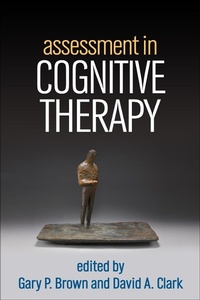
Assessment in Cognitive Therapy
Published on 19. December 2014
366 pages
978-1-4625-1818-0 (ISBN)
Description

Practitioners, students, and researchers in clinical psychology; also of interest to psychiatrists, social workers, counselors, and others who conduct assessments in clinical and research settings. May serve as a supplemental text in graduate-level courses such as Clinical Assessment, Cognitive-Behavioral Therapy, and Evidence-Based Practice.
More details
Other editions
Additional editions
Gary P. Brown | David A. Clark
Assessment in Cognitive Therapy
Book
01/2015
1st Edition
Guilford Press
€58.50
Article not available at the moment
Persons
Gary P. Brown, PhD, is Senior Lecturer in the Psychology Department at Royal Holloway, University of London, United Kingdom, and Director of Research for the Clinical Psychology Doctoral Program. Dr. Brown has published extensively in the area of cognitive therapy for depression and anxiety. His particular focus has been on assessment and measurement, and he has been involved in the development of a number of the key measures used in the field. He has also been active in helping to develop the system of cognitive-behavioral training in the United Kingdom.
David A. Clark, PhD, Professor Emeritus in the Department of Psychology at the University of New Brunswick, Canada, has been a practicing clinical psychologist since 1985. He is a Fellow of the Canadian Psychological Association, Founding Fellow and Trainer Consultant of the Academy of Cognitive and Behavioral Therapies, and ad hoc consultant with the Beck Institute for Cognitive Behavior Therapy. Dr. Clark is a recipient of the Aaron T. Beck Award for Significant and Enduring Contributions to Cognitive Therapy. He was a founding member of the Obsessive Compulsive Cognitions Working Group and is a past associate editor of Cognitive Therapy and Research. Dr. Clark has published numerous research and clinical articles and offers professional training workshops worldwide on cognitive-behavioral therapy for OCD, depression, and anxiety disorders. He is the author of numerous books for professionals and the general public.
David A. Clark, PhD, Professor Emeritus in the Department of Psychology at the University of New Brunswick, Canada, has been a practicing clinical psychologist since 1985. He is a Fellow of the Canadian Psychological Association, Founding Fellow and Trainer Consultant of the Academy of Cognitive and Behavioral Therapies, and ad hoc consultant with the Beck Institute for Cognitive Behavior Therapy. Dr. Clark is a recipient of the Aaron T. Beck Award for Significant and Enduring Contributions to Cognitive Therapy. He was a founding member of the Obsessive Compulsive Cognitions Working Group and is a past associate editor of Cognitive Therapy and Research. Dr. Clark has published numerous research and clinical articles and offers professional training workshops worldwide on cognitive-behavioral therapy for OCD, depression, and anxiety disorders. He is the author of numerous books for professionals and the general public.
Content
Introduction
1. Cognitive Clinical Assessment: Contributions and Impediments to Progress, David A. Clark & Gary P. Brown
I. Cognitive Assessment Strategies and Practices
2. "Better the Devil You Know"? A Conceptual Critique of Endorsement Methods in Cognitive Research and Practice, Gary P. Brown & David A. Clark
3. Production-Based Assessment in Cognitive-Behavioral Therapy, David A. F. Haaga & Ari Solomon
4. Imagery-Based Cognitive-Behavioral Assessment, Susie Hales, Simon E. Blackwell, Martina Di Simplicio, Lalitha Iyadurai, Kerry Young, & Emily A. Holmes
5. Assessment of Cognitive Vulnerability to Psychopathology: Issues in Theory and Practice, Lyndsay E. Evraire, David J. A. Dozois, & Elizabeth P. Hayden
6. Implementing an Evidence-Based Approach to Cognitive-Behavioral Assessment, John Hunsley & Katherine Elliott
II. Cognitive Assessment and Diagnosis
7. Dimensionality in Cognitive-Behavioral Assessment, Amanda A. Uliaszek, Alison Alden, & Richard E. Zinbarg
8. The Cognitive Content-Specificity Hypothesis: Contributions to Diagnosis and Assessment, John Baranoff & Tian Po S. Oei
9. Transdiagnostic Cognitive Assessment and Case Formulation for Anxiety: A New Approach, Angela H. Smith, Chelsea G. Ratcliff & Peter J. Norton
10. Beyond DSM Diagnosis: The Pros and Cons of Cognitive Case Formulation, Peter Bieling & Brenda Key
III. Challenges and Continuing Controversies
11. Toward a Validity Framework for Cognitive Behavioral Therapy Self-Report Assessment, Nick Hawkes & Gary P. Brown
12. Enhancing Measurement Validation in Cognitive-Clinical Research with Structural Equation Modeling and Item Response Theory, Kristin Naragon-Gainey & Timothy A. Brown
13. Implicit Measures of Associations: A Case of Exaggerated Promises?, Anne Roefs, Jorg Huijding, Fren T. Y. Smulders, Anita T. M. Jansen, & Colin M. MacLeod
14. Advances in Construct Validity Theory: Implications for Cognitive Behavioral Therapy Assessment, Leila Guller & Gregory T. Smith
Conclusion
15. Fresh Pools or Stagnant Streams: Current Status of Cognitive Clinical Assessment, Gary P. Brown & David A. Clark
