

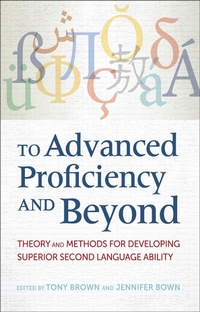
To Advanced Proficiency and Beyond
Description

To Advanced Proficiency and Beyond: Theory and Methods for Developing Superior Second Language Ability addresses an important issue in Second Language Acquisition-how to help learners progress from Intermediate and Advanced proficiency to Superior and beyond. Due to the pressures of globalization, American society encounters an ever-increasing demand for speakers with advanced language abilities. This volume makes available cutting edge research on working memory and cognition and empirical studies of effective teaching. In addition it can serve as a practical handbook for seasoned and pre-professional instructors alike. The bringing together of the latest in second language acquisition theory, decades of empirical research, and practical classroom application makes for an unprecedented volume examining the achievement of Superior-level foreign language proficiency.
More details
Other editions
Additional editions
Persons
Tony Brown is a professor in the department of German and Russian at Brigham Young University. He has published articles in the Foreign Language Annals, Modern Language Journal, Russian Language Journal, and Language Policy.
Jennifer Bown is a professor in the department of German and Russian at Brigham Young University. Her articles have appeared in such journals as Language Teaching, Foreign Language Annals, Modern Language Journal, and Innovation in Language Teaching and Learning.
Content
Introduction: Past Context, Present Focus, Future Directions: Shifting Focus from Intermediate Skills in Classroom Training to Advanced/Superior and Beyond
Cynthia L. Martin
Part One: Defining Characteristics of High-level Language Learning and Learners
1. Experience with Higher Levels of Proficiency
Betty Lou Leaver and Christine Campbell
2. L1, L2, and Cognitive Development: Exploring Relationships
Dan Dewey, Ray Clifford, and Troy Cox
Part Two: Approaches to Maximizing Language Gain at Home and Abroad
3. Developing Superior Language Proficiency and Analytical Skills for the Federal Workforce
Deborah Kennedy and Christa Hansen
4. Advanced Foreign Language Study through Debate
Tony Brown, Jennifer Bown, and Dennis L. Eggett
5. Chinese for Special Purposes: Individualized Instruction as a Bridge to Overseas Direct Enrollment
Matthew B. Christensen and Dana S. Bourgerie
6. Taking on the ?Ceiling Effect? in Arabic
R. Kirk Belnap and Khaled Abuamsha
7. The Development of L2 Proficiency and Literacy within the Context of the Federally Supported Overseas Language Training Programs for Americans
Dan E. Davidson
Part Three: Future Directions in Assessment, Program Design, and National Policy
8. From Proficiency to Expertise: Using HR Evaluation Methods to Assess Advanced Foreign Language and Culture Ability
Patrick McAloon
9. Professional Language Skills: Unprecedented Demand and Supply
Richard D. Brecht, William P. Rivers, John P. Robinson, and Dan E. Davidson
10. Expanded Understandings and Programmatic Approaches for Achieving Advanced Language Ability
Frederick H. Jackson
Conclusion: To Advanced Proficiency and Beyond: Charting a New Course in the Twenty-First Century
Tony Brown and Jennifer Bown
Contributors
Index
