

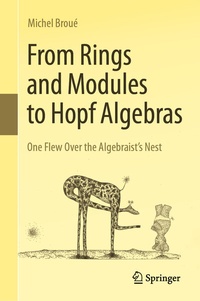
From Rings and Modules to Hopf Algebras
One Flew Over the Algebraist's Nest
Published on 30. January 2024
X, 533 pages
978-3-031-50062-6 (ISBN)
Description

This textbook provides an introduction to fundamental concepts of algebra at upper undergraduate to graduate level, covering the theory of rings, fields and modules, as well as the representation theory of finite groups.
Throughout the book, the exposition relies on universal constructions, making systematic use of quotients and category theory - whose language is introduced in the first chapter. The book is divided into four parts. Parts I and II cover foundations of rings and modules, field theory and generalities on finite group representations, insisting on rings of polynomials and their ideals. Part III culminates in the structure theory of finitely generated modules over Dedekind domains and its applications to abelian groups, linear maps, and foundations of algebraic number theory. Part IV is an extensive study of linear representations of finite groups over fields of characteristic zero, including graded representations and graded characters as well as a final chapter on the Drinfeld-Lusztig double of a group algebra, appearing for the first time in a textbook at this level.
Based on over twenty years of teaching various aspects of algebra, mainly at the École Normale Supérieure (Paris) and at Peking University, the book reflects the audiences of the author's courses. In particular, foundations of abstract algebra, like linear algebra and elementary group theory, are assumed of the reader. Each of the of four parts can be used for a course - with a little ad hoc complement on the language of categories. Thanks to its rich choice of topics, the book can also serve students as a reference throughout their studies, from undergraduate to advanced graduate level.
Throughout the book, the exposition relies on universal constructions, making systematic use of quotients and category theory - whose language is introduced in the first chapter. The book is divided into four parts. Parts I and II cover foundations of rings and modules, field theory and generalities on finite group representations, insisting on rings of polynomials and their ideals. Part III culminates in the structure theory of finitely generated modules over Dedekind domains and its applications to abelian groups, linear maps, and foundations of algebraic number theory. Part IV is an extensive study of linear representations of finite groups over fields of characteristic zero, including graded representations and graded characters as well as a final chapter on the Drinfeld-Lusztig double of a group algebra, appearing for the first time in a textbook at this level.
Based on over twenty years of teaching various aspects of algebra, mainly at the École Normale Supérieure (Paris) and at Peking University, the book reflects the audiences of the author's courses. In particular, foundations of abstract algebra, like linear algebra and elementary group theory, are assumed of the reader. Each of the of four parts can be used for a course - with a little ad hoc complement on the language of categories. Thanks to its rich choice of topics, the book can also serve students as a reference throughout their studies, from undergraduate to advanced graduate level.
Reviews / Votes
"The textbook begins with an introductory chapter that establishes the conventions for the rest of the book. It starts by defining fundamental concepts and results on groups and introduces the language of category theory, accompanied by motivating examples. This provides a unified framework for the material presented in subsequent chapters. ... The broad range of topics covered ensures accessibility to both undergraduate and graduate students, making this book an excellent resource for multiple courses at different levels." (Valeriano Aiello, zbMATH 1558.13001, 2025)
More details
Series
Edition
1st ed. 2024
Language
English
Place of publication
Cham
Switzerland
Publishing group
Springer International Publishing
Illustrations
X, 533 p. 20 illus., 10 illus. in color.
File size
9,16 MB
ISBN-13
978-3-031-50062-6 (9783031500626)
DOI
10.1007/978-3-031-50062-6
Schweitzer Classification
Other editions
Additional editions
Book
01/2024
Springer
€106.99
Shipment within 15-20 days
Person
Michel Broué is a distinguished French mathematician specialising in algebra. He is known for his work on modular representations of finite groups (where a famous conjecture bears his name), on the "generic approach" to representations of finite reductive groups, as well as for work on related areas like cyclotomic Hecke algebras. During a career spanning half a century, he has been the editor-in-chief of the Journal of Algebra (2001-2017), the director of the Department of Mathematics and Computer Science of the École Normale Supérieure and the director of the Institut Henri Poincaré (1999-2009).
Content
1 Prerequisites and Preliminaries.- Part I Rings and Modules.- 2 Rings, Polynomials, Divisibility.- 3 Polynomial Rings in Several Indeterminates.- 4 More on Modules.- 5 On Representations of Finite Groups.- Part II Integral Domains, Polynomials, Fields.- 6 Prime and Maximal Ideals, Integral Domains.- 7 Fields, Division Rings.- Part III Finitely Generated Modules.- 8 Integrality, Noetherianity.- 9 Finitely Generated Projective Modules.- 10 Finitely Generated Modules Over Dedekind Domains.- 11 Complement on Dedekind Domains.- Part IV Characteristic Zero Linear Representations of Finite Groups.- 12 Monoidal Categories: An Introduction.- 13 Characteristic 0 Representations.- 14 Playing With the Base Field.- 15 Induction and Restriction: Some Applications to Finite Groups.- 16 Brauer's Theorem and Some Applications.- 17 Graded Representations and Characters.- 18 The Drinfeld-Lusztig Double of a Group Algebra.
