

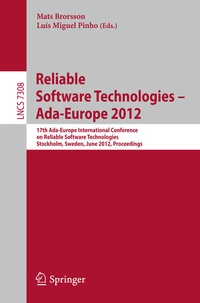
Reliable Software Technologies -- Ada-Europe 2012
17th Ada-Europe International Conference on Reliable Software Technologies, Stockholm, Sweden, June 11-15, 2012, Proceedings
Published on 7. June 2012
XII, 220 pages
978-3-642-30598-6 (ISBN)
Description

This book constitutes the refereed proceedings of the 17th Ada-Europe International Conference on Reliable Software Technologies, Ada-Europe 2012, held in Stockholm, Sweden, in June 2012. The revised 15 full papers presented were carefully reviewed and selected from 34 submissions. They are organized in topical sections on application frameworks, use of ada, modeling, testing and validation,and real-time systems.
More details
Other editions
Additional editions
Mats Brorsson | Luis Miguel Pinho
Reliable Software Technologies -- Ada-Europe 2012
17th Ada-Europe International Conference on Reliable Software Technologies, Stockholm, Sweden, June 11-15, 2012, Proceedings
Book
05/2012
1st Edition
Springer
€53.49
Shipment within 7-9 days
Content
- Title
- Preface
- Organization
- Table of Contents
- Application Frameworks
- Ada Ravenscar Code Archetypes for Component-Based Development
- Introduction
- Overview of the Design Approach
- User Model Entities in the Platform Independent Model Space
- Implementation Entities in the Platform Specific Model Space
- Mapping of Design Entities
- Interface
- Component Type
- Component Implementation
- Component Instance and Container
- Realization of Concurrency and Real-Time Properties
- Delegation Chains
- Archetypes for Threads
- Sporadic Thread
- Parameter Passing for Sporadic Operations
- Discussion
- Related Work
- Conclusions
- References
- An Integrated Framework for Multiprocessor, Multimoded Real-Time Applications
- Introduction
- Example System
- Functional Description
- Operating Modes
- Hardware Platform and Software Workload Model
- Real-Time System Development Workflow
- Schedulability Analysis
- Steady-State Analysis
- Transition Analyses
- Operating Modes Specification
- Mode Manager Specification
- UML Finite State Machine Elements
- Specification of Partial Mode Changes
- Implementation within the Real-Time Framework
- Mode Manager
- Mode Changer
- Conclusions
- References
- Integrating Middleware for Timely Reconfiguration of Distributed Soft Real-Time Systems with Ada DSA
- Introduction
- Background and Related Work
- iLAND Middleware
- Architecture Overview
- Platform Independence
- Limitations for Real-Time
- Adjusting to Ada Distribution Specifics
- Integrating iLAND with Ada DSA. An Interoperable Solution
- Adaptation to the Common Bridge
- Validation
- Conclusions
- References
- Use of Ada
- Source Code as the Key Artifact in Requirement-Based Development: The Case of Ada 2012
- Introduction
- Requirements
- Software Architecture
- Code
- Testing
- Traceability
- Conclusion
- References
- Teaching 'Concepts of Programming Languages' with Ada
- Introduction
- Design of the Course "Concepts of Programming Languages"
- Organization
- Introductory Chapters
- Basic Decisions in Designing the Course
- Course Segment "Questions and Discussions"
- Background
- Examples: Easy Level
- Examples: Medium Level
- Examples: Difficult Level
- Programs for Trying out and Discussing
- Cross-References to Other Courses
- Evaluation of the Course
- How to Evaluate a University Course?
- Evaluation by the Students
- Advantages and Drawbacks of the Course as Seen by the Lecturer
- Conclusion
- References
- Designing the API for a Cryptographic Library
- Introduction
- Introducing the libadacrypt
- Handling Secure Authenticated Encryption (AE)
- Generic Composition
- Nonce Problematic
- Plaintext Leaking
- An API for Authenticated Encryption Schemes
- Conclusion and Outlook
- References
- Modeling
- Handling Synchronization Requirements under Separation of Concerns in Model-Driven Component-Based Development
- Introduction
- Our View of Separation of Concerns
- Specification of Needs and the Solution
- The Role of Software Architecture
- SofC in a Component Model for High-integrity Systems
- SofC Applied: Handling Synchronization Requirements
- Synchronization Levels
- Supporting Atomic Blocks in the Component Model
- Formulating Assumptions about Atomic Blocks at the Client-Side Level
- Guaranteeing Atomic Blocks in the Design Environment
- Conclusions and Future Work
- References
- An Approach to Model Checking Ada Programs
- Introduction
- Model Extraction
- Property Specification
- Case Study
- Related Work
- Conclusions
- References
- Formal Modelling for Ada Implementations: Tasking Event-B
- Introduction
- Motivation
- An Overview of Event-B
- An Overview of Tasking Event-B
- Case Study
- Event-B Development
- Guiding Code Generation with Tasking Event-B
- Writing Directly to Memory Locations
- Tooling
- Conclusions
- Related Work
- References
- Testing and Validation
- Augmenting Formal Development with Use Case Reasoning
- Introduction
- Background
- Event-B
- The Use Case Extension of Event-B
- Small Example
- Use Case Semantics
- Co-refinement of Machines and Use Cases
- Case Study
- Abstract Model
- First Refinement
- Second Refinement
- Third Refinement
- Fourth, Fifth and Sixth Refinements
- Seventh Refinement
- Conclusion
- References
- Formal Goal-Oriented Development of Resilient MAS in Event-B
- Introduction
- Formal Modelling and Refinement in Event B
- Modelling in Event-B
- Event-B Refinement
- A Formal View of Goal-Oriented Multi-agent System
- Patterns for Goal-Oriented Development
- Abstract Goal Modelling Pattern
- Goal Decomposition Pattern
- Agent Modelling Pattern
- Agent Refinement Pattern
- Case Study: A Multi-robotic System
- A Case Study Description
- Pattern-Driven Refinement of a Multi-robotic System
- Conclusions
- Discussion
- Related Work
- References
- Choices, Choices: Comparing between CHOC'LATE and the Classification-Tree Methodology
- Introduction
- OverviewofCHOC'LATE and CTM
- CHOC'LATE
- CTM
- Applicability of CHOC'LATE and CTM
- Strengths andWeaknesses of CHOC'LATE and CTM
- Relations among Categories and Choices
- Inherent Limitation of Tree Structure
- Automatic Deduction and Consistency Checking of Relations
- Test Frame Generation
- Documentation of the Software under Test
- Selection Guidelines
- Related Work
- Summary and Conclusion
- References
- Real-Time Systems
- Improving the Performance of Execution Time Control by Using a Hardware Time Management Unit
- Introduction
- The Time Management Unit (TMU)
- UC3 Implementation of TMU
- Ada 2012 Execution Time Control
- Implementation without TMU
- Design
- Hardware Timer
- Clock Management
- Measuring Time
- Setting the Hardware Timer
- Alarms
- Interrupt Handler
- Modifications for Using the TMU
- TMU Interface
- Hardware Timer Usage
- Interrupt Handlers
- Context Switch
- PerformanceTesting
- Reading the RTC and ETC
- Context Switch Overhead
- Interrupt Handler Overhead
- Timing Event Overhead
- Cost to Interrupted Task
- Discussion
- Performance Improvements
- Modifications of Run-Time Environment
- TMU Design, Implementation and Portability
- Conclusion
- References
- Implementing and Verifying EDF Preemption-Level Resource Control
- Introduction
- Analysis of Baker's Algorithm
- EDF Verification Tool
- Abstract Specification
- Scenario Creator
- Simulator
- Code Generator
- Controller
- Implementation
- Summary
- Evaluation
- Scenario Descriptions
- Summary
- Conclusions
- References
- Efficient Constraint Handling during Designing Reliable Automotive Real-Time Systems
- Introduction
- Related Works
- Contribution and Outline
- Design Constraints
- How to Satisfy Constraints in an Efficient Way
- Implications on Design Space Exploration
- System Configuration - Optimization Framework
- Experimental Results
- Conclusion
- References
- Author Index
