

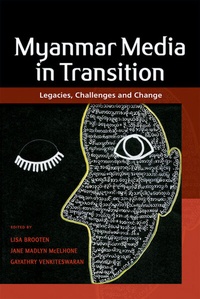
Myanmar Media in Transition
Legacies, Challenges and Change
Published on 5. August 2019
407 pages
978-981-4843-40-9 (ISBN)
Description

No detailed description available for "Myanmar Media in Transition".
More details
Edition
Digital original
Language
English
Place of publication
Singapore
United Kingdom
Target group
Professional and scholarly
US School Grade: College Graduate Student
Edition type
Digital original
File size
4,00 MB
ISBN-13
978-981-4843-40-9 (9789814843409)
Copyright in bibliographic data and cover images is held by Nielsen Book Services Limited or by the publishers or by their respective licensors: all rights reserved.
Schweitzer Classification
Other editions
Additional editions
Lisa Brooten | Jane Madlyn McElhone | Gayathry Venkiteswaran
Myanmar Media in Transition
Legacies, Challenges and Change
Book
05/2019
ISEAS
€42.20
Shipment within 3-4 weeks
Content
- Intro
- Contents
- Contributors and Editors
- Burma or Myanmar? A Note onTerminology
- 1. Introduction: Myanmar Media Historically and the Challenges of Transition, by Lisa Brooten, Jane Madlyn McElhone and Gayathry Venkiteswaran
- PART I: Structural Constraints and Opportunities
- 2. Legal Changes for Media and Expression: New Reforms, Old Controls, by Gayathry Venkiteswaran, Yin Yadanar Thein and Myint Kyaw
- 3. Whispered Support: Two Decades of International Aid for Independent Journalism and Free Expression, by Jane Madlyn McElhone and Lisa Brooten
- 4. The Changing Face of Print Media: An Interview with News Veteran Thiha Saw. Interviewed by Jane Madlyn McElhone and Gayathry Venkiteswaran
- 5. Privacy Risks in Myanmar's Emerging ICT Sector, by Kamran Emad and Erin McAuliffe
- PART II: Journalism in Transition
- 6. Silencing a Snakehead Fish: A Case Study in Local Media, Rural-Based Activism, and Defamation Litigation in Southern Myanmar, by Jennifer Leehey
- 7. Precarity and Risk in Myanmar's Media: A Longitudinal Analysis of Natural Disaster Coverage by The Irrawaddy, by Susan Banki and Ja Seng Ing
- 8. Educating a New Generation of Watchdogs: Interview with Ye Naing Moe, Director of the Yangon and Mandalay Journalism Schools. Interviewed by Nai Nai and Jane Madlyn McElhone
- 9. The Metamorphosis of Media in Myanmar's Ethnic States, by Jane Madlyn McElhone
- 10. Covering Rakhine: Journalism, Conflict and Identity, by Eaint Thiri Thu
- 11. Media in Myanmar: Laws, Military and the Public, by Lawi Weng
- 12. Cracking the Glass Ceiling in Myanmar Media, by Thin Lei Win
- 13. Media and the 2015 General Elections, by Carine Jaquet
- PART III: Creative Expression
- 14. Myanmar's Pop Music Industry in Transition, by Heather MacLachlan
- 15. New Video Generation: The Myanmar Motion Picture Industry in 2017, by Jane M. Ferguson
- 16. Films for Dignity, by Mon Mon Myat
- 17. A "Fierce" Fear: Literature and Loathing after the Junta, by Ma Thida
- PART IV: Society and Media
- 18. The Tea Shop Meets the 8 O'clock News: Facebook, Convergence and Online Public Spaces, by Yan Naung Oak and Lisa Brooten
- 19. From Blogging to Digital Rights: Telecommunications Reform in Myanmar, by Htaike Htaike Aung and Wai Myo Htut
- 20. Counter-Narratives: Myanmar's Digital Media Activists, by Sarah Oh
- Epilogue: Media Studies in Myanmar - Where Do We Go from Here?, by Lisa Brooten, Jane Madlyn McElhone and Gayathry Venkiteswaran
- Index
