

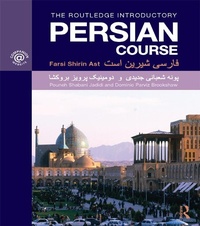
The Routledge Introductory Persian Course
Farsi Shirin Ast
Published on 10. June 2010
288 pages
978-1-135-22899-6 (ISBN)
Description

The Routledge Introductory Persian Course: Farsi Shirin Ast is an innovative Persian language course designed both for undergraduate and postgraduate students who are new to the language.
Focusing both on grammatical and communicative competence, the course contains 15 lessons combining authentic dialogues and texts with grammar explanations, exercises and audio materials to guide and support the student through the key skills of reading, writing, speaking and listening.
Key features:
lively, content-based materials - the language is taught and practiced through a variety of dialogues and texts on the culture, history, and traditions of Iran
complete vocabulary lists - each vocabulary entry contains the English meaning, the part of speech in Persian, as well as a sample sentence in Persian
colloquial situational dialogues - students are introduced to spoken Persian from the outset
carefully controlled exercises - new grammatical points are practiced in a variety of controlled exercises that bridge between students' existing information and the new information
audio material - students can develop natural pronunciation by imitating the audio recordings of the vocabulary, dialogues, and texts available freely on the companion website
glossaries - comprehensive Persian to English and English to Persian glossaries.
The Routledge Introductory Persian Course: Farsi Shirin Ast provides everything that students and instructors need for an engaging and effective learning environment.
Pouneh Shabani Jadidi is Head of the Persian Language Program and Faculty Lecturer in Persian at the Institute of Islamic Studies, McGill University, Montreal, Canada.
Dominic Parviz Brookshaw is Lecturer in Persian Studies and Iranian Literature at the University of Manchester, UK.
Focusing both on grammatical and communicative competence, the course contains 15 lessons combining authentic dialogues and texts with grammar explanations, exercises and audio materials to guide and support the student through the key skills of reading, writing, speaking and listening.
Key features:
lively, content-based materials - the language is taught and practiced through a variety of dialogues and texts on the culture, history, and traditions of Iran
complete vocabulary lists - each vocabulary entry contains the English meaning, the part of speech in Persian, as well as a sample sentence in Persian
colloquial situational dialogues - students are introduced to spoken Persian from the outset
carefully controlled exercises - new grammatical points are practiced in a variety of controlled exercises that bridge between students' existing information and the new information
audio material - students can develop natural pronunciation by imitating the audio recordings of the vocabulary, dialogues, and texts available freely on the companion website
glossaries - comprehensive Persian to English and English to Persian glossaries.
The Routledge Introductory Persian Course: Farsi Shirin Ast provides everything that students and instructors need for an engaging and effective learning environment.
Pouneh Shabani Jadidi is Head of the Persian Language Program and Faculty Lecturer in Persian at the Institute of Islamic Studies, McGill University, Montreal, Canada.
Dominic Parviz Brookshaw is Lecturer in Persian Studies and Iranian Literature at the University of Manchester, UK.
More details
Language
English
Place of publication
London
United Kingdom
Publishing group
Taylor & Francis Ltd
Target group
College/higher education
File size
3,51 MB
ISBN-13
978-1-135-22899-6 (9781135228996)
Copyright in bibliographic data and cover images is held by Nielsen Book Services Limited or by the publishers or by their respective licensors: all rights reserved.
Schweitzer Classification
Other editions
Additional editions
Pouneh Shabani-Jadidi | Dominic Parviz Brookshaw
The Routledge Introductory Persian Course
Farsi Shirin Ast
Book
05/2010
1st Edition
Routledge
€178.27
Article exhausted; check for reprint
Pouneh Shabani-Jadidi | Dominic Parviz Brookshaw
The Routledge Introductory Persian Course
Farsi Shirin Ast
Book
05/2010
1st Edition
Routledge
€74.46
Article exhausted; check for reprint
Persons
Dr. Pouneh Shabani Jadidi is the Head of the Persian Language Program and Faculty Lecturer in Persian at the Institute of Islamic Studies, McGill University, Montreal, Canada. Dr. Shabani Jadidi taught translation and linguistics at Islamic Azad University in Tehran from 1997 to 2004 and has taught Persian language at McGill since 2006. She received her PhD in Education from the Islamic Azad University in Tehran in 2004. Dr. Shabani Jadidi is currently completing a second PhD in Persian Linguistics at the University of Ottawa, where she is involved in a study on compound verbs in Persian.
Dr. Dominic Parviz Brookshaw is Lecturer in Persian Studies and Iranian Literature at the University of Manchester, England. He holds a DPhil in Persian Literature from the University of Oxford. Dr. Brookshaw taught Persian language and literature at The University of Oxford from 2003 to 2005, and then at McGill University from 2005 to 2007. Since 2007 he has taught Persian language and literature at The University of Manchester.
Dr. Dominic Parviz Brookshaw is Lecturer in Persian Studies and Iranian Literature at the University of Manchester, England. He holds a DPhil in Persian Literature from the University of Oxford. Dr. Brookshaw taught Persian language and literature at The University of Oxford from 2003 to 2005, and then at McGill University from 2005 to 2007. Since 2007 he has taught Persian language and literature at The University of Manchester.
Content
Acknowledgements
Introduction
Lesson 1: The Persian alphabet
Lesson 2: Introduce yourself. Where are you
from?
Lesson 3: Is Iran or Canada larger?
Lesson 4: How many provinces does Iran
have?
Lesson 5: What do you know about Noruz?
Lesson 6: What day is the weekend in Iran?
Lesson 7: What is your favourite sport?
Lesson 8: Do you haggle?
Lesson 9: What do you believe in?
Lesson 10: Are women and men equal?
Lesson 11: Where is Persepolis?
Lesson 12: Is pop music better or traditional
music?
Lesson 13: What kind of a university is your
university?
Lesson 14: Are you single or married?
Lesson 15: Why do you stand on ceremony?
Persian-English glossary
English-Persian glossary
Index
Introduction
Lesson 1: The Persian alphabet
Lesson 2: Introduce yourself. Where are you
from?
Lesson 3: Is Iran or Canada larger?
Lesson 4: How many provinces does Iran
have?
Lesson 5: What do you know about Noruz?
Lesson 6: What day is the weekend in Iran?
Lesson 7: What is your favourite sport?
Lesson 8: Do you haggle?
Lesson 9: What do you believe in?
Lesson 10: Are women and men equal?
Lesson 11: Where is Persepolis?
Lesson 12: Is pop music better or traditional
music?
Lesson 13: What kind of a university is your
university?
Lesson 14: Are you single or married?
Lesson 15: Why do you stand on ceremony?
Persian-English glossary
English-Persian glossary
Index
