

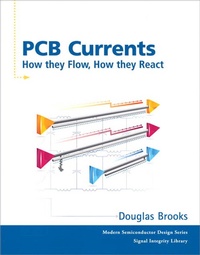
PCB Currents
How They Flow, How They React
1st Edition
Published on 21. May 2013
352 pages
978-0-13-341537-7 (ISBN)
Description

The Plain-English Guide to Electronics and Current Flow for Every PCB Designer
Today, PCB designers must deal with issues such as crosstalk and EMI--issues that were once associated only with components. This requires electronics knowledge that many PCB designers never gain through formal training. In PCB Currents, renowned PCB designer Douglas Brooks teaches these essentials descriptively, in plain English, with as little reliance on mathematics as possible. Building on his widely praised seminars, Brooks explains what current is, how it flows, and how it reacts. He begins by reviewing the nature of current, and then explains current flow in basic circuits, discusses sources that supply and drive current, and addresses the unique problems associated with current on PCBs. Brooks concludes by thoroughly illuminating signal integrity issues caused by current flow. He offers practical design solutions for each common type of problem, as well as for complex challenges involving very high frequency harmonics and very short wavelengths.
Coverage includes
* Current: its fundamental nature, basic definitions, and key concepts
* Five fundamental laws of current, including Kirchoff's law and Ohm's law
* Basic circuit concepts: resistive circuits, reactive circuits, and impedance
* Voltage and current sources: Where electrons come from and why they move
* Current-related PCB issues: temperature, transmission lines, reflections, coupled currents, power distribution, skin effect, dielectric losses, and vias
* Solutions for signal integrity issues caused by current flow, from on-board inductance and apparent resistance changes to more complex problems
The text is written to be accessible and valuable for PCB designers at all levels of experience, whether they have engineering training or not.
Today, PCB designers must deal with issues such as crosstalk and EMI--issues that were once associated only with components. This requires electronics knowledge that many PCB designers never gain through formal training. In PCB Currents, renowned PCB designer Douglas Brooks teaches these essentials descriptively, in plain English, with as little reliance on mathematics as possible. Building on his widely praised seminars, Brooks explains what current is, how it flows, and how it reacts. He begins by reviewing the nature of current, and then explains current flow in basic circuits, discusses sources that supply and drive current, and addresses the unique problems associated with current on PCBs. Brooks concludes by thoroughly illuminating signal integrity issues caused by current flow. He offers practical design solutions for each common type of problem, as well as for complex challenges involving very high frequency harmonics and very short wavelengths.
Coverage includes
* Current: its fundamental nature, basic definitions, and key concepts
* Five fundamental laws of current, including Kirchoff's law and Ohm's law
* Basic circuit concepts: resistive circuits, reactive circuits, and impedance
* Voltage and current sources: Where electrons come from and why they move
* Current-related PCB issues: temperature, transmission lines, reflections, coupled currents, power distribution, skin effect, dielectric losses, and vias
* Solutions for signal integrity issues caused by current flow, from on-board inductance and apparent resistance changes to more complex problems
The text is written to be accessible and valuable for PCB designers at all levels of experience, whether they have engineering training or not.
More details
Edition
1. Auflage
Language
English
Place of publication
United States
Publishing group
Pearson Education (US)
Target group
College/higher education
File size
15,42 MB
ISBN-13
978-0-13-341537-7 (9780133415377)
Copyright in bibliographic data and cover images is held by Nielsen Book Services Limited or by the publishers or by their respective licensors: all rights reserved.
Schweitzer Classification
Other editions
Additional editions
Book
02/2018
Pearson
€91.60
Shipment within 15-20 days
Person
Douglas Brooks has a B.S./E.E. and an M.S./E.E. from Stanford University and a Ph.D. from the University of Washington. He has had forty years of experience in the electronics industry, ranging from circuit design engineer on the space program to president of his own manufacturing company. For the past twenty years he has been president of UltraCAD Design, Inc., a premier PCB Design Service Bureau in the Pacific Northwest.
Brooks has published hundreds of articles during his career. In the last twenty years, these articles have appeared in PCB Design Magazine, on Iconnect007's websites, on Mentor Graphics' web pages, and on UltraCAD's web pages. In 2003, he published the book Signal Integrity Issues and Printed Circuit Board Design (Prentice Hall).
Brooks served on the faculty of San Diego State University for three years and was a visiting associate professor at the University of Washington for one year. He has given numerous seminars on Signal Integrity Issues in PCB Design over the past fifteen years all over the United States and in Moscow, Beijing and Shanghai, Taiwan, Japan, and Australia.
Brooks finally retired in 2012.
Brooks has published hundreds of articles during his career. In the last twenty years, these articles have appeared in PCB Design Magazine, on Iconnect007's websites, on Mentor Graphics' web pages, and on UltraCAD's web pages. In 2003, he published the book Signal Integrity Issues and Printed Circuit Board Design (Prentice Hall).
Brooks served on the faculty of San Diego State University for three years and was a visiting associate professor at the University of Washington for one year. He has given numerous seminars on Signal Integrity Issues in PCB Design over the past fifteen years all over the United States and in Moscow, Beijing and Shanghai, Taiwan, Japan, and Australia.
Brooks finally retired in 2012.
Content
Preface ix
Part I: Nature of Current 1
Chapter 1: Electrons and Charges 3
Chapter 2: Basic Current Concepts 19
Chapter 3: Basic Current Laws 57
Part II Current Flow In Basic Circuits 65
Chapter 4: Resistive Circuits 67
Chapter 5: Reactive Circuits: Capacitors and Capacitance 77
Chapter 6: Reactive Circuits: Inductors and Inductance 91
Chapter 7: Reactive Circuits: Resonance 105
Chapter 8: Impedance 113
Chapter 9: Real Components and Parasitics 133
Chapter 10: Time Constants and Filters 143
Chapter 11: Transformers 159
Chapter 12: Differential Current Flow 173
Chapter 13: Semiconductors 181
Part III: Voltage and Current Sources 193
Chapter14: Voltage and Current Sources 195
Part IV: Current Flow On Circuit Boards 199
Chapter 15: Where Do Currents Flow on Circuit Boards 201
Chapter 16: Current and Trace Temperatures 205
Chapter 17: Current Reflections 213
Chapter 18: Coupled Currents/EMI/Crosstalk 233
Chapter 19: Current Distribution and Bypass Capacitors 249
Chapter 20: Frequency-Variable Resistance and Lossy Transmission Lines 263
Chapter 21: Currents and Vias 275
Chapter 22: Current and Signal Integrity 285
Appendices: 301
Appendix A:Current flow and Maxwell 303
Appendix B: Eye diagrams 307
Appendix C: Death of the Circuit Board 311
Index 313
Part I: Nature of Current 1
Chapter 1: Electrons and Charges 3
Chapter 2: Basic Current Concepts 19
Chapter 3: Basic Current Laws 57
Part II Current Flow In Basic Circuits 65
Chapter 4: Resistive Circuits 67
Chapter 5: Reactive Circuits: Capacitors and Capacitance 77
Chapter 6: Reactive Circuits: Inductors and Inductance 91
Chapter 7: Reactive Circuits: Resonance 105
Chapter 8: Impedance 113
Chapter 9: Real Components and Parasitics 133
Chapter 10: Time Constants and Filters 143
Chapter 11: Transformers 159
Chapter 12: Differential Current Flow 173
Chapter 13: Semiconductors 181
Part III: Voltage and Current Sources 193
Chapter14: Voltage and Current Sources 195
Part IV: Current Flow On Circuit Boards 199
Chapter 15: Where Do Currents Flow on Circuit Boards 201
Chapter 16: Current and Trace Temperatures 205
Chapter 17: Current Reflections 213
Chapter 18: Coupled Currents/EMI/Crosstalk 233
Chapter 19: Current Distribution and Bypass Capacitors 249
Chapter 20: Frequency-Variable Resistance and Lossy Transmission Lines 263
Chapter 21: Currents and Vias 275
Chapter 22: Current and Signal Integrity 285
Appendices: 301
Appendix A:Current flow and Maxwell 303
Appendix B: Eye diagrams 307
Appendix C: Death of the Circuit Board 311
Index 313
