

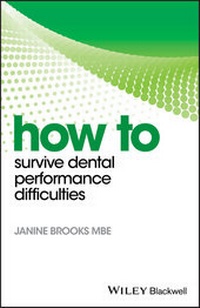
How to Survive Dental Performance Difficulties
Description

* Offers a practical guide for preventing and overcoming dental performance issues
* Highlights case studies of dental professionals who have direct experience of being referred for fitness to practise issues
* Includes information on the support available to dental professionals, the requirements that need to be met, and how to meet them
* Contains information on the effective use of evidence, improvement practice tools such as personal development plans, continuing professional education, reflective diaries, and audits
* Offers guidance on how to increase self-awareness and insight
More details
Other editions
Additional editions
Person
JANINE BROOKS MBE, DMedEth, MSc, FFGDP(UK), MCDH, DDPHRCS, BDS, FAcadMEd, is a Lead Clinical Tutor at the University of Bristol; Educational Inspector for the General Dental Council; Trustee of the Dentists' Health Support Trust; Coach for the Professional Support Unit, Thames Valley; CEO of Dentalia Coaching and Training Consultancy; Director of the Dental Coaching Academy and co-founder of Dental Mentors UK.
Content
Foreword, ix
Acknowledgements, xi
Abbreviations, xiii
Chapter 1 The basics of performance, 1
Introduction, 1
What is performance? 3
What is poor performance? 6
Fitness to practise, 9
Red door/green door, 10
Chapter 2 Background and contributory factors: How performance issues can arise, 13
Introduction, 13
Pressures on dentists, 14
Factors that underpin poor performance, 15
Chapter 3 Professionalism, 27
What is professionalism? 27
What does professionalism encompass? 30
How should a professional behave? 30
Societal expectations of professionals, 31
Character, 32
Building blocks of character, 33
Ethical frameworks within which professionals operate, 34
How does character relate to professionalism? 36
Tests of integrity, 36
Virtue ethics, 37
Honesty and dishonesty, 38
Communication, 42
Criminal record, convictions and cautions, 43
Scotland, 45
Protected conviction or caution, 45
Chapter 4 Regulation of dentistry and dental professionals, 48
Regulation, 48
General Medical Council, 49
General Pharmaceutical Council, 50
General Dental Council, 50
Registration, 51
NHS England, 52
Care Quality Commission, 53
Healthcare Inspectorate Wales, 54
Scotland, 54
Northern Ireland, 55
Professional Standards Authority, 56
Regulation of Dental Services Programme Board, 57
Health and Safety Executive, 58
Medicines and Healthcare Products Regulatory Agency, 59
Right-touch regulation, 60
Chapter 5 Organisations that play a supporting role, 63
Specialist indemnity providers, 63
Educational support, 64
Health support, 67
Mentoring/professional support, 68
Advisory support, 69
Conclusion, 70
Chapter 6 The anatomy of a fitness to practise case, 72
Introduction, 72
Fitness to practise, 74
General Dental Council, 74
Fitness to practise process, 75
Interim Orders Committee, 77
Investigating Committee, 77
Practice Committees, 78
Sanctions, 78
Convictions/cautions, 82
Analysis, 83
Erasure, 86
Conclusion, 91
Chapter 7 The registrant's journey, personal statements and case studies, 93
How it can begin, 94
The Hero's Journey, 95
Case studies, 101
Stages of change or grief, 111
Taking a preventive approach, 113
Chapter 8 Building self-awareness and insight, 115
Self-awareness, 116
Insight, 116
Learning styles, 119
Tools to deepen self-awareness, 124
Conclusion, 138
Chapter 9 Tools that can help, 140
Personal development plan, 141
Peer review, 144
Professional discussion and dialogue, 144
Case studies and presentations, 145
Clinical audit, 146
Staff meetings, 148
Patient surveys (feedback), 148
360° multisource feedback, 150
Standards, national guidelines, 151
Working with a mentor, 151
Working with a coach, 152
Appendix A Personal development plan template, 154
Appendix B Patient engagement questionnaire, 156
Appendix C Influencing skills questionnaire - 360° colleague feedback, 157
Chapter 10 Supporting colleagues who struggle, 160
Being non-judgemental, 160
Listening, 160
Paraphrasing, 161
Questioning, 161
Guiding, 161
Reflective practice/writing and learning, 161
Working one to one, 172
Force field analysis, 176
Neurological levels, 177
Conclusion, 181
Index, 183
Chapter 1
The basics of performance
Introduction
This book has been written to help those dental professionals who have struggled with their performance, are struggling, might struggle or are supporting colleagues who are struggling. That is probably just about the whole dental profession at some point in a working career. It will be of use to all categories of dental professional, clinical and non-clinical.
For a number of years, I have worked with dental professionals who have been referred to the General Dental Council (GDC). This has largely been in the capacity of providing advice, coaching or mentoring support to individuals. Over my career, I have worked with and supported dental professionals who have been deemed poor performers. I was instrumental in setting up the National Clinical Assessment Service (NCAS) systems for dentistry and I worked as an Associate Postgraduate Dental Dean supporting dentists in difficulty. I regularly coach or mentor dentists who are facing GDC hearings or local performance procedures. I have also been responsible for developing and implementing training and managing teams of dentists who supported colleagues undertaking programmes of remediation. Before all that, I was a Clinical Director of Community Dental Services for almost 20 years and directly responsible for a large staff and occasionally I had to deal with staff who performed poorly. I'm not the most experienced in these areas, but I consider myself to have a very good knowledge and experience over 30+ years.
All this experience has led me to want to write this book that I hope will help others who come into contact with remediation in whatever guise. Primarily, it provides information that would be helpful should you personally find yourself the subject of a GDC investigation. It will also be of help to those who support professionals under investigation, whether that be with regulation or with an organisation, and here I have called on my experience of developing training programmes for coaches/mentors, educational supervisors, trainers and appraisers. It is my hope that it may also be of interest to dental professionals involved in fitness to practise panels. Here, the analysis of how processes affect those individuals referred and the case studies of colleagues may assist in humanising our regulation.
Finally, all dental professionals should find the book of use in the spirit of prevention. It is a sobering thought that any dental professional could be the subject of a GDC referral and investigation at any stage of their career - none of us is immune. During their long careers, dental professionals will interact with many, many patients, and making errors is far more common than is admitted. If you are a dental professional working in a non-clinical field, you can still be referred to the regulator, so you cannot assume that fitness to practise does not apply to you.
I have worked with issues of performance for a number of years both nationally and locally. My input has been strategic in setting up systems and processes, but also operational in that I have personally worked with many dental professionals who find themselves struggling and with a complaint against them, and I still do. My response to performance has always been that any dental professional could find themselves in this position and that few actively seek to perform badly or unprofessionally. Dentistry is a complex profession and the vast majority of dental professionals try every day to do the best work they can for the benefit of others and in the best interests of their patients. Things can go wrong for a wide variety of reasons but in my experience, a proactive, humanistic approach is much more likely to lead to resolution than a punitive reaction. Some dental professionals can find themselves more at risk of struggling and I have included a section on taking a preventive approach in Chapter 7, which includes case studies.
The book will cover reasons why dental professionals get into difficulties; issues of professionalism and underpinning culture and ethics; the regulatory processes and mechanisms within which UK dental professionals work, including the General Dental Council, the Care Quality Commission (CQC) and equivalents in Scotland, Wales and Northern Ireland, and commissioning arrangements. Also included will be information about organisations who work with individuals who struggle; the processes of the GDC when investigating and hearing a complaint; the tools that professionals can use to help them to improve performance; and how self-awareness and insight can be deepened. In addition, I have included some case studies of dental professionals who have first-hand experience of struggling and being involved in fitness to practise processes. Many, if not all of the tools, instruments and mechanisms I have included will be of use to all dental professionals in the course of their day-to-day dental practice. The final chapter considers the skills that supporters of colleagues who struggle need to develop as well as some useful one-to-one techniques.
I firmly believe that the vast majority of dental registrants have no desire to perform at less than their best. I also believe that every one of us has performed poorly during our working careers. We have all had bad days, bad weeks possibly even bad years when our performance has slipped. I'm not suggesting that all dental professionals put patient safety at serious risk but we have all produced work that could be judged as less than the best. We have all exhibited behaviour that we regretted when viewed in hindsight. The reasons for this are many and varied and I will cover those in Chapter 2. In this respect, poorly performing dental professionals are an issue for every one of us; we could all become poor performers and it is something in which we all have a part to play. We all need to be vigilant for colleagues who struggle, not to castigate them, not to point the finger and breathe a sigh of relief that it's them and not us, but to support and help them. We are a caring profession and we should extend that care to each other. If we don't care for our colleagues, how can we really care for our patients? It is not possible to have a dual approach without demonstrating a degree of hypocrisy.
What is performance?
Before I take a closer look at performance concerns, dips or difficulties, it seems appropriate to first consider what performance is. A good place to begin might be to look at definitions of performance.
Performance: 'The execution or fulfilment (of a duty, etc.)''The act or process of performing or carrying out' To perform: 'Carry into effect, be the agent of' (Oxford English Reference Dictionary, 1996)
If performance and performing are about carrying out an act, then for dental professionals that act must be dentistry, in all its forms. The duty that requires execution or fulfilment must be providing dental services for others, most usually patients. So let's take a look at definitions of dentistry:
Dentistry: 'The profession or practice of a dentist'It seems to me that this definition is not very helpful.
Dentist: 'A person who is qualified to treat the disease and conditions that affect the mouth, jaws, teeth and their supporting tissues' (Oxford English Reference Dictionary, 1996)Whilst this may be a definition of the most recognisable aspect of dentistry, it fails to cover the richness of roles that dental professionals undertake in the broader field of services to patients, the public and society.
Does that bring us any closer to what dental performance is? Probably a little, but it doesn't get to the essence or spirit of what performance actually is, let alone what satisfactory performance, competent performance, acceptable performance, good performance, excellent performance, underperformance or poor performance is. Every act, intervention or conversation undertaken by a dental professional, in the operation of their role, is performed. Each can be judged to be either acceptable or unacceptable. Performance is the essence of dentistry.
The nine principles of Standards for the Dental Team (GDC, 2013) set out what dental registrants must do to maintain their registration with the General Dental Council. They are the standards against which all dental professionals are judged. They can be deemed to be our standards of performance. On page 3 of Standards for the Dental Team, performance is explicitly noted.
'This document sets out the standards of conduct, performance and ethics that govern you as a dental professional. It specifies the principles, standards and guidance which apply to all members of the dental team. It also sets out what patients can expect from their dental professionals.'
The Business Dictionary (2017) defines performance as:
'The accomplishment of a given task measured against preset known standards of accuracy, completeness, cost, and speed'.
It seems to me that this is getting closer to defining performance for dental professionals. I'm going to take the definition apart a little further.
Task: The performance...
