

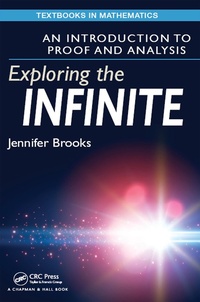
Exploring the Infinite
An Introduction to Proof and Analysis
1st Edition
Published on 30. November 2016
300 pages
978-1-4987-0452-6 (ISBN)
Description

Exploring the Infinite addresses the trend toward
a combined transition course and introduction to analysis course. It
guides the reader through the processes of abstraction and log-
ical argumentation, to make the transition from student of mathematics to
practitioner of mathematics.
This requires more than knowledge of the definitions of mathematical structures,
elementary logic, and standard proof techniques. The student focused on only these
will develop little more than the ability to identify a number of proof templates and
to apply them in predictable ways to standard problems.
This book aims to do something more; it aims to help readers learn to explore
mathematical situations, to make conjectures, and only then to apply methods
of proof. Practitioners of mathematics must do all of these things.
The chapters of this text are divided into two parts. Part I serves as an introduction
to proof and abstract mathematics and aims to prepare the reader for advanced
course work in all areas of mathematics. It thus includes all the standard material
from a transition to proof" course.
Part II constitutes an introduction to the basic concepts of analysis, including limits
of sequences of real numbers and of functions, infinite series, the structure of the
real line, and continuous functions.
Features
Two part text for the combined transition and analysis course
New approach focuses on exploration and creative thought
Emphasizes the limit and sequences
Introduces programming skills to explore concepts in analysis
Emphasis in on developing mathematical thought
Exploration problems expand more traditional exercise sets
a combined transition course and introduction to analysis course. It
guides the reader through the processes of abstraction and log-
ical argumentation, to make the transition from student of mathematics to
practitioner of mathematics.
This requires more than knowledge of the definitions of mathematical structures,
elementary logic, and standard proof techniques. The student focused on only these
will develop little more than the ability to identify a number of proof templates and
to apply them in predictable ways to standard problems.
This book aims to do something more; it aims to help readers learn to explore
mathematical situations, to make conjectures, and only then to apply methods
of proof. Practitioners of mathematics must do all of these things.
The chapters of this text are divided into two parts. Part I serves as an introduction
to proof and abstract mathematics and aims to prepare the reader for advanced
course work in all areas of mathematics. It thus includes all the standard material
from a transition to proof" course.
Part II constitutes an introduction to the basic concepts of analysis, including limits
of sequences of real numbers and of functions, infinite series, the structure of the
real line, and continuous functions.
Features
Two part text for the combined transition and analysis course
New approach focuses on exploration and creative thought
Emphasizes the limit and sequences
Introduces programming skills to explore concepts in analysis
Emphasis in on developing mathematical thought
Exploration problems expand more traditional exercise sets
Reviews / Votes
This book consists of two distinct sections. The first resembles a traditional introduction to proof (including counterexamples) and standard mathematical topics (sets, functions, number theory, some abstract algebra, etc.). The work could serve as a textbook for a semester course on that alone. The second part focuses on analysis of the real line. The work begins by establishing the existence of an uncountable set followed by the completion of the real line via Cauchy sequences. Next is the topology of the real line (basic point set in a metric space ending with Heine-Borel and the Cantor set). It concludes by examining continuous and uniformly continuous functions, derivatives, and absolutely and conditionally convergent series and rearrangements. The book is well written and accessible to students, with thought-provoking exercises sprinkled throughout and larger exercise sets at the end of each chapter. It could easily be used for a two-semester course after multivariable calculus, preparing students with the fundamentals for upper-division courses, particularly an advanced calculus course. In the appendix, there are also aEURoeProgramming Projects,aEUR such as a brief course on Python as a suggested language. This book is worthy of consideration.--J. R. Burke, Gonzaga University, Choice magazine 2016
More details
Series
Edition
1. Auflage
Language
English
Place of publication
Philadelphia, PA
United States
Publishing group
Taylor & Francis Inc
Target group
College/higher education
Professional and scholarly
This book is intended for instructors and students taking a course in introductory analysis. It also would be useful to instructors and students who have not taken a transition course and to education majors.
Product notice
Reflowable
Illustrations
25 s/w Abbildungen
25 Illustrations, black and white
ISBN-13
978-1-4987-0452-6 (9781498704526)
Copyright in bibliographic data and cover images is held by Nielsen Book Services Limited or by the publishers or by their respective licensors: all rights reserved.
Schweitzer Classification
Other editions
Additional editions
Book
01/2023
1st Edition
Chapman & Hall/CRC
€78.23
Shipment within 10-20 days
Book
12/2016
1st Edition
Chapman & Hall/CRC
€141.00
Shipment within 15-20 days
Person
Jennifer Halfpap is an Associate Professor in the Department of Mathematical Sciences at the University of Montana, Missoula, USA. She is also the Associate Chair of the department, directing the Graduate Program.
Content
I Fundamentals of Abstract MathematicsBasic NotionsA First Look at Some Familiar Number SystemsInequalitiesA First Look at Sets and FunctionsProblemsMathematical InductionFirst ExamplesFirst ProgramsFirst Proofs: The Principle of Mathematical InductionStrong InductionThe Well-Ordering Principle and InductionProblemsBasic Logic and Proof TechniquesLogical Statements and Truth TablesQuantified Statements and Their NegationsProof TechniquesProblemsSets, Relations, and FunctionsSetsRelationsFunctionsProblemsElementary Discrete MathematicsBasic Principles of CombinatoricsLinear Recurrence RelationsAnalysis of AlgorithmsProblemsNumber Systems and Algebraic StructuresRepresentations of Natural NumbersIntegers and Divisibility Modular ArithmeticThe Rational NumbersAlgebraic StructuresProblemsCardinalityThe Definition Finite Sets RevistedCountably Infinite SetsUncountable SetsProblemsII Foundations of AnalysisSequences of Real NumbersThe Limit of Real NumbersProperties of LimitsCauchy SequencesProblemsA Closer Look at the Real Number SystemR as a Complete Ordered FieldConstruction of RProblemsSeries, Part 1Basic NotionsInfinite Geometric SeriesTests for Convergence of SeriesRepresentations of Real NumbersProblemsThe Structure of the Real LineBasic Notions from TopologyCompact SetsA First Glimpse at the Notion of MeasureProblemsContinuous FunctionsSequential ContinuityRelated NotionsImportant TheoremsProblemsDifferentiationDefinition and First ExamplesProperties of Differential Functions and Rules for DifferentiationApplications of the DerivativeProblemsSeries, Part 2Absolutely and Conditionally Convergent SeriesRearrangementsProblemsA A Very Short Course on PythonGetting StartedInstallation and RequirementsPython BasicsFunctionsRecursion
