

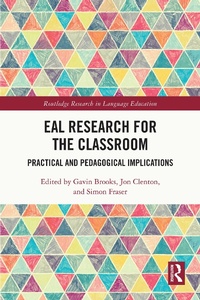
EAL Research for the Classroom
Practical and Pedagogical Implications
1st Edition
Published on 27. June 2023
240 pages
978-1-000-90322-5 (ISBN)
Description

With an estimated 1.6 million English as an Additional Language (EAL) learners in the UK, and over 5 million in the USA, EAL research is urgently needed to inform practice. This edited volume investigates the multifaceted elements that shape EAL pedagogy and research in a variety of settings and research areas, including linguistic ability influences on subject-specific skills, integrating learners' home languages into classroom environments, and the importance of supporting EAL teachers in the classroom. In doing so, the contributors provide an international perspective on the emerging field of EAL research. The research-based chapters detail fundamental concerns related to EAL learner education.
The text is composed of five parts: Part I explores the question of what is EAL and how a definition can shape policy construction; Part II examines the challenges EAL learners face in the classroom, including the use of first languages and the relative impact learner language proficiency has on subject-specific classes; Part III discusses the challenges involved with preparing learners to study in an EAL environment; Part IV investigates concerns relating to supporting EAL teachers in the classroom; and Part V brings together the insights from the previous chapters and provides a road map for future research in the field. The volume draws on researcher expertise from a variety of universities and institutions worldwide. It explores diverse language backgrounds in multilingual contexts. It covers empirical studies with pedagogical, policy, and further research implications.
The volume represents a single resource invaluable for EAL teachers, trainers, and trainees, as well as researchers in education, language learning and teaching, bilingualism and multilingualism, and second language acquisition.
The text is composed of five parts: Part I explores the question of what is EAL and how a definition can shape policy construction; Part II examines the challenges EAL learners face in the classroom, including the use of first languages and the relative impact learner language proficiency has on subject-specific classes; Part III discusses the challenges involved with preparing learners to study in an EAL environment; Part IV investigates concerns relating to supporting EAL teachers in the classroom; and Part V brings together the insights from the previous chapters and provides a road map for future research in the field. The volume draws on researcher expertise from a variety of universities and institutions worldwide. It explores diverse language backgrounds in multilingual contexts. It covers empirical studies with pedagogical, policy, and further research implications.
The volume represents a single resource invaluable for EAL teachers, trainers, and trainees, as well as researchers in education, language learning and teaching, bilingualism and multilingualism, and second language acquisition.
More details
Series
Edition
1. Auflage
Language
English
Place of publication
London
United Kingdom
Publishing group
Taylor & Francis Ltd
Target group
College/higher education
Product notice
Reflowable
Illustrations
33 Tables, black and white; 10 Line drawings, black and white; 2 Halftones, black and white; 12 Illustrations, black and white
ISBN-13
978-1-000-90322-5 (9781000903225)
Copyright in bibliographic data and cover images is held by Nielsen Book Services Limited or by the publishers or by their respective licensors: all rights reserved.
Schweitzer Classification
Other editions
Additional editions
Gavin Brooks | Jon Clenton | Simon Fraser
EAL Research for the Classroom
Practical and Pedagogical Implications
Book
11/2024
1st Edition
Routledge
€61.20
Shipment within 10-20 days
Gavin Brooks | Jon Clenton | Simon Fraser
EAL Research for the Classroom
Practical and Pedagogical Implications
Book
06/2023
1st Edition
Routledge
€196.20
Shipment within 10-20 days
Persons
Gavin Brooks is a lecturer at Kyoto Sangyo University, Japan. He has taught EAL and EFL in Asia and South America for over two decades. His research interests include second language vocabulary, especially the vocabulary needs of EAL students, corpus linguistics, and measures of lexical diversity.
Jon Clenton is an associate professor at Hiroshima University, Japan. His research interests include the assessment of vocabulary knowledge, L2 vocabulary development in terms of bilingual models, word association studies, lexical processing, and L2 measurement tools. His research has resulted in several international journal article publications.
Simon Fraser is a professor at Hiroshima University, Japan. His research interests include English for Specific Purposes (ESP), corpus linguistics, and L2 vocabulary development. His lexical analyses of medical English corpora have informed the development of medical English materials and wordlists, and he has published widely in this area.
Jon Clenton is an associate professor at Hiroshima University, Japan. His research interests include the assessment of vocabulary knowledge, L2 vocabulary development in terms of bilingual models, word association studies, lexical processing, and L2 measurement tools. His research has resulted in several international journal article publications.
Simon Fraser is a professor at Hiroshima University, Japan. His research interests include English for Specific Purposes (ESP), corpus linguistics, and L2 vocabulary development. His lexical analyses of medical English corpora have informed the development of medical English materials and wordlists, and he has published widely in this area.
Content
Lists of figures. List of tables. List of contributors. Acknowledgements. Part I. Introduction 1. Contemporary approaches to EAL education. 2. What do we mean when we say "EAL"?. Part II. Teaching language skills in the EAL classroom 3. Exploring the importance of vocabulary for English as an Additional Language learners' reading comprehension. 4. The contribution of general language ability, reading comprehension and working memory to mathematics achievement among children with English as an Additional Language (EAL): An exploratory study. 5. An analysis of EAL learners' pragmatic strategies: Exploring the exam answers of multilingual doctoral students. Part III. Preparing students for the EAL classroom 6. Preparing young learners for the vocabulary demands of the EMI classroom: A case study of one teacher from the Maldives. 7. Preparing EAL students for the demands of writing assignments in history classes. Part IV. Preparing teachers for the EAL classroom 8. The impact of multilingualism and multiculturalism on teacher education in Ireland: Meeting localised needs in a global classroom. 9. An investigation of the use of standardized and local assessments for young EAL students. 10. Getting to know your learners in an EAL context: Speed bumps and sweet spots. Part V. Conclusion 11. Conclusion: EAL and the road ahead - Practical pathways for future EAL education. Index
