

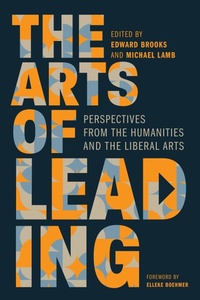
The Arts of Leading
Description

A deeply insightful approach to cultivating leaders of character centered on the arts and humanities
What does it mean to lead? Whom do we consider to be leaders? And how might viewing leadership through the many lenses of the humanities expand our understanding of how it is imagined, represented, and enacted?
Drawing on insights from eminent scholars in the classics, philosophy, religion, literature, history, art, music, and theater, The Arts of Leading reveals the power of the arts and humanities to unsettle common assumptions about leadership. Rather than instrumentalizing the arts and humanities or reducing them to mere management resources, this series of thoughtful and refreshing essays engages a litany of diverse and nuanced perspectives to uncover alternative ways of imagining and embodying leadership across different historical, moral, political, and cultural contexts.
By exploring how a wide range of disciplines can illuminate and humanize complex aspects of leadership that are often obscured in a discourse hooked on reductive paradigms and quick fixes, The Arts of Leading invites leaders, scholars, and citizens to expand their practice of leadership in our ever-evolving world.
More details
Other editions
Additional editions
Persons
Edward Brooks is executive director of the Oxford Character Project and director of the Programme for Global Leadership in the Department of Politics and International Relations at the University of Oxford. He is also cofounder of Oxford's SDG Impact Lab and coeditor of Cultivating Virtue in the University (2022) and Literature and Character Education in Universities (2022).
Michael Lamb is the F. M. Kirby Foundation Chair of Leadership and Character, executive director of the Program for Leadership and Character, and associate professor of interdisciplinary humanities at Wake Forest University. He is also an associate fellow of the Oxford Character Project and author of A Commonwealth of Hope (2022) and coeditor of Cultivating Virtue in the University (2022) and Everyday Ethics (Georgetown University Press, 2019).
Elleke Boehmer is Professor of World Literature in English at the University of Oxford. She is a founding figure in the field of colonial and postcolonial literary studies, and internationally known for her research in the anglophone literatures of empire and anti-empire.
Content
Foreword
Leading Stories and Stories of Leaders
Elleke Boehmer
Introduction
Humanizing Leadership: Reimagining Leadership as a Liberal Art
Edward Brooks and Michael Lamb
PART I. CLASSICS
1. Conversant Leadership: Ciceronian Ideas for Our Precarious Age
Joy Connolly
2. Tragedies of Leadership: Sophocles, Aristotle, and Shakespeare on Tyranny
Edith Hall
PART II. PHILOSOPHY AND RELIGION
3. Leadership Lessons from Plato's Republic
Noah Lopez
4. Mosaic Leadership
Alan Mittleman
5. Just Leadership in Early Islam: The Teachings and Practice of Imam Ali
Tahera Qutbuddin
6. Women's Work and the Question of Leadership
Marla Frederick
PART III. LITERATURE
7. Shakespeare, His Books, and Leadership
John Miles
8. Crooked Politics: Shakespeare's Richard III and Leadership in the Twenty-First-Century United States
Kristin M. S. Bezio
PART IV. HISTORY
9. Lincoln and Leadership in a Racist Democracy
Paul Escott
10. Leadership from the Ground: Enslaved People and the Civil War
Thavolia Glymph
PART V. VISUAL ARTS
11. Leadership in Bronze: Boston's Shaw Memorial and the Battle over Civil War Memory
David M. Lubin
12. Visual Leadership: The Power of Art in the Obama Presidency
Gwendolyn DuBois Shaw
PART VI. PERFORMING ARTS
13. "O Clap Your Hands!": Leadership Lessons from the Experience of Music
Pegram Harrison
14. Acting to Uncover: Theater and Inclusive Leadership
Melissa Jones Briggs
Conclusion
Demos and Deep Democracy: Leadership, the Humanities, and a New Human
Corey D. B. Walker
List of Contributors
Acknowledgments
Index
