

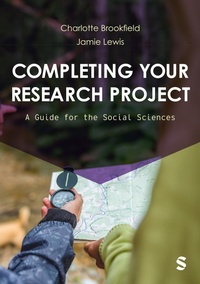
Completing Your Research Project
A Guide for the Social Sciences
1st Edition
Published on 8. January 2025
320 pages
978-1-5296-7596-2 (ISBN)
Description

Simple. Comprehensive. Logical. This book is a companion guide for anyone completing a research project in the social sciences. It covers the whole research process, from planning, developing, collecting data, analysing data, and writing up. It will help you manage and complete your research project successfully.
It will guide you on:
-Planning your research project
-Developing data collection tools
-Analysing and interpreting data
-Presenting your research in different formats
Featuring chapter objectives, checklists, student exercises, weblinks, and further reading, this comprehensive guide ensures readers navigate the complexities of research within a manageable step-by-step framework.
It will guide you on:
-Planning your research project
-Developing data collection tools
-Analysing and interpreting data
-Presenting your research in different formats
Featuring chapter objectives, checklists, student exercises, weblinks, and further reading, this comprehensive guide ensures readers navigate the complexities of research within a manageable step-by-step framework.
Reviews / Votes
'Doing a first research project can be intimidating. This offers a practical guide for the puzzled student. Written in an easy to read, conversational style, full of helpful examples, this will become the key book in the field'. -- David Silverman Completing Your Research Project is a comprehensive guide for social science students. It takes the reader through planning, the collection and analysis of data, presenting findings, writing up and submission and what examiners are looking for in their assessments. This is an authoritative book that students will find invaluable. -- Tim MayMore details
Language
English
Place of publication
London
United Kingdom
Publishing group
Sage Publications Ltd (Digital)
Target group
College/higher education
ISBN-13
978-1-5296-7596-2 (9781529675962)
Copyright in bibliographic data and cover images is held by Nielsen Book Services Limited or by the publishers or by their respective licensors: all rights reserved.
Schweitzer Classification
Other editions
Additional editions
Book
01/2025
1st Edition
SAGE Publications Ltd
€37.50
Shipment within 3-4 weeks
Book
01/2025
1st Edition
SAGE Publications Ltd
€121.81
Shipment within 3-4 weeks
Persons
Charlotte Brookfield is a Reader at Cardiff University's School of Social Sciences. Charlotte is based in the Cardiff Q-Step Centre of Excellence in Quantitative Methods Teaching and Learning. The Centre is one of eighteen across the UK which aim to enhance the quantitative research methods training experience for social science students. The pedagogic activities of the Centre have influenced Charlotte's research interests and in particular, she is interested in exploring the extent to which British sociology engages with quantitative approaches and the possible factors that may contribute toward sociology students' resistance to study and use quantitative techniques.
Charlotte teaches on a range of research methods and substantive modules at both undergraduate and postgraduate level. Specifically, she convenes the Real World Research Placement module, where students are afforded the opportunity to put into practice the quantitative skills they have acquired in lectures in a local work organisation. Organisations involved in this module include the Welsh Government, the Welsh Blood Service and the Welsh Wheelchair Basketball Association. It was through leading this module that Charlotte came to realise the necessity for social science students and graduates to have a greater familiarity with Microsoft Excel.
In her spare time, Charlotte enjoys baking and crafting.
Jamie Lewis is a Reader in Sociology at Cardiff University's School of Social Sciences. His research is mainly situated in the Sociology of Science and Technology Studies (STS), but also extends to the public understanding of science (PUS) and medical sociology. He is presently working on a Expert Citizen Science project on air pollution. He is one of the authors of Psychiatric Genetics: from hereditary madness to big biology and is writing a book examining the development and stabilisation of Bigfootology.
His area of research interests include:
? developments in qualitative research;
? the boundaries between science, pseudo-science and non-science
? the sociology of biomedical knowledge with particular emphasis on the social implications of new genetic and stem cell technologies;
? issues of culture, interdisciplinarity and collaboration in big science;
? public engagement and public understanding of risk;
? aspects of practical accomplishment and modelling in the laboratory
;? science, activism and civic repair.
He is also an editor of the journal, Qualitative Research.
Charlotte teaches on a range of research methods and substantive modules at both undergraduate and postgraduate level. Specifically, she convenes the Real World Research Placement module, where students are afforded the opportunity to put into practice the quantitative skills they have acquired in lectures in a local work organisation. Organisations involved in this module include the Welsh Government, the Welsh Blood Service and the Welsh Wheelchair Basketball Association. It was through leading this module that Charlotte came to realise the necessity for social science students and graduates to have a greater familiarity with Microsoft Excel.
In her spare time, Charlotte enjoys baking and crafting.
Jamie Lewis is a Reader in Sociology at Cardiff University's School of Social Sciences. His research is mainly situated in the Sociology of Science and Technology Studies (STS), but also extends to the public understanding of science (PUS) and medical sociology. He is presently working on a Expert Citizen Science project on air pollution. He is one of the authors of Psychiatric Genetics: from hereditary madness to big biology and is writing a book examining the development and stabilisation of Bigfootology.
His area of research interests include:
? developments in qualitative research;
? the boundaries between science, pseudo-science and non-science
? the sociology of biomedical knowledge with particular emphasis on the social implications of new genetic and stem cell technologies;
? issues of culture, interdisciplinarity and collaboration in big science;
? public engagement and public understanding of risk;
? aspects of practical accomplishment and modelling in the laboratory
;? science, activism and civic repair.
He is also an editor of the journal, Qualitative Research.
Content
Introduction
Chapter One: What is Social Science Research and Why is it Important?
Chapter Two: Planning a Social Science Research Project
Chapter Three: Reviewing Social Science Literature
Chapter Four: Being an Ethical Researcher
Chapter Five: Methods of Social Science Data Collection
Chapter Six: Social Science Data Analysis
Chapter Seven: Presenting Your Social Science Research
Chapter Eight: Introducing and Concluding
Chapter Nine: Submitting Your Social Science Research Project
Chapter One: What is Social Science Research and Why is it Important?
Chapter Two: Planning a Social Science Research Project
Chapter Three: Reviewing Social Science Literature
Chapter Four: Being an Ethical Researcher
Chapter Five: Methods of Social Science Data Collection
Chapter Six: Social Science Data Analysis
Chapter Seven: Presenting Your Social Science Research
Chapter Eight: Introducing and Concluding
Chapter Nine: Submitting Your Social Science Research Project
