

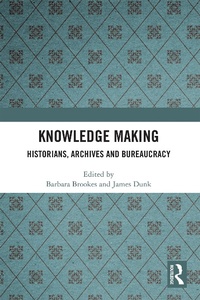
Knowledge Making
Historians, Archives and Bureaucracy
1st Edition
Published on 25. November 2020
170 pages
978-1-000-09410-7 (ISBN)
Description

Paper has been the material of bureaucracy, and paperwork performs functions of order, control, and surveillance. Knowledge Making: Historians, Archives and Bureaucracy explores how those functions transform over time, allowing private challenges to the public narratives created by institutions and governments.
Paperwork and bureaucratic systems have determined what we know about the past. It seems that now, as the digital is overtaking paper (though mirroring its forms), historians are able to see the significance of the materiality of paper and its role in knowledge making - because it is no longer taken for granted.
The contributors to this volume discuss the ways in which public and private institutions - asylums, hospitals, and armies - developed bureaucratic systems which have determined the parameters of our access to the past. The authors present case studies of paperwork in different national contexts, which engage with themes of privacy and public accountability, the beginning of record-keeping practices, and their 'ends', both in the sense of their purposes and in what happens to paper after the work has finished, including preservation and curation in repositories of various kinds, through to the place of paper and paperwork in a 'paperless' world.
The chapters in this book were originally published in a special issue of Rethinking History: The Journal of Theory and Practice.
Paperwork and bureaucratic systems have determined what we know about the past. It seems that now, as the digital is overtaking paper (though mirroring its forms), historians are able to see the significance of the materiality of paper and its role in knowledge making - because it is no longer taken for granted.
The contributors to this volume discuss the ways in which public and private institutions - asylums, hospitals, and armies - developed bureaucratic systems which have determined the parameters of our access to the past. The authors present case studies of paperwork in different national contexts, which engage with themes of privacy and public accountability, the beginning of record-keeping practices, and their 'ends', both in the sense of their purposes and in what happens to paper after the work has finished, including preservation and curation in repositories of various kinds, through to the place of paper and paperwork in a 'paperless' world.
The chapters in this book were originally published in a special issue of Rethinking History: The Journal of Theory and Practice.
More details
Edition
1. Auflage
Language
English
Place of publication
London
United Kingdom
Publishing group
Taylor & Francis Ltd
Target group
College/higher education
Product notice
Reflowable
ISBN-13
978-1-000-09410-7 (9781000094107)
Copyright in bibliographic data and cover images is held by Nielsen Book Services Limited or by the publishers or by their respective licensors: all rights reserved.
Schweitzer Classification
Other editions
Additional editions
Book
01/2024
1st Edition
Routledge
€62.50
Shipment within 15-20 days
Book
06/2020
1st Edition
Routledge
€205.90
Shipment within 15-20 days
Persons
Barbara Brookes is Professor of History at the University of Otago, Dunedin, New Zealand. Her research interests lie in medical and gender history. Her award-winning A History of New Zealand Women, Bridget Williams Books, was published in 2016. She is currently working on a biography of Anna Longshore Potts MD.
James Dunk is a historian of medicine and science at the University of Sydney, Australia, and is working on psychological and public health responses to global environmental change. His history of madness in colonial Australia, Bedlam at Botany Bay, was published by NewSouth in 2019 and shortlisted for the Ernest Scott Prize.
James Dunk is a historian of medicine and science at the University of Sydney, Australia, and is working on psychological and public health responses to global environmental change. His history of madness in colonial Australia, Bedlam at Botany Bay, was published by NewSouth in 2019 and shortlisted for the Ernest Scott Prize.
Content
Introduction: Bureaucracy, archive files, and the making of knowledge
1. Asylum case records: fact and fiction
2. Bookkeeping madness. Archives and filing between court and ward
3. Work, paperwork and the imaginary Tarban Creek Lunatic Asylum, 1846
4. Papering over madness: accountability and resistance in colonial asylum files: a New Zealand case study
5. Paper Soldiers: the life, death and reincarnation of nineteenth-century military files across the British Empire
6. Red ink, blue ink, blood and tears? War records and nation-making in Australia and New Zealand
7. A tale of two bureaucracies: asylum and lunacy law paperwork
1. Asylum case records: fact and fiction
2. Bookkeeping madness. Archives and filing between court and ward
3. Work, paperwork and the imaginary Tarban Creek Lunatic Asylum, 1846
4. Papering over madness: accountability and resistance in colonial asylum files: a New Zealand case study
5. Paper Soldiers: the life, death and reincarnation of nineteenth-century military files across the British Empire
6. Red ink, blue ink, blood and tears? War records and nation-making in Australia and New Zealand
7. A tale of two bureaucracies: asylum and lunacy law paperwork
