

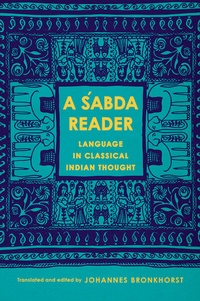
A Sabda Reader
Language in Classical Indian Thought
1st Edition
Published on 6. May 2019
376 pages
978-0-231-54831-1 (ISBN)
Description

Language (sabda) occupied a central yet often unacknowledged place in classical Indian philosophical thought. Foundational thinkers considered topics such as the nature of language, its relationship to reality, the nature and existence of linguistic units and their capacity to convey meaning, and the role of language in the interpretation of sacred writings. The first reader on language in-and the language of-classical Indian philosophy, A Sabda Reader offers a comprehensive and pedagogically valuable treatment of this topic and its importance to Indian philosophical thought.
A Sabda Reader brings together newly translated passages by authors from a variety of traditions-Brahmin, Buddhist, Jaina-representing a number of schools of thought. It illuminates issues such as how Brahmanical thinkers understood the Veda and conceived of Sanskrit; how Buddhist thinkers came to assign importance to language's link to phenomenal reality; how Jains saw language as strictly material; the possibility of self-contradictory sentences; and how words affect thought. Throughout, the volume shows that linguistic presuppositions and implicit notions about language often play as significant a role as explicit ideas and formal theories. Including an introduction that places the texts and ideas in their historical and cultural context, A Sabda Reader sheds light on a crucial aspect of classical Indian thought and in so doing deepens our understanding of the philosophy of language.
A Sabda Reader brings together newly translated passages by authors from a variety of traditions-Brahmin, Buddhist, Jaina-representing a number of schools of thought. It illuminates issues such as how Brahmanical thinkers understood the Veda and conceived of Sanskrit; how Buddhist thinkers came to assign importance to language's link to phenomenal reality; how Jains saw language as strictly material; the possibility of self-contradictory sentences; and how words affect thought. Throughout, the volume shows that linguistic presuppositions and implicit notions about language often play as significant a role as explicit ideas and formal theories. Including an introduction that places the texts and ideas in their historical and cultural context, A Sabda Reader sheds light on a crucial aspect of classical Indian thought and in so doing deepens our understanding of the philosophy of language.
All prices
More details
Other editions
Additional editions

Book
approx. 10/2026
Columbia University Press
€43.33
Not yet published
Book
03/2019
Columbia University Press
€99.04
Article not available at the moment
Person
Bronkhorst Johannes :
Johannes Bronkhorst (PhD, Sanskrit and Pali, University of Pune) is Professor Emeritus of Sanskrit and Indian Studies at the University of Lausanne. He is the author of a number of books, including Karma (Hawaii, 2011), Buddhist Teaching in India (Wisdom, 2009), Tradition and Argument in Classical Indian Linguistics (Springer, 2013), Language and Reality (Brill, 2011), and How the Brahmins Won (Brill, 2016).Johannes Bronkhorst is professor emeritus of Sanskrit and Indian studies at the University of Lausanne. He is the author of a number of books, including Buddhist Teaching in India (2009) and How the Brahmins Won: From Alexander to the Guptas (2016).
Johannes Bronkhorst (PhD, Sanskrit and Pali, University of Pune) is Professor Emeritus of Sanskrit and Indian Studies at the University of Lausanne. He is the author of a number of books, including Karma (Hawaii, 2011), Buddhist Teaching in India (Wisdom, 2009), Tradition and Argument in Classical Indian Linguistics (Springer, 2013), Language and Reality (Brill, 2011), and How the Brahmins Won (Brill, 2016).Johannes Bronkhorst is professor emeritus of Sanskrit and Indian studies at the University of Lausanne. He is the author of a number of books, including Buddhist Teaching in India (2009) and How the Brahmins Won: From Alexander to the Guptas (2016).
Content
Preface
Part I. Introduction
General Observations About Philosophy in India
1. The Brahmanical Background
2. Buddhist Thought: Source of Inspiration
3. The Grammarian Patanjali
4. The Special Place of Sanskrit and the Veda
5. Self-Contradictory Sentences
6. Do Words Affect Cognition?
7. Words and Sentences
8. Other Denotative Functions of the Word
Part II. Reader
1. The Brahmanical Background
2. Buddhist Thought: Source of Inspiration
3. The Grammarian Patanjali
4. The Special Place of Sanskrit and the Veda
5. Self-Contradictory Sentences
6. Do Words Affect Cognition?
7. Words and Sentences
8. Other Denotative Functions of the Word
Index of Translated Passages
The Texts and Their Dates
Chronological Table of Authors and Works
Editions Used
Technical Terms and Their Equivalents in English
Abbreviations
Notes
References
Index
Part I. Introduction
General Observations About Philosophy in India
1. The Brahmanical Background
2. Buddhist Thought: Source of Inspiration
3. The Grammarian Patanjali
4. The Special Place of Sanskrit and the Veda
5. Self-Contradictory Sentences
6. Do Words Affect Cognition?
7. Words and Sentences
8. Other Denotative Functions of the Word
Part II. Reader
1. The Brahmanical Background
2. Buddhist Thought: Source of Inspiration
3. The Grammarian Patanjali
4. The Special Place of Sanskrit and the Veda
5. Self-Contradictory Sentences
6. Do Words Affect Cognition?
7. Words and Sentences
8. Other Denotative Functions of the Word
Index of Translated Passages
The Texts and Their Dates
Chronological Table of Authors and Works
Editions Used
Technical Terms and Their Equivalents in English
Abbreviations
Notes
References
Index

