

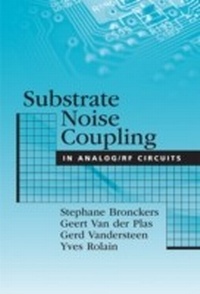
Substrate Noise Coupling in Analog/RF Circuits
1st Edition
Published on 1. January 2010
270 pages
978-1-59693-272-2 (ISBN)
Description

This practical resource offers you detailed guidance on the impact of substrate noise on a wide range of circuits operating from baseband frequencies up to mm-wave frequencies. This unique book presents case studies to illustrate that careful modeling of the assembly characteristics and layout details is required to bring simulations and measurements into agreement. You learn how to use a proper combination of isolation structures and circuit techniques to make analog/RF circuits more immune to substrate noise.
More details
Other editions
Additional editions
Stephane Bronckers | Geert Van der Plas
Substrate Noise Coupling in Analog/RF Circuits
Book
03/2010
Artech House Publishers
€104.18
Shipment within 10-20 days
Content
- Substrate Noise Coupling in Analog/RF Circuits
- Contents
- Foreword
- Preface
- Acknowledgments
- Chapter 1 Introduction
- 1.1 INTRODUCTION AND MOTIVATION
- 1.2 BOOK OVERVIEW
- References
- Chapter 2 Substrate Noise Propagation
- 2.1 INTRODUCTION
- 2.2 MODELING THE SUBSTRATE
- 2.2.1 Analytical Resistance Calculation Between Two Contacts
- 2.2.2 Finite Difference Method
- 2.2.3 Finite Element Method
- 2.3 THE SUBSTRATE MODELED WITH FDM
- 2.3.1 Experimental Description
- 2.3.2 Analysis of the Substrate Noise Propagation
- 2.3.3 Conclusions
- 2.4 THE SUBSTRATE AS A FINITE ELEMENT MODEL
- 2.4.1 Simulation Methodology
- 2.4.2 Dealing with N-Doped Regions
- 2.4.3 Simulation Setup for the Test Structure
- 2.4.4 Comparison
- 2.4.5 Conclusions
- 2.5 CONCLUSIONS
- References
- Chapter 3 Passive Isolation Structures
- 3.1 INTRODUCTION
- 3.2 OVERVIEW AND DESCRIPTION OF THE DIFFERENT TYPES OFPASSIVE ISOLATION STRUCTURES
- 3.2.1 The Template Layout
- 3.2.2 Integrating the Different Types of Guard Rings
- 3.2.3 Simulation Setup
- 3.3 PREDICTION AND UNDERSTANDING OF GUARD RINGS
- 3.3.1 Reference Structure
- 3.3.2 P-Well Block Isolation
- 3.3.3 N-Well Isolation
- 3.3.4 P+ Guard Ring Shielding
- 3.3.5 Triple Well Shielding
- 3.3.6 Comparison and Conclusion
- 3.4 DESIGN OF AN EFFICIENT P+ GUARD RING
- 3.4.1 Impedance of the Ground Interconnect
- 3.4.2 Width of the P+ Guard Ring
- 3.4.3 Distance to the Victim
- 3.4.4 Guidelines for Good P+ Guard Ring Design
- 3.5 CONCLUSIONS
- References
- Chapter 4 Noise Coupling in Active Devices
- 4.1 INTRODUCTION
- 4.2 SUBSTRATE NOISE IMPACT ON ANALOG DESIGN
- 4.3 IMPACT SIMULATION METHODOLOGY
- 4.3.1 EM Simulation
- 4.3.2 Circuit Simulation
- 4.4 TRANSISTOR TEST BENCH
- 4.4.1 Description of the Transistor Under Test
- 4.4.2 Modeling the Transistor Test Bench
- 4.4.3 Experimental Validation
- 4.5 SUBSTRATE NOISE COUPLING MECHANISMS IN A TRANSISTOR
- 4.5.1 Analyzing the Different Coupling Mechanisms in a Transistor
- 4.5.2 Description and Measurement of the Device Under Test
- 4.5.3 Modeling Different Substrate Noise Coupling Mechanisms
- 4.5.4 Quantifying the Different Substrate Noise Coupling Mechanisms
- 4.5.5 Experimental Validation of the Substrate Noise Coupling Mechanisms
- 4.6 CONCLUSIONS
- References
- Chapter 5 Measuring the Coupling Mechanisms in Analog/RF Circuits
- 5.1 INTRODUCTION
- 5.2 MEASUREMENT-BASED IDENTIFICATION OF THE DOMINANTSUBSTRATE NOISE COUPLING MECHANISMS
- 5.2.1 Measurement of the Different Spurs
- 5.2.2 Sensitivity Functions
- 5.2.3 Determining the Influence of the PCB
- 5.3 EXAMPLE: 900 MHZ LC-VCO
- 5.3.1 Description of the LC-VCO
- 5.3.2 Substrate Sensitivity Measurements
- 5.3.3 Revealing the Dominant Coupling Mechanism for FM Spurs
- 5.3.4 Revealing the Dominant Coupling Mechanism for AM Spurs
- 5.3.5 Influence of the PCB Decoupling Capacitors on the Substrate NoiseImpact
- 5.3.6 Conclusions
- 5.4 STUDY OF THE COUPLING MECHANISMS BETWEEN A POWER AMPLIFIER AND AN LC-VCO
- 5.4.1 Description of the Design of the PPA and the LC-VCO
- 5.4.2 Coupling Mechanisms Between the PPA and the LC-VCO
- 5.4.3 Measuring the Dominant Coupling Mechanisms
- 5.4.4 Conclusions
- 5.5 CONCLUSIONS
- References
- Chapter 6 The Prediction of the Impact of Substrate Noise on Analog/RF Circuits
- 6.1 INTRODUCTION
- 6.2 THE SUBSTRATE MODELED WITH FDM
- 6.2.1 Impact Simulation Methodology
- 6.2.2 Prediction of the Impact of Substrate Noise from DC Up to LO Frequency
- 6.2.3 Experimental Validation of the Simulation Methodology
- 6.2.4 Conclusions
- 6.3 SUBSTRATE MODELED BY THE FEM METHOD
- 6.3.1 Impact Simulation Methodology
- 6.3.2 Prediction of the Impact of Substrate Noise
- 6.3.3 Verification with Measurements
- 6.3.4 Conclusions
- 6.4 TECHNIQUES TO REDUCE SUBSTRATE NOISE COUPLING
- 6.4.1 Layout Techniques to Reduce the Substrate Noise Coupling
- 6.4.2 Circuit Techniques to Reduce the Substrate Noise Coupling
- 6.4.3 3D Stacking as a Solution to Substrate Noise Issues
- 6.4.4 Separated Analog/Digital Ground
- 6.4.5 Shared Analog/Digital Ground
- 6.4.6 Experimental Validation
- 6.4.7 Conclusions
- 6.5 CONCLUSIONS
- References
- Chapter 7 Noise Coupling in Analog/RF Systems
- 7.1 INTRODUCTION
- 7.2 IMPACT SIMULATION METHODOLOGY
- 7.2.1 EM Simulation
- 7.2.2 Parasitic Extraction
- 7.2.3 Circuit Simulation
- 7.3 ANALYZING THE IMPACT OF SUBSTRATE NOISE IN ANALOG/RFSYSTEMS
- 7.3.1 Analysis of the Propagation of Substrate Noise
- 7.3.2 Analyzing the Substrate Noise Coupling
- 7.4 SUBSTRATE NOISE IMPACT ON A 48-53 GHZ LC-VCO
- 7.4.1 Description of the LC-VCO
- 7.4.2 Simulation Setup
- 7.4.3 Conclusion
- 7.5 IMPACT OF SUBSTRATE NOISE ON A DC TO 5 GHZ WIDEBAND RECEIVER
- 7.5.1 Description of the Wideband Receiver
- 7.5.2 Simulation Setup
- 7.5.3 Parasitic Extraction
- 7.5.4 Circuit Simulation
- 7.5.5 Revealing the Dominant Coupling Mechanism
- 7.5.6 Experimental Verification
- 7.6 CONCLUSIONS AND DISCUSSION
- 7.6.1 Conclusions
- 7.6.2 Discussion
- References
- Appendix A Narrowband Frequency Modulation of LC Tank VCOs
- References
- Appendix B Port Conditions
- References
- List of Acronyms
- About the Authors
- Index
- Color insert
