

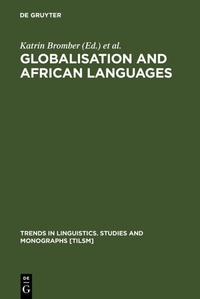
Globalisation and African Languages
Description

Globalisation and African Languages links African language studies to the concept of 'globalisation' which increasingly undergoes critical review. Hence, African linguists of various provenience can make valuable contributions to this debate.
In cultural matters, which by definition include language, there is often a sense that globalisation leads to a major trend of homogenisation, which results in a reduction of diversity on the one hand and, on the other, in new themes being incorporated into global (cultural) patterns. However, often conflicting and overlapping particularistic interests exist which have a constructive as well as destructive potential.
This aspect leads directly to the first of three sections of this volume, LANGUAGE USE AND ATTITUDES, which addresses some of the burning issues in sociolinguistic research. Since this research area is tightly linked to the educational domain these important issues are addressed in articles that comprise the second section of this volume: LANGUAGE POLICY AND EDUCATION. The third section of the volume presents articles dealing with LANGUAGE DESCRIPTION AND CLASSIFICATION demonstrating which parts of different language systems are affected through contact under historical and modern conditions.
The contributions of all the well-known scholars in this volume show that globalisation is a two-way street, and to ensure that all sides benefit in a reciprocal manner means the impacts have to be monitored globally, regionally, nationally and locally. By disseminating and emphasising these linguistic findings as part of the global cultural heritage, African language studies may offer urgently needed new perspectives towards a rapidly changing world.
More details
Other editions
Additional editions
Persons
Content
- Intro
- Foreword
- Acknowledgements
- Tabula gratulatoria
- Karsten Legère - African language studies on the move: A short biography
- Karsten Legère: A bibliography
- Introduction
- Section I: Language use and attitudes
- Der übergeordnete ideologische Rahmen der Sprachkonflikte weltweit
- Indianer und andere Minderheiten - Überlegungen zu einer sprachplanerischen Minoritologie
- Setswana: An under-exploited national resource?
- Can a 'foreign' language be a national medium of education? Linguistic ecology and equality in Namibia
- Revisiting reversing language shift: African languages in high modernity
- Triglossia: African privilege or necessity
- Section II: Language policy and education
- Using Northern Sotho as medium of instruction in vocational training
- Developing a language policy in an African country: The case of Malawi
- Writing and reading in English and L1: Attitudes among pupils in Lira and Mpigi, Uganda
- Section III: Language description and classification
- The impact of Kiswahili on Kiluguru
- Loan words in Swahili
- The noun phrase in the Kerebe language
- The infinitive as a part of speech in Swahili
- On vowel systems in the southern Bole-Tangale languages
- !Xun as a type B language
- How many languages are there in Africa, really?
- Languages and language names in Mozambique, 150 years ago and now
- Observations on Swahili and Midzichenda plant names
- Subject index
