


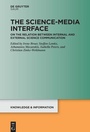
The Science-Media Interface
Description

The publication and distribution of scientific results is of major importance for the functioning of an information society and the tackling of the complex challenges the world faces today. It is not only scholars who rely on scientific publications to advance research but also the general public which demands scientific knowledge for its forthcoming.
Major suppliers of scientific knowledge are the researchers themselves, science communicators and science journalists - each of which choose their very own approaches to selection, presentation and communication of science, often depending on the target group. Although different in their goals and approaches, digital media in particular has led to great overlaps which result in interwoven relationships equally affecting both external and internal forms of science communication.
This edited book describes, quantifies and critically discusses the interplay between publisher- and journalism-driven science communication and its effect on the scholarly communication system, especially on the measures of impact evaluation. It is of major interest to researchers from science of science, bibliometrics, science communication, and journalism studies.
More details
Other editions
Additional editions
Persons
I. Broer , Hans-Bredow-Institut, Hamburg; S. Lemke , A. Mazarakis , I. Peters , ZBW Kiel; C. Zinke-Wehlmann , Universität Leipzig.
