

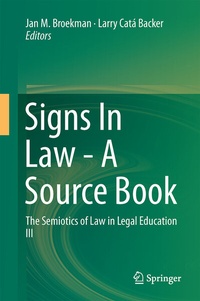
Signs In Law - A Source Book
Description

More details
Other editions
Additional editions
Content
Preface.- Acknowledged Sources.- 1. Introduction Reading Semiotics; Jan M. Broekman and Larry Catà Backer.- 2. Eco and the Text of the Communist Manifesto; Jan M. Broekman and Larry Catà Backer.- Part I From Legal Significs to Legal Semiotics.- 3. Origins and Effects of Legal Significs; Jan M. Broekman and Larry Catà Backer.- 4. "Word-Value" and "The 'I'; Frederik van Eeden.- 5. "Significs" and "Significs and Philosophy"; Gerrit Mannoury.- 6. "What is Significs?"; Lady Victoria Welby.- 7. Editorial 1: J.I. de Haan, the First Legal Semiotician.- 8. Essence and Task of Legal Significs; Jacob Israël de Haan.- 9. Legal Significs and its Application in the Terms 'Liable', 'Responsible' and 'Accountable'; Jacob Israël de Haan.- Part II Godfathers of Semiotics-Welby, Peirce, Greimas, Lacan.- 10. Editorial 2: 'Meaning' and the Welby-Peirce Correspondence.- 11.Meaning; Lady Victoria Welby.- 12. Two Letters to Lady V. Welby: Oct. 12, 1904 and Dec. 24/25 and 28, 1908; Ch. S. Peirce.-13. Editorial 3: Firstness, Shock, and Signs.- 14. Firstness, Shock, Law, and The Hand of the Sheriff; Ch. S. Peirce.- 15. Editorial 4: Layered Discourses, Dynamic Semiotics.- 16. A View On A. J. Greimas's Essay "The Semiotic Analysis of A Legal Discourse: Commercial Laws That Govern Companies and Groups of Companies"Larry Catà Backer.- 17. Editorial 5: I and Self (Welby, Lacan).- 18. Lacan, The Mirror and the "I"; Jan M. Broekman.- Part III Semiotics of Law Today.- 19. Justinian Corpus Iuris Civilis (Fragment).- 20. Editorial 6: On Persons, Things and Obligations in Semiotic Perspective.- 21. Fundamental Concepts of Roman Law; Max Radin.- 22. Family as a Commonsensical Device and its Place in Law; Tracey Summerfield and Alec McHoul.- 23. The Multiple Faces of a Corporation's Legal Personality; Larry Catà Backer.- 24. Property: The Legal 'Thing' as Artwork; Roberta Kevelson.- 25. Place, Space, and Time in the Sign of Property; Robin P. Malloy.- 26. The Ethics of Property: A semiotic Inquiry Into Ownership; Denis J. Brion.- 27. Quid pro quo: Contractual Semiosis and Translation; Dinda L. Gorlée.- 28. The Semiotics of International Law: Interpretation of the ABM Treaty; R.W.Benson.- 29. Cultural Immersion, Difference and Categories in US Comparative Law: Conclusions; Vivian Grosswald Curran.- Part IV Developing Semiotic Awareness.- 30. Law in Signification Processes; Jan M. Broekman and Larry Catà Backer.- 31. Editorial 7: From Prize-Winning Seminar Papers to a General Conclusion.- 32. Can Words Really Set A Man Free? A Semiotic Analysis of the American Criminal Defendant's Right to Allocution; Charles Volkert.- 33. Shareholder Derivative Action and Corporate Identity in Delaware Jurisprudence; Alan C. Green.- 34. Signs Without Authority: The Battle of Experts, the Caricature of a Discourse and the Failure of Scientific Evidence; Robert Marriott.- 35. Semiotics in a New Key; Jan M. Broekman and Larry Catà Backer.- General References.- About the Authors.- Name Index.- Subject Index.
