

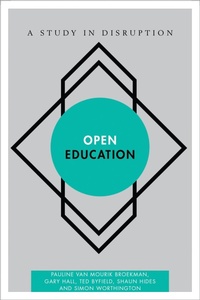
Open Education
A Study in Disruption
1st Edition
Published on 17. November 2014
126 pages
979-8-216-32497-3 (ISBN)
Description

What for decades could only be dreamt of is now almost within reach: the widespread provision of free online education, regardless of a geographic location, financial status, or ability to access conventional institutions of learning.
But does open education really offer the openness, democracy and cost-effectiveness its supporters promise? Or will it lead to a two-tier system, where those who can't afford to attend a traditional university will have to make do with online, second-rate alternatives?
Open Education engages critically with the creative disruption of the university through free online education. It puts into political context not just the Massive Open Online Courses (MOOCS) but also TED Talks, Wikiversity along with self-organised 'pirate' libraries and 'free universities' associated with the anti-austerity protests and the global Occupy movement. Questioning many of the ideas open education projects take for granted, including Creative Commons, it proposes a radically different model for the university and education in the twenty-first century.
But does open education really offer the openness, democracy and cost-effectiveness its supporters promise? Or will it lead to a two-tier system, where those who can't afford to attend a traditional university will have to make do with online, second-rate alternatives?
Open Education engages critically with the creative disruption of the university through free online education. It puts into political context not just the Massive Open Online Courses (MOOCS) but also TED Talks, Wikiversity along with self-organised 'pirate' libraries and 'free universities' associated with the anti-austerity protests and the global Occupy movement. Questioning many of the ideas open education projects take for granted, including Creative Commons, it proposes a radically different model for the university and education in the twenty-first century.
More details
Edition
1. Auflage
Language
English
Place of publication
United States
Publishing group
Bloomsbury Publishing Plc
Target group
Professional and scholarly
ISBN-13
979-8-216-32497-3 (9798216324973)
Copyright in bibliographic data and cover images is held by Nielsen Book Services Limited or by the publishers or by their respective licensors: all rights reserved.
Schweitzer Classification
Other editions
Additional editions
Book
10/2014
Rowman & Littlefield International
€121.00
Shipment within 3-4 weeks
Persons
Pauline van Mourik Broekman, Co-founder, Mute, and Mute collective member.
Gary Hall is Director of the Centre for Disruptive Media at Coventry University, UK, and visiting professor at the Hybrid Publishing Lab-Leuphana Inkubator, Leuphana University, Germany. He is also co-founder (in 1999) of the open access journal Culture Machine, a pioneer of OA in the humanities, and co-founder (in 2006) of Open Humanities Press, which was the first open access publisher explicitly dedicated to critical and cultural theory. He is the author and editor of several books on digital culture and the idea of the university, the best known of which is Digitize This Book!: The Politics of New Media, or Why We Need Open Access Now (2008).
Ted Byfield is a New York-based independent researcher and writer. He served for over a decade on the design faculty of the New School University, and is a former visiting fellow at Yale Law School's Information Society Project. He co-founded the Open Syllabus Project research network, and since 1998 has co-moderated the>
Shaun Hides is Head of Department of Media and Co-director of the Disruptive Media Learning Lab, Coventry University, UK. He authored the Department's Open Media strategy, led a JISC-funded OER project on open-connected teaching innovation and has spoken at numerous events on OER, Innovation and the impact of disruptive technologies on education. He is an advisor to the British Council.
Simon Worthington is a Research Associate at the Hybrid Publishing Consortium-Leuphana Inkubator, Leuphana University, Germany.
Original idea and direction:
Jonathan Shaw is Co-director of the Disruptive Media Learning Lab, Coventry University, UK, visiting fellow at the Centre for Excellence in Media Practice at Bournemouth University and the Chair of the Associate for Photography in Higher Education. He was awarded a Direct Fellowship of Royal Photographic Society (RPS), and a Fellowship of the Royal Society for the encouragement of Arts, Manufactures and Commerce (RSA), in recognition for his achievements in Photography and innovative educational practices.
Gary Hall is Director of the Centre for Disruptive Media at Coventry University, UK, and visiting professor at the Hybrid Publishing Lab-Leuphana Inkubator, Leuphana University, Germany. He is also co-founder (in 1999) of the open access journal Culture Machine, a pioneer of OA in the humanities, and co-founder (in 2006) of Open Humanities Press, which was the first open access publisher explicitly dedicated to critical and cultural theory. He is the author and editor of several books on digital culture and the idea of the university, the best known of which is Digitize This Book!: The Politics of New Media, or Why We Need Open Access Now (2008).
Ted Byfield is a New York-based independent researcher and writer. He served for over a decade on the design faculty of the New School University, and is a former visiting fellow at Yale Law School's Information Society Project. He co-founded the Open Syllabus Project research network, and since 1998 has co-moderated the
Shaun Hides is Head of Department of Media and Co-director of the Disruptive Media Learning Lab, Coventry University, UK. He authored the Department's Open Media strategy, led a JISC-funded OER project on open-connected teaching innovation and has spoken at numerous events on OER, Innovation and the impact of disruptive technologies on education. He is an advisor to the British Council.
Simon Worthington is a Research Associate at the Hybrid Publishing Consortium-Leuphana Inkubator, Leuphana University, Germany.
Original idea and direction:
Jonathan Shaw is Co-director of the Disruptive Media Learning Lab, Coventry University, UK, visiting fellow at the Centre for Excellence in Media Practice at Bournemouth University and the Chair of the Associate for Photography in Higher Education. He was awarded a Direct Fellowship of Royal Photographic Society (RPS), and a Fellowship of the Royal Society for the encouragement of Arts, Manufactures and Commerce (RSA), in recognition for his achievements in Photography and innovative educational practices.
Content
Preface/ 1 The University in the 21st Century/ 2 A Radically Different Model of Education and the University/ 3 The Educational Context/ 4 Open Education/ 5 Open Education Typologies/ 6 Towards a Philosophy of Open Education/ Conclusion: Diverse 'disruption'/ Bibliography/Index
