

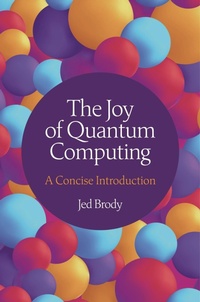
The Joy of Quantum Computing
Description

An engaging and accessible presentation of the most famous algorithms and applications of quantum computing The Joy of Quantum Computing introduces quantum computing succinctly, and with minimal mathematical formalism. Engagingly written-a feast for the reader's inner nerd-it presents the most famous algorithms and applications of quantum computing and quantum information science, including the "killer apps," Grover's search algorithm, and Shor's factoring algorithm. The only prerequisite is precalculus; readers need no knowledge of quantum physics. Matrices are relegated to the (completely optional) final two chapters. The book shows readers that quantum information science is about more than just high-speed calculations and data security. It is also about the fundamental meaning of quantum mechanics and the ultimate nature of reality. The Joy of Quantum Computing is suitable for classroom use or independent study by questing autodidacts. • Offers detailed explanations of quantum circuits, quantum algorithms, and quantum mysteries • Explains how to apply quantum information science to cryptography (and how Shor's algorithm menaces classical cryptography) • Introduces the mystifying topics of quantum teleportation and the no-cloning theorem • Discusses Bell inequalities, which permit experimental tests of philosophical assumptions • Presents a simple model of quantum decoherence, shedding light on Schrödinger's mysterious cat
More details
Other editions
Additional editions
Person
Content
- Cover
- Contents
- Preface: Almost Too Much Awesome
- 1. Forging the Quantum Key
- 2. The First Quantum Algorithm: "Collaboration between Parallel Universes"?
- 3. Qubit? Cube It
- 4. Quantum Teleportation: Too Awesome to Require a Pun
- 5. The No-Cloning Theorem: Why We Can't Send Messages to the Past
- 6. A Nobel Prize in Experimental Philosophy
- 7. Quantum Adder: Like Regular Addition, but Way More Confusing
- 8. Grover's Search: One Algorithm to Rule Them All, One Algorithm to Find Them
- 9. QFT and IQFT . . . WTF?
- 10. Quantum Phase Estimation: I Can Value Eigenvalues
- 11. The Farthest Shor: Breaking the Internet
- 12. How to Correct Those Flipping Errors
- 13. Enter the Matrix
- 14. Quantum Decoherence and the Infinitely More Than Nine Lives of Schrödinger's Cat
- Acknowledgments
- Appendix A. Further Reading
- Appendix B. Table of Quantum Gates
- Appendix C. Exercises
- Index
