

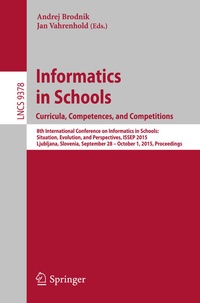
Informatics in Schools. Curricula, Competences, and Competitions
8th International Conference on Informatics in Schools: Situation, Evolution, and Perspectives, ISSEP 2015, Ljubljana, Slovenia, September 28 - October 1, 2015, Proceedings
Published on 23. September 2015
XVI, 183 pages
978-3-319-25396-1 (ISBN)
Description

This book constitutes the refereed proceedings of the 8th International Conference on Informatics in Schools: Situation, Evolution, and Perspectives, ISSEP 2015, held in Ljubljana, Slovenia, in September/October 2015. The 14 full papers presented together with 3 invited talks were carefully reviewed and selected from 36 submissions. The focus of the conference was on following topics: sustainable education in informatics for pupils of all ages; connecting informatics lessons to the students' everyday lives; teacher education in informatics; and research on informatics in schools (empirical/qualitative/quantitative/theory building/research methods/comparative studies/transferability of methods and results from other disciplines).
More details
Other editions
Additional editions

Andrej Brodnik | Jan Vahrenhold
Informatics in Schools. Curricula, Competences, and Competitions
8th International Conference on Informatics in Schools: Situation, Evolution, and Perspectives, ISSEP 2015, Ljubljana, Slovenia, September 28 - October 1, 2015, Proceedings
Book
11/2015
Springer
€51.36
Shipment within 10-15 days
Content
- Intro
- Preface
- Organization
- Contents
- Surprising Computer Science
- 1 Introduction
- 2 The Secret Code
- 3 Communicating the Magic
- 4 Paradoxes and Surprises
- 5 The Dark Side of Magic
- 6 Conclusion
- The Theory Behind Theory - Computer ScienceEducation Research Through the Lenses of SituatedLearning
- 1 Introduction
- 2 Theoretical Framework
- 3 Enculturation into Theory of Computation Community
- 4 Conclusion and Outlook
- Robotics Activities-Is the Investment Worthwhile?
- 1 Introduction
- 2 Background
- 2.1 Research on Young Students Learning CS
- 2.2 Robotics
- 2.3 The Research in Light of Previous Work
- 3 Description of the Research
- 3.1 Research Question
- 3.2 Population
- 3.3 Research Framework
- 3.4 Research Instruments and Data Analysis
- 3.5 The Questionnaire
- 4 Results
- 5 Discussion
- 6 Conclusions
- Dimensions of Programming Knowledge
- 1 Introduction
- 2 Background and Related Work
- 2.1 Concept Maps and Declarative Knowledge
- 2.2 The SOLO Taxonomy
- 2.3 The Cognitive Structure of Programming
- 3 The Educational Context
- 4 The Study
- 4.1 Design
- 4.2 Data Analysis
- 4.3 Discussion
- 5 Knowledge and Competencies
- 6 Conclusion and Future Work
- Defining Proficiency Levels of High School Students inComputer Science by an Empirical Task Analysis
- 1 Motivation
- 2 MoKoM Background and Prior Results
- 4 Overview of Proficiency Levels
- 5 Conclusions
- Classification of Programming Tasks According to Required Skills and Knowledge Representation
- 1 Introduction
- 2 Related Work
- 3 Methodology
- 3.1 Sources for the Tasks
- 3.2 Selection of the Tasks
- 3.3 Classification of the Tasks
- 4 The Resulting Types
- 4.1 Type 1a. ``write code''
- 4.2 Type 1b. ``write code''
- 4.3 Type 2. ``write code using the given code''
- 4.4 Type 3. ``adjust/extend/complete the given code''
- 4.5 Type 4. ``optimize the given code''
- 4.6 Type 5. ``debug the given code''
- 4.7 Type 6. ``set the right preconditions to the given code''
- 4.8 Type 7. ``test the given code''
- 4.9 Type 8. ``transform the given code''
- 4.10 Type 9. ``trace/explain the given code''
- 4.11 Type 10. ``specify a problem to the given code''
- 4.12 Type 11. ``draw a diagram to the given code''
- 5 Incidence of the Types
- 6 Forms of Knowledge Representation in the Tasks
- 7 Conclusion and Future Work
- Online vs Face-To-Face Engagement of Computing Teachers for their Professional Development Needs
- 1 Introduction
- 2 Professional Development of Computing Teachers
- 3 Communities of Practice - Online and Offline
- 4 The Computing at School Community
- 5 Methodology
- 6 Findings
- 6.1 Teacher Profile
- 6.2 Professional Development (PD) in Computing
- 6.3 The CAS Community
- 7 Discussion
- 8 Conclusion
- Programming in Scratch Using Inquiry-Based Approach
- 1 Inquiry-Based Learning and Programming Education
- 2 Project and Methodology
- 3 Findings
- 4 Pupils' Perception of the Teaching Experiment
- 5 Conclusion
- Olympiad in Computer Science and Discrete Mathematics
- 1 Introduction
- 2 Analysis of CS Competition Organization
- 3 Analysis of DM&TI-2015 Content
- 4 Solution for the Task ``Graphs''
- 5 Technology of DM&TI Tasks Design
- 6 Technology of Manipulators Design
- 7 The DM&TI-2015 Results
- 8 Conclusions
- CS Unplugged: Experiences and Extensions
- 1 Introduction
- 1.1 The Slovenian Translation
- 1.2 Setup
- 2 Experiences and Adaptations
- 2.1 Binary Number Representation
- 2.2 Text Encoding and Decoding
- 2.3 Error Correction
- 2.4 Text Compression
- 2.5 Programming Languages
- 2.6 Bisection
- 2.7 Sorting Algorithms
- 2.8 Sorting Networks
- 2.9 Deadlock
- 2.10 Algorithms on Graphs
- 2.11 Cryptography
- 2.12 Artificial Intelligence
- 3 Conclusion
- Computing at School in Sweden - Experiences from Introducing Computer Science within Existing Subjects
- 1 Introduction
- 2 Overview of Computing in Swedish Schools
- 3 Bebras
- 4 Activities in Linköping
- 5 Activities in Lund
- 6 Activities in Luleå
- 7 Activities in Stockholm
- 8 Lessons Learned and Ways Forward
- Introducing a New Computer Science Curriculum for All School Levels in Poland
- Introduction
- Terminology
- Early History of Computers in Education in Poland
- Informatics Education in Poland Today
- Informatics Education
- Computational Thinking
- A New Computer Science Curriculum
- Is Computer Science Education in Crisis?
- The New Computer Science Curriculum
- Implementation Comments, Supporting Activities
- The Road Map
- Analyzing the Twitter Data Stream Using the Snap! Learning Environment
- 1 Introduction
- 2 Data Stream Systems
- 2.1 Function of Data Stream Systems
- 2.2 Usage Examples of Data Stream Systems
- 2.3 Principles of Data Stream Analyses in Daily Life
- 3 Using Snap! for Twitter Analysis
- 3.1 Possibilities and Usage
- 3.2 Realization and Technical Aspects
- 4 Summary
- Is Coding the Way to Go?
- 1 Introduction
- 2 The Algomotricity Maze Workshop (AlMa)
- 3 Assessment
- 4 AlMa vs HoC
- 4.1 Algorithm, Program, and Code
- 4.2 The Hour of Code (HoC)
- 4.3 Differences
- 4.4 Discussion
- Visual Literacy in Introductory Informatics Problems
- 1 Introduction
- 2 Roles of Diagrams in Problem Solving
- 3 Method: Qualitative Analysis of Problem Statements
- 4 Coding Rules for Bebras Contest Task Diagrams
- 5 Perspectives: Next Steps
- References
- Author Index
