

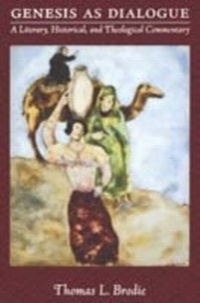
Genesis As Dialogue
A Literary, Historical, and Theological Commentary
1st Edition
Published on 16. August 2001
612 pages
978-0-19-803164-2 (ISBN)
Description

Recent years have seen a remarkable surge in interest in the book of Genesis - the first book of the Hebrew Bible, and a foundational text of Western culture. In this new commentary, Thomas Brodie offers a complete and accessible overview of Genesis from literary, theological, and historical standpoints. Brodie's work is organized around three main ideas. The first is that the primary subject of Genesis is human existence; the second is that Genesis' basic organizational unity is binary, or diptych. Brodie argues that the entire book is composed of diptychs - accounts which, like some paintings, consist of two parts or panels. Finally, Brodie contends that many of Genesis' sources still exist, and can be identified and verified.
More details
Other editions
Additional editions
Book
09/2001
Oxford University Press Inc
€233.00
Shipment within 15-20 days
Content
- Intro
- Contents
- A Note on Method
- Abbreviations
- INTRODUCTION
- I. The Text and Its Immediate Context (Genesis-Kings, "The Primary History")
- 1. Genesis's Unity
- Arguments against Unity
- Conclusion: A Shift in the Weight of Evidence
- 2. Further Evidence of Genesis's Unity
- Body-Like Complexity and Chiasms
- Spiraling Structures: Consistent Patterns of Expanding Episodes
- Double Dramas, Including Diptychs
- Combining the Structures
- The Spiraling Transition from Myth to History: A Closer Look
- General Conclusion
- 3. The Quest for the Theory behind the Diptychs
- The Complex Nature of Reality (the Diptych as Mind-Opening)
- The Complex Nature of Art (Based on Relationships, Not Absolutes)
- "Bakhtin, the Bible, and Dialogic Truth"
- Conclusion
- 4. The Diptych Structure: Original or Redactional?
- Toward a Solution
- General Conclusion to Chapters 1-4
- 5. Genesis as Part of a Larger Unity (the Primary History, Genesis-Kings)
- The Unity within Specific Books
- Continuity between Books
- Continuity within the Primary History as a Whole
- Ways of Visualizing the Unity of Genesis-Kings
- General Conclusion to Chapters 1-5
- II. Historical Background
- 6. The Historical and Social Background
- The Persian Empire
- The Greek Expansion
- The Interweaving of Greeks and Persians
- Conclusion
- 7. Greco-Persian Features
- Theological Inquiry
- The Codification of Law
- The Transition from Epic Poetry to Historiography
- The Convergence of the Primary History with Greco-Persian Historiography
- 8. Verifiable Sources
- Historiography
- Epic
- Prophecy
- Law
- Other
- Conclusion
- 9. Toward Detecting the Process of Composition
- The General Process
- The General Nature of the Sources: Oral or Written?
- The Number of People Involved in Writing
- Some Specific Procedures Concerning Form and Depth
- Conclusion
- 10. Date, Place, and People: A Summary of Key Arguments
- The Date
- The Place and the People
- III. Genesis's Content and Meaning
- 11. Genesis's Central Concern
- The Two Threads-History and Humanity
- Relationship between the Two Levels
- The Shaping of Genesis through Basic Life-Related Features
- General Conclusion
- 12. Genesis and History
- The Origin of Humankind
- The Origin of Israel
- Genesis and Historical Evidence
- 13. Genesis and Psychology
- An Example
- Toward Greater Clarity and Development
- 14. Genesis and Spirituality
- Aspects of Spirituality
- 15. Genesis as a Refiection of the Complexity of Life
- Genesis as Foundational
- Harmony and Disharmony
- Blessing
- Marriage and Family
- Women and Men
- The Larger Community (the Ethnic Group/the World)
- Ambivalence toward Cities
- The Centrality of Journeying
- The Journey's Context: Between Creation and Providence
- COMMENTARY
- IV. Beginnings
- 16. Creation and Its Harmony (1:1-2:24)
- Introductory Aspects
- Comment
- 17. Sin and Its Disharmony: Crime and Punishment (2:25-4:16)
- Introductory Aspects
- Comment
- 18. Genealogies: From More Disharmony to Restoration (4:17-Chap. 5)
- Introductory Aspects
- Comment
- Chapter 5 as a Conclusion to All of Genesis 1-5
- 19. The Flood's Creation: More Sinful, More Compassionate (6:1-9:17)
- Introductory Aspects
- Comment
- Excursus: The Deluge and the Theory of Two Sources
- 20. Noah's Sons: The World's Mixture of Curse and Blessing (9:18-Chap. 10)
- Introductory Aspects
- Comment
- 21. Failed Tower and Fading Family: Life's Fragmentation (Chap. 11)
- Introductory Aspects
- Comment
- V. The Story of Abraham
- 22. Abram Journeys and Sees the Land (Chaps. 12-13)
- Introductory Aspects
- Comment
- 23. War-and Vision of a Covenant (Chaps. 14-15)
- Introductory Aspects
- Comment
- 24. Personal Conflict, and Vision of a Deeper Covenant (Chaps. 16-17)
- Introductory Aspects
- Comment
- 25. Sodom: Generosity-Based Justice (18:1-19:29)
- Introductory Aspects
- Comment
- 26. Abraham and Isaac among the Nations (19:30-Chap. 21)
- Introductory Aspects
- Comment
- 27. Facing Death (Chaps. 22-23)
- Introductory Aspects
- Comment
- 28. Rebekah, Betrothal, and Genealogy (24:1-25:18)
- Introductory Aspects
- Comment
- VI. The Story of Jacob
- 29. Isaac's Jacob-Oriented Journey (25:19-26:33)
- Introductory Aspects
- Comment
- 30. Blessing and Betrothal: Jacob Deceives and Is Deceived (26:34-29:30)
- Introductory Aspects
- Comment
- 31. Jacob's Children and Flocks (29:31-Chap. 30)
- Introductory Aspects
- Comment
- 32. The Long Journey Homeward (Chaps. 31-33)
- Introductory Aspects
- Comment
- 33. From Paralysis to Pilgrimage (34:1-35:20)
- Introductory Aspects
- Comment
- 34. Genealogies: Jacob Declines and Esau Prospers (35:21-37:1)
- Introductory Aspects
- Comment
- VII. The Story of Joseph
- 35. Prophecy and Conversion (37:2-Chap. 38)
- Introductory Aspects
- Comment
- 36. Joseph: The Initiatory Trials (Chaps. 39-40)
- Introductory Aspects
- Comment
- 37. Remembering Joseph: His Rise and the Brothers' Conversion (Chaps. 41-42)
- Introductory Aspects
- Comment
- 38. Back to Egypt: The Generosity That Brings Conversion (Chaps. 43-44)
- Introductory Aspects
- Comment
- 39. Joseph Revealed: Vision-Led Recovery of Relationship and Land (45:1-47:11)
- Introductory Aspects
- Comment
- 40. Amid Famine and Death: Life and Blessing (47:12-Chap. 48)
- Introductory Aspects
- Comment
- 41. Jacob's Death and Burial (Chaps. 49-50)
- Introductory Aspects
- Comment
- APPENDICES
- 1. Tracing Sources: Toward Clarifying the Criteria for Detecting Sources
- 2. Sources: Genesis's Use of the Prophets
- 3. Sources: Genesis's Use of Homer's Odyssey
- 4. Sources: The Theory of Four Hypothetical Documents (J, E, D, and P)
- 5. Landmarks in the Development of Literature: Toward a Map of Language, Writing, and Literature
- 6. The Landscape and the Lion: Genesis and the Gospels
- 7. Genesis in the Lectionaries
- Bibliography
- Indexto Modern Authors
- A
- B
- C
- D
- E
- F
- G
- H
- I
- J
- K
- L
- M
- N
- O
- P
- R
- S
- T
- V
- W
- Y
- Z
- Subject Index
- A
- B
- C
- D
- E
- F
- G
- H
- I
- J
- K
- L
- M
- N
- O
- P
- Q
- R
- S
- T
- U
- V
- W
- X
