

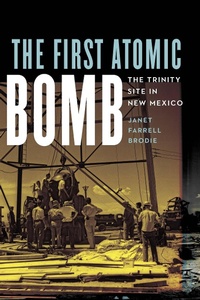
The First Atomic Bomb
The Trinity Site in New Mexico
1st Edition
Published on 1. June 2023
316 pages
978-1-4962-3655-5 (ISBN)
Description

Named a 2024 Southwest Book of the Year
On July 16, 1945, just weeks before the atomic bombing of Hiroshima and Nagasaki that brought about the surrender of Japan and the end of World War II, the United States unleashed the world's first atomic bomb at the Trinity testing site located in the remote Tularosa Valley in south-central New Mexico. Immensely more powerful than any weapon the world had seen, the bomb's effects on the surrounding and downwind communities of plants, animals, birds, and humans have lasted decades.
In The First Atomic Bomb Janet Farrell Brodie explores the history of the Trinity test and those whose contributions have rarely, if ever, been discussed-the men and women who constructed, served, and witnessed the first test-as well as the downwinders who suffered the consequences of the radiation. Concentrating on these ordinary people, laborers, ranchers, and Indigenous peoples who lived in the region and participated in the testing, Brodie corrects the lack of coverage in existing scholarship on the essential details and everyday experiences of this globally significant event. The First Atomic Bomb also covers the environmental preservation of the Trinity test site and compares it with the wide range of atomic sites now preserved independently or as part of the new Manhattan Project National Historical Park. Although the Trinity site became a significant node for testing the new weapons of the postwar United States, it is known today as an officially designated National Historic Landmark. Brodie presents a timely, important, and innovative study of an explosion that carries special historical weight in American memory.
On July 16, 1945, just weeks before the atomic bombing of Hiroshima and Nagasaki that brought about the surrender of Japan and the end of World War II, the United States unleashed the world's first atomic bomb at the Trinity testing site located in the remote Tularosa Valley in south-central New Mexico. Immensely more powerful than any weapon the world had seen, the bomb's effects on the surrounding and downwind communities of plants, animals, birds, and humans have lasted decades.
In The First Atomic Bomb Janet Farrell Brodie explores the history of the Trinity test and those whose contributions have rarely, if ever, been discussed-the men and women who constructed, served, and witnessed the first test-as well as the downwinders who suffered the consequences of the radiation. Concentrating on these ordinary people, laborers, ranchers, and Indigenous peoples who lived in the region and participated in the testing, Brodie corrects the lack of coverage in existing scholarship on the essential details and everyday experiences of this globally significant event. The First Atomic Bomb also covers the environmental preservation of the Trinity test site and compares it with the wide range of atomic sites now preserved independently or as part of the new Manhattan Project National Historical Park. Although the Trinity site became a significant node for testing the new weapons of the postwar United States, it is known today as an officially designated National Historic Landmark. Brodie presents a timely, important, and innovative study of an explosion that carries special historical weight in American memory.
Reviews / Votes
"Methodically researched and expertly written, this book is a welcome addition to the historiography of the atomic bomb and its use."-J. Bourboun, Choice "Brodie's work stands as an acces-sible, welcome, and broad survey of the Trinity Test."-Joshua McGuffie, Environmental History "Although the place and event of July 16, 1945, have drawn substantial attention within and outside of academia, The First Atomic Bomb provides a much-needed update on the history of the Trinity site."-Lucie Genay, Pacific Historical Review "From the economics of eminent domain to the politics of historic preservation, environmental despoliation, and public health, Janet Farrell Brodie's deeply researched, thoroughly compelling, and powerfully human history of the Trinity site should be read by everyone interested in the American West and the nuclear age."-David M. Wrobel, author of America's West: A History, 1890-1950 "Janet Farrell Brodie deftly weaves a 'bottom up' narrative into what is largely seen as a 'top-down,' tightly controlled military history. Her correct framing of Trinity as the first atomic experience reminds the reader of the intersection between local and global histories. . . . Clear, engaging, and substantive."-Natale A. Zappia, author of Raiders and Traders: The Indigenous World of the Colorado Basin, 1540-1859More details
Series
Language
English
Place of publication
Lincoln
United States
Target group
Professional and scholarly
Illustrations
27 photographs, index
File size
9,29 MB
ISBN-13
978-1-4962-3655-5 (9781496236555)
Copyright in bibliographic data and cover images is held by Nielsen Book Services Limited or by the publishers or by their respective licensors: all rights reserved.
Schweitzer Classification
Other editions
Additional editions
Book
06/2023
University of Nebraska Press
€58.00
Shipment within 15-20 days
Person
Janet Farrell Brodie is a professor emerita of history at Claremont Graduate University. She has published articles on atomic secrecy in multiple venues, including the Journal of Social History and the Journal of Diplomatic History and in the edited volume Inevitably Toxic: Historical Perspectives on Contamination, Exposure, and Expertise.
Content
List of Illustrations
Preface
Acknowledgments
Introduction
1. The Trinity Test
2. Dispossessions
3. Building the Test Site
4. Post-Test Events at the Trinity Site, 1946-67
5. The Army, the Air Force, the Navy, the Atomic Energy Commission, and the Trinity Site
6. The Trinity Radiation and Its Afterlives
7. Historical Preservation of the Trinity Site
Notes
Bibliography
Index
Preface
Acknowledgments
Introduction
1. The Trinity Test
2. Dispossessions
3. Building the Test Site
4. Post-Test Events at the Trinity Site, 1946-67
5. The Army, the Air Force, the Navy, the Atomic Energy Commission, and the Trinity Site
6. The Trinity Radiation and Its Afterlives
7. Historical Preservation of the Trinity Site
Notes
Bibliography
Index
