

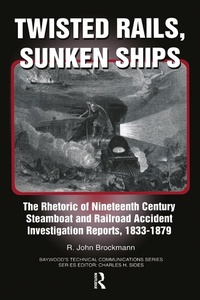
Twisted Rails, Sunken Ships
The Rhetoric of Nineteenth Century Steamboat and Railroad Accident Investigation Reports, 1833-1879
1st Edition
Published on 11. March 2020
288 pages
978-1-351-84088-0 (ISBN)
Description

Contemporary disaster investigation reports into the Shuttle, Three Mile Island, or the World Trade Centre did not happen by chance, but were the result of an evolution of the discourse communities involved with investigating technological accidents. The relationships of private companies, coroners, outside experts, and government investigators all had to be developed and experimented with before a genre of investigation reports could exist. This book is the story of the evolution of these investigation discourse communities in published reports written between 1833 and 1879. Using the reports generated by seven different accidents on railroads and steamboats between 1833 and 1876, it is possible to observe the changes in how these reports interacted and changed over the course of the nineteenth century: The Explosion of the Steamboat New England in the Connecticut River, 1833; The Explosion of the Locomotive Engine Richmond near Reading Pennsylvania, 1844; The Explosion of the Steam Boat Moselle in Cincinatti, 1838; The Camden and Amboy Railroad Collision in Burlington, New Jersey, 1855; The Gasconade Bridge Collapse on the Pacific Railroad in Missouri, 1855; The Eastern Railroad Collision in Revere, Massachusetts, 1871; The Ashtabula Railroad Bridge Collapse in Ohio, 1876
More details
Edition
1. Auflage
Language
English
Place of publication
London
United Kingdom
Publishing group
Taylor & Francis Ltd
Target group
Professional and scholarly
ISBN-13
978-1-351-84088-0 (9781351840880)
Copyright in bibliographic data and cover images is held by Nielsen Book Services Limited or by the publishers or by their respective licensors: all rights reserved.
Schweitzer Classification
Other editions
Additional editions
John Brockman
Twisted Rails, Sunken Ships
The Rhetoric of Nineteenth Century Steamboat and Railroad Accident Investigation Reports, 1833-1879
Book
09/2020
1st Edition
Routledge
€57.50
Shipment within 15-20 days
John Brockman
Twisted Rails, Sunken Ships
The Rhetoric of Nineteenth Century Steamboat and Railroad Accident Investigation Reports, 1833-1879
Book
06/2004
1st Edition
Baywood Publishing Company Inc
€196.60
Shipment within 3-4 weeks
Person
Professor R. John Brockmann has been a member of the English Department, Concentration in Business and Technical Writing, University of Delaware, for 20 years. He received the Jay R. Gould Award for Excellence in Teaching technical communication from the Society for Technical Communication in 2003. He was elected a Fellow of the Society for Technical Communication in 1995, and received the "Joseph T. Rigo Award, 1986" from the Association of Computing Machinery, Special Interest Group for Documentation of Computers (ACM SIGDOC), for his "significant contributions to the knowledge and understanding of software technical writing."
Content
Introduction: The Dance of Nineteenth Century Steamboat and Railroad Accident Investigation Reports
Two 1911 ICC Reports
Shifts in America Affecting Accident Investigation Reports
Three Shifts in the Discourse Community
PART ONE: USING SCIENCE AS A CORPORATE DEFENSE
Chapter 1: The Collaboration of Science and the Corporations Takes Center Stage While the Coroner's Jury is Befuddled by Complexity
The Accident-The Explosion of the Steam Boat New England, October 9, 1883
The Coroner's Jury Investigation
The Company Investigation Report Exonerates Its Actions Using Science
Establishing a Scientific Ethos for the Investigation Report
Dispositio (Arrangement) as a Means of Persuasion in the Investigation Report
"Outside Experts" Give Their Findings . . . But Not Very Persuasively Other "Outside Experts" Offer Their Critical Comments, But Much Later
In the End
Chapter 2: Science for Sale
The Accident-Explosion of the Locomotive Engine Richmond near Reading, Penna. on the 2nd of September 1844
The Coroner's Jury Verdict-Act of God or an Act of Man
The Shaky Scientific Ethos of Dionysus Lardner
Needing to Present Both Sides when Lardner Declaims
Committee on Science and the Arts Report
In the End
PART TWO: PUBLICITY, POLITICAL PRESSURE, AND EMOTIONAL INVOLVEMENT BY AUTHORS TRANSFORM DISASTER INVESTIGATIONS
Chapter 3: Publicity, Politics, and Emotions Enter the Investigation Constellation-The Steamboat Moselle Explosion, Spring 1838 The Steamboat Moselle Explosion on the Cincinnati Waterfront Cincinnati in the 1830s: Frontier Law and Order
Political Control of the Investigation Locke's Highly Charged Personal Emotional Involvement in the Investigation
How Locke Used Silliman's Report
The Beginning of a New Approach to Accident Investigation
In the End
Chapter 4: What Happens When the Scientific Ethos is Missing in Investigation Reports: The Camden and Amboy Railroad Disaster, 29 of August 1855
Railroad Dangers
The Joint Companies (the Camden and Amboy Railroad and the Delaware and Raritan Canal) and Commodore Robert F. Stockton
The Coroner's Jury Verdict
The Joint Companies Try to Exonerate their Actions but Meet with Disdain
The Franklin Institute Scientists Offer a Sermon, Not Science The Stockton-Van Rensselaer Controversy
In the End
Chapter 5: The Gasconade Bridge Accident, November 2, 1855
A Celebration with Political Effects
Railroad Truss Bridges
Unfinished Bridges were Routinely Used
The Accident
The Coroner's Inquest
The Press Weighs In
The Company's Report-Does Not Fully Exonerate the Company
Henry Kayser-A Critical Scientific Voice of the Company
Julius Adams's Rebuttal
In the End
PART THREE: THE ANTEBELLUM PERIOD OF DISASTER INVESTIGATION: TRANSFORMATION ENDS AND A CONSTELLATION OF ROLES AND REPORTS BECOMES NORMAL
The Role of the Newspapers in the Investigative Process
International Influences in the United States Investigative Process
Chapter 6: The Eastern Railroad Accident at Revere, Massachusetts, August 26, 1871
The Accident
Instant Analysis, The Railroad Gazette, September 2, 1871
Coroner's Jury Verdict, September 10
Report of the Committee of the Directors, October 20, 1871, and "Justice" in the American Railroad Times, October 21 to December 23
The Massachusetts Railroad Commission Report, January 1872
Charles Francis Adams, Jr.'s Account of the Revere Accident, Atlantic Monthly, January 1876
In the End
Chapter 7: The Ashtabula Railroad Disaster, December 29, 1876- The State and the Professionals Take Over
Four Variations on the Tried-and-True Howe Truss Design
The Accident
The Investigations
Three Unique Investigations
In the End-Move toward Legislative Action
Chapter 8: Notes on Railroad Accidents
A Railroad Philosopher
Contemporary Reviews of Notes on Railroad Accidents
Rhetorical Element One: "Thrilling Incidents"
Rhetorical Element Two: "Accident Taxonomy"
Rhetorical Element Three: "Statistics"
Rhetorical Element Four: "Scientific Analysis"
The Impact of Notes on Railroad Accidents
Glossary
Index
Two 1911 ICC Reports
Shifts in America Affecting Accident Investigation Reports
Three Shifts in the Discourse Community
PART ONE: USING SCIENCE AS A CORPORATE DEFENSE
Chapter 1: The Collaboration of Science and the Corporations Takes Center Stage While the Coroner's Jury is Befuddled by Complexity
The Accident-The Explosion of the Steam Boat New England, October 9, 1883
The Coroner's Jury Investigation
The Company Investigation Report Exonerates Its Actions Using Science
Establishing a Scientific Ethos for the Investigation Report
Dispositio (Arrangement) as a Means of Persuasion in the Investigation Report
"Outside Experts" Give Their Findings . . . But Not Very Persuasively Other "Outside Experts" Offer Their Critical Comments, But Much Later
In the End
Chapter 2: Science for Sale
The Accident-Explosion of the Locomotive Engine Richmond near Reading, Penna. on the 2nd of September 1844
The Coroner's Jury Verdict-Act of God or an Act of Man
The Shaky Scientific Ethos of Dionysus Lardner
Needing to Present Both Sides when Lardner Declaims
Committee on Science and the Arts Report
In the End
PART TWO: PUBLICITY, POLITICAL PRESSURE, AND EMOTIONAL INVOLVEMENT BY AUTHORS TRANSFORM DISASTER INVESTIGATIONS
Chapter 3: Publicity, Politics, and Emotions Enter the Investigation Constellation-The Steamboat Moselle Explosion, Spring 1838 The Steamboat Moselle Explosion on the Cincinnati Waterfront Cincinnati in the 1830s: Frontier Law and Order
Political Control of the Investigation Locke's Highly Charged Personal Emotional Involvement in the Investigation
How Locke Used Silliman's Report
The Beginning of a New Approach to Accident Investigation
In the End
Chapter 4: What Happens When the Scientific Ethos is Missing in Investigation Reports: The Camden and Amboy Railroad Disaster, 29 of August 1855
Railroad Dangers
The Joint Companies (the Camden and Amboy Railroad and the Delaware and Raritan Canal) and Commodore Robert F. Stockton
The Coroner's Jury Verdict
The Joint Companies Try to Exonerate their Actions but Meet with Disdain
The Franklin Institute Scientists Offer a Sermon, Not Science The Stockton-Van Rensselaer Controversy
In the End
Chapter 5: The Gasconade Bridge Accident, November 2, 1855
A Celebration with Political Effects
Railroad Truss Bridges
Unfinished Bridges were Routinely Used
The Accident
The Coroner's Inquest
The Press Weighs In
The Company's Report-Does Not Fully Exonerate the Company
Henry Kayser-A Critical Scientific Voice of the Company
Julius Adams's Rebuttal
In the End
PART THREE: THE ANTEBELLUM PERIOD OF DISASTER INVESTIGATION: TRANSFORMATION ENDS AND A CONSTELLATION OF ROLES AND REPORTS BECOMES NORMAL
The Role of the Newspapers in the Investigative Process
International Influences in the United States Investigative Process
Chapter 6: The Eastern Railroad Accident at Revere, Massachusetts, August 26, 1871
The Accident
Instant Analysis, The Railroad Gazette, September 2, 1871
Coroner's Jury Verdict, September 10
Report of the Committee of the Directors, October 20, 1871, and "Justice" in the American Railroad Times, October 21 to December 23
The Massachusetts Railroad Commission Report, January 1872
Charles Francis Adams, Jr.'s Account of the Revere Accident, Atlantic Monthly, January 1876
In the End
Chapter 7: The Ashtabula Railroad Disaster, December 29, 1876- The State and the Professionals Take Over
Four Variations on the Tried-and-True Howe Truss Design
The Accident
The Investigations
Three Unique Investigations
In the End-Move toward Legislative Action
Chapter 8: Notes on Railroad Accidents
A Railroad Philosopher
Contemporary Reviews of Notes on Railroad Accidents
Rhetorical Element One: "Thrilling Incidents"
Rhetorical Element Two: "Accident Taxonomy"
Rhetorical Element Three: "Statistics"
Rhetorical Element Four: "Scientific Analysis"
The Impact of Notes on Railroad Accidents
Glossary
Index
