

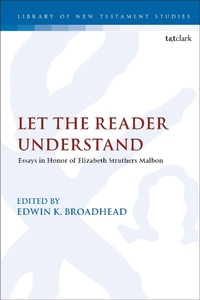
Let the Reader Understand
Essays in Honor of Elizabeth Struthers Malbon
1st Edition
Published on 22. March 2018
384 pages
978-0-567-67406-7 (ISBN)
Description

This book honors the extraordinary contribution of Elizabeth Struthers Malbon to biblical studies. In the opening chapter, Werner Kelber places Malbon's work within the larger context of critical reflection, from antiquity to the modern era, on the role and function of discourse. Kelber locates Malbon's approach squarely within the framework of modernity and concludes that her "supremely creative achievement has been the employment of modern, narrative critical tools with a view toward uncovering the fecundity of the gospel of Mark."
Drawing from and conversing with Professor Malbon's extensive publications, each of the five sections engages a theme from her works, focusing particularly on the Gospel of Mark. This tribute includes meaning as narrative, issues in methodology, studies in characterization, narrative readings of specific texts, and aesthetic and political readings. Contributors include: Werner H. Kelber; R. Alan Culpepper; Kelly R. Iverson; Mikeal C. Parsons; David Barr; David J.A. Clines; Robert C. Tannehill; J. Cheryl Exum; Heidi Hornik and Richard Walsh.
Drawing from and conversing with Professor Malbon's extensive publications, each of the five sections engages a theme from her works, focusing particularly on the Gospel of Mark. This tribute includes meaning as narrative, issues in methodology, studies in characterization, narrative readings of specific texts, and aesthetic and political readings. Contributors include: Werner H. Kelber; R. Alan Culpepper; Kelly R. Iverson; Mikeal C. Parsons; David Barr; David J.A. Clines; Robert C. Tannehill; J. Cheryl Exum; Heidi Hornik and Richard Walsh.
More details
Series
Edition
1. Auflage
Language
English
Place of publication
London
United Kingdom
Publishing group
Bloomsbury Publishing PLC
Target group
Professional and scholarly
ISBN-13
978-0-567-67406-7 (9780567674067)
Copyright in bibliographic data and cover images is held by Nielsen Book Services Limited or by the publishers or by their respective licensors: all rights reserved.
Schweitzer Classification
Other editions
Additional editions
Book
09/2019
T.& T.Clark Ltd
€43.50
Shipment within 3-4 weeks
Book
03/2018
T.& T.Clark Ltd
€163.20
Shipment within 3-4 weeks
Person
Content
Introduction
Preface -- Edwin Broadhead, Berea College, USA
Elizabeth Struthers Malbon: Scholarly Publications and Contributions
Tribute -- David Rhoads, Lutheran School of Theology, Chicago, USA
Tribute -- John R. Donahue, Loyola University Maryland, USA
Tribute -- Robert Fowler, Baldwin Wallace University, USA
Part One
1. Meaning as Narrative: The Creative Achievement of Elizabeth Struthers Malbon in Context -- Werner Kelber, Rice University, USA
Part Two: Issues in Methodology
1. Elizabeth Malbon's Contribution to Our Understanding of Mark's Christology -- Alan Culpepper, McAfee School of Theology, USA
2. Becoming a Disciple without Seeing Jesus: Narrative as a Means of Knowing -- Elizabeth Shively, University of St. Andrew's, UK
3. Characterization in Narrative and Performance -- Kelly Iverson, Baylor University, USA
Part Three: Studies in Characterization
1. Mark's Jesus: Sayings and Deeds -- Joanna Dewey, Episcopal Divinity School, USA
2. Characterizing Jesus in Mark's Longer Ending -- Christopher Skinner, Loyola University Chicago, USA
3. The Characterization of the Demons in Mark's Gospel -- Joel Williams, Cedarville University, USA
4. The Waiting Guest Room and Prophetic Characterization: A Critical Note -- Edwin Broadhead, Berea College, USA
5. Jesus and the Good Samaritan: A Study in Characterization -- Mikeal Parsons, Baylor University, USA
6. Uncovering Jesus: Characterization in the Narrative of John's Apocalypse -- David Barr, Wright State University, USA
Part Four: Narrative Readings
7. Mark's Poor Widow Revisited: The Case for Narrative Tension --Brent Driggers, Lutheran Theological Southern Seminary of Lenoir-Rhyne University, USA
8. The Magnificat: A Disenchantment -- David Clines, University of Sheffield, UK
9. Paul and Mark-A Family Resemblance -- Calvin Roetzel, University of Minnesota, USA
10. Salvific Suffering in Paul: Eschatological, Vicarious, and Mimetic -- Jerry Sumney, Lexington Theological Seminary, USA
11. The Wrestling Episode of Genesis 32 -- Brian Britt, Virginia Tech University, USA
Part Five: Aesthetic and Political Readings
12. Love of Enemies and the Problem of Mass Incarceration -- Robert C. Tannehill, Methodist Theological School in Ohio at Delaware, USA
13. Visual Criticism and Dante Gabriel Rossetti's Ecce Ancilla Domini - J. Cheryl Exum, University of Sheffield, UK
14. The Influence of the Junius Bassus Sarcophagus on Italian Renaissance Sculpture -- Heidi J. Hornik, Baylor University, USA
15. Brancusi's Table of Silence and the Resurrection of God in the Gospel of Mark -- Geert Van Oyen, Catholic University Leuven, Belgium
16. Discovering Where the Bodies are Hidden: Latitudinal Eschatological Perspectives in the Gospel of Mark -- Philip Ruge-Jones, independent scholar
17. Jesus of Montreal as an Interpretation of the Gospel of Mark -- Richard Walsh, Methodist University, USA
18. Listening and Giving Voice: Poems from the Gospel of Mark -- Cynthia Kittredge, Seminary of the Southwest in Austin, USA
Conclusion
Edwin Broadhead - Berea College, USA
Index
Preface -- Edwin Broadhead, Berea College, USA
Elizabeth Struthers Malbon: Scholarly Publications and Contributions
Tribute -- David Rhoads, Lutheran School of Theology, Chicago, USA
Tribute -- John R. Donahue, Loyola University Maryland, USA
Tribute -- Robert Fowler, Baldwin Wallace University, USA
Part One
1. Meaning as Narrative: The Creative Achievement of Elizabeth Struthers Malbon in Context -- Werner Kelber, Rice University, USA
Part Two: Issues in Methodology
1. Elizabeth Malbon's Contribution to Our Understanding of Mark's Christology -- Alan Culpepper, McAfee School of Theology, USA
2. Becoming a Disciple without Seeing Jesus: Narrative as a Means of Knowing -- Elizabeth Shively, University of St. Andrew's, UK
3. Characterization in Narrative and Performance -- Kelly Iverson, Baylor University, USA
Part Three: Studies in Characterization
1. Mark's Jesus: Sayings and Deeds -- Joanna Dewey, Episcopal Divinity School, USA
2. Characterizing Jesus in Mark's Longer Ending -- Christopher Skinner, Loyola University Chicago, USA
3. The Characterization of the Demons in Mark's Gospel -- Joel Williams, Cedarville University, USA
4. The Waiting Guest Room and Prophetic Characterization: A Critical Note -- Edwin Broadhead, Berea College, USA
5. Jesus and the Good Samaritan: A Study in Characterization -- Mikeal Parsons, Baylor University, USA
6. Uncovering Jesus: Characterization in the Narrative of John's Apocalypse -- David Barr, Wright State University, USA
Part Four: Narrative Readings
7. Mark's Poor Widow Revisited: The Case for Narrative Tension --Brent Driggers, Lutheran Theological Southern Seminary of Lenoir-Rhyne University, USA
8. The Magnificat: A Disenchantment -- David Clines, University of Sheffield, UK
9. Paul and Mark-A Family Resemblance -- Calvin Roetzel, University of Minnesota, USA
10. Salvific Suffering in Paul: Eschatological, Vicarious, and Mimetic -- Jerry Sumney, Lexington Theological Seminary, USA
11. The Wrestling Episode of Genesis 32 -- Brian Britt, Virginia Tech University, USA
Part Five: Aesthetic and Political Readings
12. Love of Enemies and the Problem of Mass Incarceration -- Robert C. Tannehill, Methodist Theological School in Ohio at Delaware, USA
13. Visual Criticism and Dante Gabriel Rossetti's Ecce Ancilla Domini - J. Cheryl Exum, University of Sheffield, UK
14. The Influence of the Junius Bassus Sarcophagus on Italian Renaissance Sculpture -- Heidi J. Hornik, Baylor University, USA
15. Brancusi's Table of Silence and the Resurrection of God in the Gospel of Mark -- Geert Van Oyen, Catholic University Leuven, Belgium
16. Discovering Where the Bodies are Hidden: Latitudinal Eschatological Perspectives in the Gospel of Mark -- Philip Ruge-Jones, independent scholar
17. Jesus of Montreal as an Interpretation of the Gospel of Mark -- Richard Walsh, Methodist University, USA
18. Listening and Giving Voice: Poems from the Gospel of Mark -- Cynthia Kittredge, Seminary of the Southwest in Austin, USA
Conclusion
Edwin Broadhead - Berea College, USA
Index
