

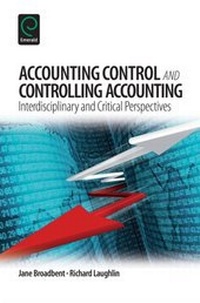
Accounting Control and Controlling Accounting
Interdisciplinary and Critical Perspectives
1st Edition
Published on 21. May 2013
307 pages
978-1-78190-763-4 (ISBN)
Description

This book advocates and illustrates the power of Interdisciplinary & Critical Perspectives, drawn from a range of social sciences, to critically analyse accounting processes & practices. Its particular focus is the extensive forms of societal regulations & requirements that are made over organisations, particularly public sector organisations, that are driven by forms of accounting, collectively described as Accounting Control in the book. These regulations & requirements are deeply resented by these public sector organisations and, as a result, all manner of resistance strategies are adopted, which are described as Controlling Accounting in the book. The book is primarily conceptual but, given the particular Interdisciplinary & Critical research approach adopted, relies heavily on drawing from empirical cases to develop the conceptual ideas. The book, therefore, analyses actual public sector Accounting Control & Controlling Accounting strategies and counter-strategies primarily, but not exclusively, from the United Kingdom, to develop the conceptual ideas. The book ends with a critical analysis of the forces & counter-forces of Accounting Control & Controlling Accounting.
All prices
More details
Language
English
Place of publication
Bingley
United Kingdom
Target group
Professional and scholarly
File size
2,25 MB
ISBN-13
978-1-78190-763-4 (9781781907634)
Copyright in bibliographic data and cover images is held by Nielsen Book Services Limited or by the publishers or by their respective licensors: all rights reserved.
Schweitzer Classification
Other editions
Additional editions
Jane Broadbent | Richard Laughlin
Accounting Control and Controlling Accounting
Interdisciplinary and Critical Perspectives
Book
05/2013
Emerald Group Publishing Limited
€203.90
Shipment within 10-20 days
Content
- Front Cover
- Accounting Control and Controlling Accounting: Interdisciplinary and Critical Perspectives
- Copyright Page
- Contents
- Preface
- Chapter 1. Introduction
- 1.1 Society, Organisations and Accounting
- 1.1.1 Society and Organisations: Unpacking the Complexity
- 1.1.2 The Role and Nature of Accounting, Accounting Control and Controlling Accounting
- 1.2 Clarifying Accounting, Accounting Logic and Accountability
- 1.2.1 Traditional Accounting, Accounting Logic and Accountability
- 1.3 Outline of the Book
- Chapter 2. Interdisciplinary and Critical Perspectives on Accounting
- 2.1 Some Reflections on the Development of the ICPA Project
- 2.1.1 Creating the Space for Discourse: Individual and Institutional Change Agents
- 2.1.2 Positive Accounting Theory: A Key Driving Force
- 2.2 ICPA Research Approaches: Clarifying New Domains
- 2.2.1 The Concern with Research Approaches: Setting the Scene
- 2.2.2 The Nature of Research Approaches: A Clarification Through and Beyond Burrell and Morgan
- 2.2.3 The Nature of Research Approaches: A New Approach to Categorisation
- 2.3 Choosing a Research Approach and a Case for Middle-Range Thinking
- 2.4 A Concluding Comment
- Chapter 3. A Middle-Range Theory of Accounting Control and Controlling Accounting
- 3.1 Lifeworld, Steering, Systems and Accounting
- 3.1.1 Habermas's Thinking on Lifeworld, Steering and Systems
- 3.1.2 Refining Habermas's Model of Lifeworld, Steering and Systems
- 3.1.2.1 Justification and practicality of social evolution as an ideal
- 3.1.2.2 Clarifying institutions and organisations
- 3.1.2.3 The role of accounting and finance in steering
- 3.2 Middle-Range Thinking and Accounting Control
- 3.2.1 Performance Management Systems as Steering Mechanism: A Conceptual Overview
- 3.2.2 Finance and Accounting Steering Mechanisms
- 3.2.2.1 Transactional and relational ex ante information
- 3.2.2.2 Transactional and relational ex post information
- 3.3 Controlling Accounting: A Middle-Range Theory
- 3.4 Some Concluding Thoughts
- Chapter 4. Accounting Control: The Ex Ante Information of New Public Financial Management
- 4.1 From Progressive Public Administration to NPM to NPFM
- 4.2 From NPM to NPFM in the UK
- 4.2.1 CSRs and SRs
- 4.2.2 PSAs, Targets and Business Plans
- 4.2.3 Some Reflective Comments
- 4.3 The Delivery Chain of Accounting Control
- 4.3.1 The Delivery Chain of Accounting Control of HE in England
- 4.3.2 The DFES and DTI Delivery Chain of Accounting Control
- 4.4 Some Reflective Conclusions
- Chapter 5. Accounting Control: The Ex Post Information Requirements for Public Service Organisations
- 5.1 Ex Post Information Requirements of Traditional Accounting: Nature and Regulatory Bodies
- 5.1.1 A Concluding Thought
- 5.2 Ex Post Information of Accountability and Accounting Logic: Requirements and Regulation
- 5.2.1 Narrative Reporting as Accountability that Amplifies Traditional Financial Statements
- 5.2.2 An Extension of Narrative Accountability Reporting into Governance, Internal Control and Risk Management
- 5.2.3 Accountability for Accounting Logic's Ex Ante Requirements
- 5.2.4 Some Concluding Thoughts
- 5.3 Ex Post Information Requirements at the Organisational Level: The Case of Higher Education in England
- 5.3.1 Information Requirements of Boards of Governors
- 5.3.2 Information Requirements of HEFCE
- 5.3.3 Accounting and Accountability Requirements
- 5.3.4 Some Concluding Thoughts
- 5.4 Accounting Control: Some Concluding Observations
- Chapter 6. Controlling Accounting: An Introduction and the Rebuttal and Evolution Alternatives
- 6.1 Controlling Accounting in a Case Where no Accounting Control is Involved: The Church of England
- 6.1.1 Finance and Accounting in the Church of England: An Overview
- 6.1.2 Controlling Accounting: An Analysis
- 6.1.3 Generic Lessons from the Case of the Church of England
- 6.2 Controlling Accounting through Rebuttal
- 6.2.1 Rebuttal in Relation to Influencing Ex Post Information Requirements
- 6.2.2 Rebuttal in Relation to Influencing Ex Ante Expectations
- 6.3 Controlling Accounting through Evolution
- 6.4 Some Concluding Thoughts
- Chapter 7. Controlling Accounting: The Reorientation and Colonisation Alternatives
- 7.1 Reorientation through Absorption
- 7.1.1 Reorientation through Absorption: The Case of LMS for Schools and the Revised GP Contract for GP Practices
- 7.1.2 Some Reflective Thoughts on Reorientation through Absorption
- 7.2 Reorientation through Boundary Management
- 7.2.1 Reorientation through Boundary Management: The Examples of HEIs and PFI in the NHS
- 7.2.2 Some Reflective Thoughts on Reorientation through Boundary Management
- 7.3 Colonisation
- 7.4 Some Concluding Thoughts on Controlling Accounting
- Chapter 8. Reflections and Policy Proposals
- 8.1 Accounting Control and Controlling Accounting: An Overview
- 8.2 Accounting Control: Problems, Solutions and Policy Proposals
- 8.3 Controlling Accounting: Problems, Solutions and Policy Proposals
- 8.4 A Final Comment and Thought
- References

