

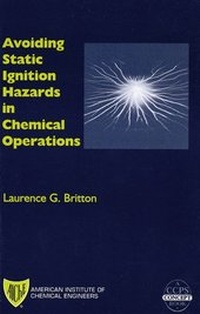
Avoiding Static Ignition Hazards in Chemical Operations
Description

More details
Other editions
Additional editions
Person
Laurence G. Britton is the author of Avoiding Static Ignition Hazards in Chemical Operations: A CCPS Concept Book, published by Wiley.
Content
Acknowledgments.
Chapter 1. Introduction.
1.1. Purpose.
1.2. Exclusive.
1.3. Units.
1.4. Organization of the Book.
Chapter 2. Fundamentals of Static Electricity.
2.1. What is Static Electricity.
2.1.1. Charge Separation.
2.1.2. Magnitude of Current and Potential.
2.1.3. Concentration of Charged Species.
2.1.4. Importance of Trace Contaminants.
2.1.5. Hazard Evaluation.
2.1.6. Statistics.
2.2. Charge Generation.
2.2.1. Induction Charging.
2.2.2. Ionic Charging.
2.3. Charge Dissipation.
2.3.1. Variability of Conductivity.
2.4. Charge Accumulation.
2.5. Ignition.
2.5.1. Effective Energy.
2.6. Static Discharges.
2.6.1. Corona Discharge.
2.6.2. Brush Discharge.
2.6.3. Bulking Brush Discharge.
2.6.4. Spark Discharge.
2.6.5. Propagating Brush Discharge (PBD).
2.6.6. Surface Streamer.
2.7. Personnel Spark and Shock Hazards.
2.7.1. Body Capacitance and Resistance.
2.7.2. Voltage (V) and Energy (W) Attained.
2.7.3. Human Shock Response.
Chapter 3. Evaluating the Hazard of Static Electricity.
3.1. General.
3.2. Hazard Identification Methods.
3.2.1. Decision Trees.
3.3. Charge Accumulation.
3.3.1. Conductive Objects.
3.3.2. Nonconductive Objects.
3.4. Energy Estimates.
3.4.1. Charge Sharing.
3.5. Instrumentation.
3.5.1. Charge.
3.5.2. Electric Field.
3.5.3. Potential.
3.5.4. Ignition Energy.
3.5.5. Conductivity of Liquids.
3.5.6. Resistivity of Solids.
3.5.7. Resistance.
3.6. Direct Observation of Discharges.
3.7. Radio Frequency Detection of Discharges.
3.8. Measuring the Effective Energy of Nonspark Discharges.
3.8.1. Gas Composition.
Chapter 4. Controlling Electrostatic Hazards.
4.1. Bonding and Grounding.
4.1.1. Definitions.
4.1.2. Purpose of Bonding and Grounding.
4.1.3. Resistance to Ground.
4.1.4. Bonding and Grounding Systems.
4.1.5. Ground Rods.
4.1.6. Grounding and Cathodic Protection.
4.2. Control of Charge Relaxation.
4.2.1. Increase of Conductivity.
4.2.2. Charge Neutralizers.
4.3. Control of Personnel Charging.
4.3.1. Personnel Grounding.
4.3.2. Clothing.
4.3.3. Gloves.
4.4. Control of Flammable Atmospheres.
4.4.1. Liquid Nitrogen/Liquid Air Hazards.
Chapter 5. Flammable Liquids, Vapors, and Gases.
5.1. Ignition Hazards of Liquid Vapor and Mist.
5.1.1. Flammable Liquid.
5.1.2. Flammable Limits.
5.1.3. Liquid Mist.
5.1.4. Minimum Ignition Energy (MIE).
5.1.5. Explosion Prevention Systems.
5.2. Generation and Relaxation (Loss) of Charge in Liquid Systems.
5.2.1. Charge Generation.
5.2.2. Charge Density.
5.2.3. Factors Influencing Charge Generation.
5.2.4. Charge Relaxation.
5.2.5. Classification of Liquids based on Conductivity.
5.2.6. Antistatic Additives.
5.2.7. Bonding and Grounding.
5.3. Flow in Pipe, Hose, and Tubing.
5.3.1. Metallic Piping Systems.
5.3.2. Nonconductive Pipe and Linings.
5.3.3. Flexible Hoses.
5.3.4. Dip Pipes.
5.3.5. Filters and Relaxation Tanks.
5.3.6. Suspended Material.
5.3.7. Valves and Other Line Restrictions.
5.4. Filling Criteria for Tank Operations.
5.4.1. Storage Tanks.
5.4.2. Road Tankers.
5.4.3. Rail Cars.
5.4.4. Liquid Phase Mixers, Blenders, and Reactors.
5.4.5. Liquid-Solid Mixers, Blenders and Reactors.
5.4.6. Vacuum Trucks.
5.4.7. Plastic Tanks.
5.5. Sampling, Gauging, and Analysis.
5.5.1. Sample Container Cord.
5.5.2. Sampling.
5.5.3. Gauging.
5.5.4. Portable Flammable Gas Analyzers.
5.6. Tank Cleaning.
5.6.1. Water Washing.
5.6.2. Solvent Washing.
5.6.3. Steam Cleaning.
5.6.4. Acid Washing.
5.6.5. Grit Blasting.
5.7. Portable Tanks.
5.7.1. Metal Portable Tanks.
5.7.2. Plastic Portable Tanks.
5.8. Portable Containers Less Than 60 Gallons Capacity.
5.8.1. All-Steel Drums.
5.8.2. Plastic Lined Drums.
5.8.3. Plastic Drums.
5.8.4. Hand-Held Containers.
5.8.5. Wet-Dry Vacuum Cleaners.
5.9. Miscellaneous Flammable Atmospheres.
5.9.1. Clean Rooms.
5.9.2. Water and Steam Curtains.
5.9.3. Static Electrification in Gas Flow.
5.9.4. Ignition of Vented Gas.
5.9.5. Hazards of Plastic Sheet and Wrap.
5.9.6. Oxidant Enriched Atmospheres.
5.9.7. Elevated Temperature and Pressure.
5.9.8. Automotive and Marine.
5.9.9. Aerosol Spray Cans.
5.10. Cathode Ray Tube Video Display Screens.
5.10.1. Cleaning.
5.10.2. Screens in Hazardous Locations.
5.10.3. Static Dissipating Screen Overlays.
Chapter 6. Powders and Solids.
6.1. Flammability of Dust Suspensions.
6.1.1. Flammable Limits.
6.1.2. Minimum Ignition Energy (MIE) of Dust Suspensions.
6.1.3. Hybrid Mixtures.
6.1.4. Unstable or Energetic Powders.
6.1.5. Effect of Temperature on Ignition Energy.
6.1.6. Effect of Moisture on Ignition Energy.
6.2. Charging Mechanisms.
6.2.1. Charge Density.
6.2.2. Classification of Powders Based on Conductivity.
6.3. Pneumatic Conveying.
6.3.1. Charging in Pipeline Flow.
6.3.2. Special Grounding Cases.
6.4. Types of Static Discharge in Powder Systems.
6.4.1. Sparks.
6.4.2. Bulking Brush Discharges.
6.4.3. Propagating Brush Discharge.
6.5. General Operations.
6.5.1. Vacuum Trucks.
6.5.2. Bag Houses.
6.6. Manual Transfers from Portable Containers.
6.7. Flexible Intermediate Bulk Containers (FIBCs).
6.7.1. Powder Transfers in Air Atmospheres.
6.7.2. Powder Transfers from FIBCs to Flammable Liquids.
6.7.3. Conductive and Antistatic FIBCs.
6.7.4. Vacuum FIBC Transfers.
Appendix A. Explanatory Material.
Propagating Brush Discharge.
Resistance to Ground.
MIE of Liquid Mists.
Hyperbolic Relaxation.
Filtration.
Filling Criteria for Tank Operations.
Effect of Road Tires.
Potentials During Water Washing of Tanks.
Effect of Particle Size on Dust MIE.
Ignition Energy of Hybrid Mixtures.
Effect of Temperature on Powder MIE.
Appendix B. Data Tables.
Flammability Data for Gases and Vapors.
Typical Conductivities, Dielectric Constants and Relaxation (or Dissipation) Times of Liquids.
Typical Resistivities, Dielectric Constants, and Breakdown Strengths of Solid Dielectrics.
Appendix C. Formulas and Mathematical Relationships (SI UNITS).
C.1. Principal Relationships.
C.2. Analysis: Grounded Sphere above Charged Nonconductive Disc.
References.
Glossary.
Index.
