

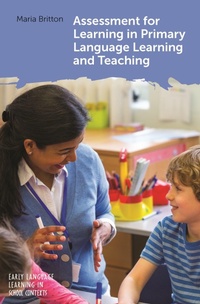
Assessment for Learning in Primary Language Learning and Teaching
Published on 29. April 2021
216 pages
978-1-80041-066-4 (ISBN)
Description

This volume provides a detailed account of the practical use of Assessment for Learning (AfL) in primary language classrooms. It gives an in-depth account of the ways in which eight experienced primary language teachers incorporated this type of assessment into their practice and discusses the possible impact of AfL on primary language learning. Key themes discussed in the volume include the relationship between AfL and language learning in childhood, which assessment methods are appropriate for primary-aged language learners, which methods support learner agency and engagement in the learning processes, and possible paths for future action, with a focus on implementation and researching AfL in primary language contexts. The findings of this book are relevant to global contexts and it will be of interest to postgraduate students and researchers in the fields of language education, language assessment and teacher education, as well as to primary and language teachers and school leaders.
Reviews / Votes
This book makes an important contribution to ongoing discussions of AfL as well as primary FL teaching and learning. The proposed view of AfL as an assessment spiral excellently reflects its solid theoretical and empirical underpinnings. Both researchers and practitioners will find this book highly valuable, as well as inspirational. * Jelena Mihaljevic Djigunovic, University of Zagreb, Croatia * Assessment for Learning has been much discussed but so far little practised with primary school aged learners of English as a foreign or second language. This study rigorously investigates the fitness for purpose of AfL for such learners. It also gives vivid evidence of the developing skills and perceptions of a set of teachers who were new to the approach but keen to try it. * Shelagh Rixon, University of Leicester, UK * This book combines in a consistent and pedagogical way conceptual reasoning with empirical evidence, and practical examples and suggestions for AfL with young learners. Its clarity, contextual awareness and, in particular, its emphasis on learner agency and the involvement of pupils in assessment processes, will undoubtedly make it a very useful resource in language teacher pre- and in-service education. * Gudrun Erickson, University of Gothenburg, Sweden * ...the book provides a rich and detailed research-based perspective on AfL, its implementation and its impact [...] it will be of value for researchers, teacher educators, and teachers, especially teachers undertaking post-graduate study or professional development and learning. -- Gwenna Finikin, Hokowhitu School, New Zealand * Language Teaching for Young Learners 4:2 (2022). *More details
Series
Language
English
Place of publication
Bristol
United Kingdom
Target group
College/higher education
Product notice
Reflowable
Dimensions
Height: 234 mm
Width: 156 mm
ISBN-13
978-1-80041-066-4 (9781800410664)
Copyright in bibliographic data and cover images is held by Nielsen Book Services Limited or by the publishers or by their respective licensors: all rights reserved.
Schweitzer Classification
Other editions
Additional editions

Book
04/2021
Multilingual Matters
€48.20
Shipment within 10-20 days
Person
Maria Britton has over 15 years of experience of working in primary schools, as a researcher, teacher, teacher trainer and senior leader. She holds a PhD from the University of Reading, UK and her research interests are the teaching, learning and assessment of young language learners.
Content
Illustrations
Abbreviations
Acknowledgements
Chapter 1. Introduction to the Book
Part 1: Defining Assessment for Learning in Primary Contexts
Chapter 2. What is AfL in Primary Language Teaching Contexts?
Chapter 3. What Research Tells Us About the Use of AfL in Primary Language Teaching
Chapter 4. Assessment and Cognitive Development in Childhood
Chapter 5. The Importance of Interactions and Affect in Assessing Primary-Aged Language Learners
Part 2: Implementing AfL in the Classroom
Chapter 6: Setting Expectations and Monitoring Progress
Chapter 7: Evaluating Achievement
Chapter 8: Teaching and AfL: Tasks, Skills and Age-Related Differences
Chapter 9: Types of Implementation of AfL
Part 3: Impact of AfL on Learning
Chapter 10: Interactions through Assessment
Chapter 11: Assessment Spiral
Chapter 12: Looking into the Future
References
Appendices
Index
Abbreviations
Acknowledgements
Chapter 1. Introduction to the Book
Part 1: Defining Assessment for Learning in Primary Contexts
Chapter 2. What is AfL in Primary Language Teaching Contexts?
Chapter 3. What Research Tells Us About the Use of AfL in Primary Language Teaching
Chapter 4. Assessment and Cognitive Development in Childhood
Chapter 5. The Importance of Interactions and Affect in Assessing Primary-Aged Language Learners
Part 2: Implementing AfL in the Classroom
Chapter 6: Setting Expectations and Monitoring Progress
Chapter 7: Evaluating Achievement
Chapter 8: Teaching and AfL: Tasks, Skills and Age-Related Differences
Chapter 9: Types of Implementation of AfL
Part 3: Impact of AfL on Learning
Chapter 10: Interactions through Assessment
Chapter 11: Assessment Spiral
Chapter 12: Looking into the Future
References
Appendices
Index
