

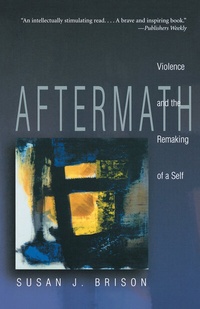
Aftermath
Violence and the Remaking of a Self
1st Edition
Published on 5. January 2023
192 pages
978-0-691-24574-4 (ISBN)
Description

A powerful personal narrative of recovery and an illuminating philosophical exploration of trauma
On July 4, 1990, while on a morning walk in southern France, Susan Brison was attacked from behind, severely beaten, sexually assaulted, strangled to unconsciousness, and left for dead. She survived, but her world was destroyed. Her training as a philosopher could not help her make sense of things, and many of her fundamental assumptions about the nature of the self and the world it inhabits were shattered.
At once a personal narrative of recovery and a philosophical exploration of trauma, this bravely and beautifully written book examines the undoing and remaking of a self in the aftermath of violence. It explores, from an interdisciplinary perspective, memory and truth, identity and self, autonomy and community. It offers imaginative access to the experience of a rape survivor as well as a reflective critique of a society in which women routinely fear and suffer sexual violence.
As Brison observes, trauma disrupts memory, severs past from present, and incapacitates the ability to envision a future. Yet the act of bearing witness, she argues, facilitates recovery by integrating the experience into the survivor's life's story. She also argues for the importance, as well as the hazards, of using first-person narratives in understanding not only trauma, but also larger philosophical questions about what we can know and how we should live.
On July 4, 1990, while on a morning walk in southern France, Susan Brison was attacked from behind, severely beaten, sexually assaulted, strangled to unconsciousness, and left for dead. She survived, but her world was destroyed. Her training as a philosopher could not help her make sense of things, and many of her fundamental assumptions about the nature of the self and the world it inhabits were shattered.
At once a personal narrative of recovery and a philosophical exploration of trauma, this bravely and beautifully written book examines the undoing and remaking of a self in the aftermath of violence. It explores, from an interdisciplinary perspective, memory and truth, identity and self, autonomy and community. It offers imaginative access to the experience of a rape survivor as well as a reflective critique of a society in which women routinely fear and suffer sexual violence.
As Brison observes, trauma disrupts memory, severs past from present, and incapacitates the ability to envision a future. Yet the act of bearing witness, she argues, facilitates recovery by integrating the experience into the survivor's life's story. She also argues for the importance, as well as the hazards, of using first-person narratives in understanding not only trauma, but also larger philosophical questions about what we can know and how we should live.
More details
Other editions
Additional editions
Book
01/2023
Princeton University Press
€25.00
Shipment within 10-20 days
Person
Susan J. Brison is the Eunice and Julian Cohen Professor for the Study of Ethics and Human Values and Professor of Philosophy at Dartmouth College.
Content
- Cover
- Contents
- Preface to the 2022 Edition
- Preface
- One. Surviving Sexual Violence
- Two. On the Personal as Philosophical
- Three. Outliving Oneself
- Four. Acts of Memory
- Five. The Politics of Forgetting
- Six. Retellings
- Afterword
- Acknowledgments
- Notes
- Bibliography
- Index
