

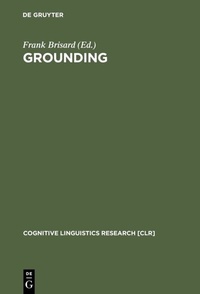
Grounding
The Epistemic Footing of Deixis and Reference
1st Edition
Published on 28. August 2012
XXXIV, 475 pages
978-3-11-089980-1 (ISBN)
Description

This compilation of invited contributions, gathering an international collection of cognitive and functional linguists, offers an outline of original empirical work carried out in grounding theory. Grounding is a central notion in cognitive grammar that addresses the linking of semantic content to contextual factors that constitute the subjective ground (or situation of speech). The volume illustrates a growing concern with the application of cognitive grammar to constructions establishing deixis and reference. It proposes a double focus on nominal and clausal grounding, as well as on ways of integrating analyses across these domains.
More details
Series
Edition
Reprint 2012
Language
English
Place of publication
Berlin/Boston
Germany
Publishing group
de Gruyter Mouton
Target group
Professional and scholarly
US School Grade: College Graduate Student
Illustrations
Num. figs.
Num. figs.
File size
12,78 MB
ISBN-13
978-3-11-089980-1 (9783110899801)
Schweitzer Classification
Other editions
Additional editions
Book
11/2002
1st Edition
De Gruyter Mouton
€159.95
Shipment within 7-9 days
Book
01/2002
1st Edition
De Gruyter Mouton
€229.00
Article exhausted; check different version
Person
Frank Brisard is Postdoctoral Fellow at the Fund for Scientific Research, University of Antwerpen, Belgium
Content
- Intro
- Acknowledgments
- List of contributors
- Introduction: The epistemic basis of deixis and reference
- Deixis and subjectivity
- Remarks on the English grounding systems
- Part I: Nominal grounding
- Grounding, subjectivity and definite descriptions
- Interaction, grounding and third-person referential forms
- The French imparfait, determiners and grounding
- Deictic principles of pronominals, demonstratives, and tenses
- Part II: Clausal grounding
- The meaning and distribution of French mood inflections
- The English present
- The preterit and the imperfect as grounding predications
- A cognitive grammar analysis of Polish nonpast perfectives and imperfectives: How virtual events differ from actual ones
- "Wieso sollte ich dich küssen, du hässlicher Mensch!". A study of the German modals sollen and müssen as "grounding predications" in interrogatives
- Grounding and the system of epistemic expressions in Dutch: A cognitive-functional view Jan Nuyts
- Subject index
