

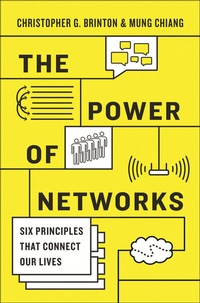
The Power of Networks
Six Principles That Connect Our Lives
1st Edition
Published on 8. July 2019
328 pages
978-1-4008-8407-0 (ISBN)
Description

An accessible illustrated introducton to the networks we use every day, from Facebook and Google to WiFi and the Internet
What makes WiFi faster at home than at a coffee shop? How does Google order search results? Why do Amazon, Netflix, and YouTube use fundamentally different rating and recommendation methods-and why does it matter? Is it really true that everyone on Facebook is connected in six steps or less? And how do cat videos-or anything else-go viral? The Power of Networks answers questions like these for the first time in a way that all of us can understand and use, whether at home, the office, or school. Using simple language, analogies, stories, hundreds of illustrations, and no more math than simple addition and multiplication, Christopher Brinton and Mung Chiang provide a smart but accessible introduction to the handful of big ideas that drive the technical and social networks we use every day-from cellular phone networks and cloud computing to the Internet and social media platforms.
The Power of Networks unifies these ideas through six fundamental principles of networking, which explain the difficulties in sharing network resources efficiently, how crowds can be wise or not so wise depending on the nature of their connections, how there are many building-blocks of layers in a network, and more. Understanding these simple ideas unlocks the workings of everything from the connections we make on Facebook to the technology that runs such platforms. Along the way, the authors also talk with and share the special insights of renowned experts such as Google's Eric Schmidt, former Verizon Wireless CEO Dennis Strigl, and "fathers of the Internet" Vint Cerf and Bob Kahn.
Networks are everywhere. The Power of Networks shows how they work-and what understanding them can do for you.
What makes WiFi faster at home than at a coffee shop? How does Google order search results? Why do Amazon, Netflix, and YouTube use fundamentally different rating and recommendation methods-and why does it matter? Is it really true that everyone on Facebook is connected in six steps or less? And how do cat videos-or anything else-go viral? The Power of Networks answers questions like these for the first time in a way that all of us can understand and use, whether at home, the office, or school. Using simple language, analogies, stories, hundreds of illustrations, and no more math than simple addition and multiplication, Christopher Brinton and Mung Chiang provide a smart but accessible introduction to the handful of big ideas that drive the technical and social networks we use every day-from cellular phone networks and cloud computing to the Internet and social media platforms.
The Power of Networks unifies these ideas through six fundamental principles of networking, which explain the difficulties in sharing network resources efficiently, how crowds can be wise or not so wise depending on the nature of their connections, how there are many building-blocks of layers in a network, and more. Understanding these simple ideas unlocks the workings of everything from the connections we make on Facebook to the technology that runs such platforms. Along the way, the authors also talk with and share the special insights of renowned experts such as Google's Eric Schmidt, former Verizon Wireless CEO Dennis Strigl, and "fathers of the Internet" Vint Cerf and Bob Kahn.
Networks are everywhere. The Power of Networks shows how they work-and what understanding them can do for you.
More details
Language
English
Place of publication
Princeton, NJ
United States
Publishing group
De Gruyter
Target group
Professional and scholarly
Edition type
Digital original
Illustrations
25 halftones. 198 line illus. 12 tables.
File size
22,14 MB
ISBN-13
978-1-4008-8407-0 (9781400884070)
Schweitzer Classification
Other editions
Additional editions
Book
11/2018
Princeton University Press
€28.50
Shipment within 10-20 days
Book
10/2016
Princeton University Press
€37.14
Article exhausted; check different version
Persons
Christopher G. Brinton is the Head of Advanced Research at Zoomi Inc., where he works on big-data analytics, social learning networks, and personalized learning. He holds a PhD in electrical engineering from Princeton University. Mung Chiang is the Arthur LeGrand Doty Professor of Electrical Engineering at Princeton, where he also serves as chairman of the Princeton Entrepreneurship Council and director of the Keller Center for Innovation in Engineering Education. In 2013, he received the Alan T. Waterman Award from the National Science Foundation. Since 2012, Brinton and Chiang have introduced networks to hundreds of thousands of people around the world through massive open online courses.
Content
Preface and Acknowledgments ix
PART I SHARING IS HARD 1
1 Controlling Your Volume 3
2 Accessing Networks "Randomly" 26
3 Pricing Data Smartly 44
A Conversation with Dennis Strigl 63
PART II RANKING IS HARD 69
4 Bidding for Ad Spaces 71
5 Ordering Search Results 86
A Conversation with Eric Schmidt 101
PART III CROWDS ARE WISE 109
6 Combining Product Ratings 111
7 Recommending Movies to Watch 128
8 Learning Socially 147
PART IV CROWDS ARE NOT SO WISE 167
9 Viralizing Video Clips 169
10 Influencing People 188
PART V DIVIDE AND CONQUER 209
11 Inventing the Internet 211
12 Routing Traffic 228
A Conversation with Robert Kahn 247
PART VI END TO END 257
13 Controlling Congestion 259
14 Navigating a Small World 278
A Conversation with Vinton Cerf 299
Index 307
PART I SHARING IS HARD 1
1 Controlling Your Volume 3
2 Accessing Networks "Randomly" 26
3 Pricing Data Smartly 44
A Conversation with Dennis Strigl 63
PART II RANKING IS HARD 69
4 Bidding for Ad Spaces 71
5 Ordering Search Results 86
A Conversation with Eric Schmidt 101
PART III CROWDS ARE WISE 109
6 Combining Product Ratings 111
7 Recommending Movies to Watch 128
8 Learning Socially 147
PART IV CROWDS ARE NOT SO WISE 167
9 Viralizing Video Clips 169
10 Influencing People 188
PART V DIVIDE AND CONQUER 209
11 Inventing the Internet 211
12 Routing Traffic 228
A Conversation with Robert Kahn 247
PART VI END TO END 257
13 Controlling Congestion 259
14 Navigating a Small World 278
A Conversation with Vinton Cerf 299
Index 307
