

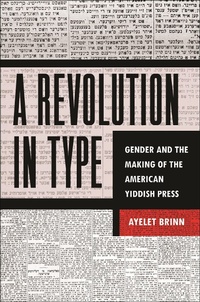
A Revolution in Type
Gender and the Making of the American Yiddish Press
Published on 14. November 2023
277 pages
978-1-4798-1767-2 (ISBN)
Description

73rd National Jewish Book Awards Finalist
A fascinating glimpse into the complex and often unexpected ways that women and ideas about women shaped widely read Jewish newspapers
Between the 1880s and 1920s, Yiddish-language newspapers rose from obscurity to become successful institutions integral to American Jewish life. During this period, Yiddish-speaking immigrants came to view newspapers as indispensable parts of their daily lives. For many Jewish immigrants from Eastern Europe, acclimating to America became inextricably intertwined with becoming a devoted reader of the Yiddish periodical press, as the newspapers and their staffs became a fusion of friends, religious and political authorities, tour guides, matchmakers, and social welfare agencies.
In A Revolution in Type, Ayelet Brinn argues that women were central to the emergence of the Yiddish press as a powerful, influential force in American Jewish culture. Through rhetorical debates about women readers and writers, the producers of the Yiddish press explored how to transform their newspapers to reach a large, diverse audience. The seemingly peripheral status of women's columns and other newspaper features supposedly aimed at a female audience-but in reality, read with great interest by male and female readers alike-meant that editors and publishers often used these articles as testing grounds for the types of content their newspapers should encompass. The book explores the discovery of previously unknown work by female writers in the Yiddish press, whose contributions most often appeared without attribution; it also examines the work of men who wrote under women's names in order to break into the press. Brinn shows that instead of framing issues of gender as marginal, we must view them as central to understanding how the American Yiddish press developed into the influential, complex, and diverse publication field it eventually became.
A fascinating glimpse into the complex and often unexpected ways that women and ideas about women shaped widely read Jewish newspapers
Between the 1880s and 1920s, Yiddish-language newspapers rose from obscurity to become successful institutions integral to American Jewish life. During this period, Yiddish-speaking immigrants came to view newspapers as indispensable parts of their daily lives. For many Jewish immigrants from Eastern Europe, acclimating to America became inextricably intertwined with becoming a devoted reader of the Yiddish periodical press, as the newspapers and their staffs became a fusion of friends, religious and political authorities, tour guides, matchmakers, and social welfare agencies.
In A Revolution in Type, Ayelet Brinn argues that women were central to the emergence of the Yiddish press as a powerful, influential force in American Jewish culture. Through rhetorical debates about women readers and writers, the producers of the Yiddish press explored how to transform their newspapers to reach a large, diverse audience. The seemingly peripheral status of women's columns and other newspaper features supposedly aimed at a female audience-but in reality, read with great interest by male and female readers alike-meant that editors and publishers often used these articles as testing grounds for the types of content their newspapers should encompass. The book explores the discovery of previously unknown work by female writers in the Yiddish press, whose contributions most often appeared without attribution; it also examines the work of men who wrote under women's names in order to break into the press. Brinn shows that instead of framing issues of gender as marginal, we must view them as central to understanding how the American Yiddish press developed into the influential, complex, and diverse publication field it eventually became.
Reviews / Votes
"Offers a compelling case for why a gendered history of American Yiddish newspapers is necessary to understand both their development as well as their success as the most important non-English press in the United States. The first of its kind, this is a thoroughly researched, clearly-written book." - Anita Norich, author of Writing in Tongues: Translating Yiddish in the Twentieth Century "Striking and impressively executed, Brinn demonstrates in highly specific detail the ways in which ideas about women and women's labor-if often misogynist ideas and exploited labor-were central in the development of the American Yiddish press. . . . Will absolutely transform the way that scholars think about and teach the history of Yiddish journalism in the US and also the history of American journalism, writ large." - Josh Lambert, Sophia Moses Robison Associate Professor of Jewish Studies and English, Wellesley College "Brinn raises the curtain of the Yiddish newspaper industry infrastructure in a revelatory manner. Researching 'behind the scene,' she identifies the role and status of women as contributors to the press, how to speak to female audiences, and the feminine consumer audience to which it is directed... The depth of Brinn's research is scintillating with thrilling discoveries." (San Diego Jewish World) "This fascinating book argues that gender played a crucial role in the development and success of New York's daily Yiddish newspapers over one hundred years ago...Ayelet Brinn, a skilled historical scholar, examines publications that span a broad ideological spectrum." - Linda Kantor-Swerdlow (Jewish Book Council)More details
Language
English
Place of publication
New York
United States
Target group
Professional and scholarly
Product notice
Reflowable
Illustrations
13 b/w illustrations
ISBN-13
978-1-4798-1767-2 (9781479817672)
Copyright in bibliographic data and cover images is held by Nielsen Book Services Limited or by the publishers or by their respective licensors: all rights reserved.
Schweitzer Classification
Other editions
Additional editions
Book
11/2023
New York University Press
€41.50
Shipment within 10-20 days
Person
Ayelet Brinn is the Philip D. Feltman Assistant Professor of Modern Jewish History in the Departments of Judaic Studies and History at the University of Hartford.
