

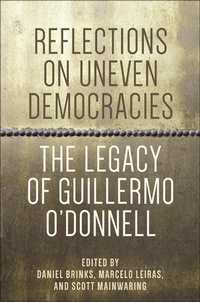
Reflections on Uneven Democracies
The Legacy of Guillermo O'Donnell
Published on 17. November 2014
432 pages
978-1-4214-1461-4 (ISBN)
Description

A tour-de-force analysis of the current state of democracy studies as seen through the scholarly legacy of Guillermo O'Donnell.
Winner of the CHOICE Outstanding Academic Title of the Choice ACRL
The third wave of democratization produced a wealth of enduring social science. Beginning in the 1970s, it prompted scholars to develop important theories on authoritarian breakdowns and transitions to democracy. No one in the field was more influential than Guillermo O'Donnell (1936-2011), whose pathbreaking work shaped the scholarship of generations of social scientists.
Reflections on Uneven Democracies honors the legacy of O'Donnell's research by advancing debates related to his work on democracy. Drawing together a veritable Who's Who of eminent scholars-including two of O'Donnell's closest collaborators, Philippe Schmitter and Laurence Whitehead-the volume examines issues related to democratic breakdowns and stability, the nature and quality of new democracies, institutional strength, the rule of law, and delegative democracy.
This reexamination of some of the most influential arguments about democracy of the past forty years leads to original approaches and insights for a new era of democracy studies. Students of democracy and institutional performance, both Latin Americanists and comparativists more generally, will find this essential reading.
Winner of the CHOICE Outstanding Academic Title of the Choice ACRL
The third wave of democratization produced a wealth of enduring social science. Beginning in the 1970s, it prompted scholars to develop important theories on authoritarian breakdowns and transitions to democracy. No one in the field was more influential than Guillermo O'Donnell (1936-2011), whose pathbreaking work shaped the scholarship of generations of social scientists.
Reflections on Uneven Democracies honors the legacy of O'Donnell's research by advancing debates related to his work on democracy. Drawing together a veritable Who's Who of eminent scholars-including two of O'Donnell's closest collaborators, Philippe Schmitter and Laurence Whitehead-the volume examines issues related to democratic breakdowns and stability, the nature and quality of new democracies, institutional strength, the rule of law, and delegative democracy.
This reexamination of some of the most influential arguments about democracy of the past forty years leads to original approaches and insights for a new era of democracy studies. Students of democracy and institutional performance, both Latin Americanists and comparativists more generally, will find this essential reading.
More details
Language
English
Place of publication
Baltimore
United States
Target group
College/higher education
Illustrations
19 s/w Zeichnungen
19 Line drawings, black and white
File size
4,80 MB
ISBN-13
978-1-4214-1461-4 (9781421414614)
DOI
10.1353/book.49254
Copyright in bibliographic data and cover images is held by Nielsen Book Services Limited or by the publishers or by their respective licensors: all rights reserved.
Schweitzer Classification
Other editions
Additional editions
Daniel Brinks | Marcelo Leiras | Scott Mainwaring
Reflections on Uneven Democracies
The Legacy of Guillermo O'Donnell
Book
11/2014
Johns Hopkins University Press
€74.00
Shipment within 10-20 days
Daniel Brinks | Marcelo Leiras | Scott Mainwaring
Reflections on Uneven Democracies
The Legacy of Guillermo O'Donnell
Book
11/2014
Johns Hopkins University Press
€37.00
Shipment within 10-20 days
Persons
Daniel Brinks is an associate professor of government at the University of Texas at Austin and the author of The Judicial Response to Police Killings in Latin America: Inequality and the Rule of Law. Marcelo Leiras is an assistant professor of political science and international relations at Universidad de San Andrés in Argentina, where he is also director of the Master of Public Administration and Policy program. Scott Mainwaring is the Eugene and Helen Conley Professor of Political Science at the University of Notre Dame. He is the coauthor of Democracies and Dictatorships in Latin America: Emergence, Survival, and Fall.
Content
Preface
Introduction. Guillermo O'Donnell and the Study of Democracy
Part I: Democratic Breakdowns, Survival, and Transitions
Chapter 1. Democratic Breakdown and Survival in Latin America, 1945-2005
Chapter 2. Argentina's Democracy Four Decades after Modernization and Bureaucratic-Authoritarianism
Chapter 3. Reflections on "Transitology": Before and After
Part II: The Political Economy of Democracy and Authoritarianism
Chapter 4. Rentier Populism and the Rise of Super-presidents in South America
Chapter 5. Democracy and Markets: Notes on a Twenty-First-Century Paradox
Chapter 6. Inequality and Democracy: Latin American Lessons for the United States
Chapter 7. Economic Performance, Political Competition, and Regime Stability in Postwar Latin America
Part III: Weak Formal Institutions, Rule of Law, and Delegate Democracy
Chapter 8. Theorizing a Moving Target: O'Donnell's Changing Views of Postauthoritarian Regimes
Chapter 9. Building Institutions on Weak Foundations: Lessons from Latin America
Chapter 10. Inequality and the Rule of Law: Ineffective Rights in Latin American Democracies
Chapter 11. Unpacking Delegative Democracy: Digging into the Empirical Content of a Rich Theoretical Concept
Chapter 12. Accountability Deficits of Delegative Democracy
Part IV: Human Agency and the Quality of Democracy
Chapter 13. Democracy, Agency, and the Classification of Political Regimes
Chapter 14. Democracy and Democratization: Guillermo O'Donnell's Late Attempt to Rework Democratic Theory
Part V: Guillermo O'Donnell and the Study of Politics
Chapter 15. "A mí, sí, me importa": Guillermo O'Donnell's Approach to Theorizing with Normative and Comparative Intent
Conclusion. Studying Big Political Issues
Timeline
References
List of Contributors
Index
Introduction. Guillermo O'Donnell and the Study of Democracy
Part I: Democratic Breakdowns, Survival, and Transitions
Chapter 1. Democratic Breakdown and Survival in Latin America, 1945-2005
Chapter 2. Argentina's Democracy Four Decades after Modernization and Bureaucratic-Authoritarianism
Chapter 3. Reflections on "Transitology": Before and After
Part II: The Political Economy of Democracy and Authoritarianism
Chapter 4. Rentier Populism and the Rise of Super-presidents in South America
Chapter 5. Democracy and Markets: Notes on a Twenty-First-Century Paradox
Chapter 6. Inequality and Democracy: Latin American Lessons for the United States
Chapter 7. Economic Performance, Political Competition, and Regime Stability in Postwar Latin America
Part III: Weak Formal Institutions, Rule of Law, and Delegate Democracy
Chapter 8. Theorizing a Moving Target: O'Donnell's Changing Views of Postauthoritarian Regimes
Chapter 9. Building Institutions on Weak Foundations: Lessons from Latin America
Chapter 10. Inequality and the Rule of Law: Ineffective Rights in Latin American Democracies
Chapter 11. Unpacking Delegative Democracy: Digging into the Empirical Content of a Rich Theoretical Concept
Chapter 12. Accountability Deficits of Delegative Democracy
Part IV: Human Agency and the Quality of Democracy
Chapter 13. Democracy, Agency, and the Classification of Political Regimes
Chapter 14. Democracy and Democratization: Guillermo O'Donnell's Late Attempt to Rework Democratic Theory
Part V: Guillermo O'Donnell and the Study of Politics
Chapter 15. "A mí, sí, me importa": Guillermo O'Donnell's Approach to Theorizing with Normative and Comparative Intent
Conclusion. Studying Big Political Issues
Timeline
References
List of Contributors
Index
