

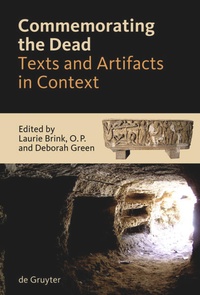
Commemorating the Dead
Description

The distinctions and similarities among Roman, Jewish, and Christian burials can provide evidence of social networks, family life, and, perhaps, religious sensibilities. Is the Roman development from columbaria to catacombs the result of evolving religious identities or simply a matter of a change in burial fashions? Do the material remains from Jewish burials evidence an adherence to ancient customs, or the adaptation of rituals from surrounding cultures? What Greco-Roman funerary images were taken over and "baptized" as Christian ones? The answers to these and other questions require that the material culture be viewed, whenever possible, in situ , through multiple disciplinary lenses and in light of ancient texts. Roman historians (John Bodel, Richard Saller, Andrew Wallace-Hadrill), archaeologists (Susan Stevens, Amy Hirschfeld), scholars of rabbinic period Judaism (Deborah Green), Christian history (Robin M. Jensen), and the New Testament (David Balch, Laurie Brink, O.P., Margaret M. Mitchell, Carolyn Osiek, R.S.C.J.) engaged in a research trip to Rome and Tunisia to investigate imperial period burials first hand. Commemorting the Dead is the result of a three year scholarly conversation on their findings.
Reviews / Votes
"Ein Abkürzungsverzeichnis, eine ausführliche Bibliographie und ein Register machen diesen höchst verdienstvollen Band zu einer inspirierenden Grundlage für weitere Forschungen zur antiken Bestattungskultur und zum Platz des frühen Christentums in seiner römischen Mitwelt."Jürgen Zangenberg in: Theologische Literaturzeitung 7-8/2011 "In Commemorating the Dead, scholars provide perceptive and thought-provoking insights into many of these questions. Their research stimulates and raises critical questions for on-going research."Terri Bednarz in: Catholic Library World 4/2010 "[...] so handelt es sich [...] um einen sehr gelungenen Beitrag zur Diskussion um die Geschichte der spätantiken Bestattungsbräuche."Schmitz-Esser in: Sehepunkte.de 9/2009More details
Other editions
Additional editions
Persons
Content
2 - Table of Contents [Seite 13]
3 - Introduction [Seite 15]
4 - Chapter 1. An Overview of the Intellectual History of Catacomb Archaeology [Seite 25]
5 - Chapter 2. Housing the Dead: The Tomb as House in Roman Italy [Seite 53]
6 - Chapter 3. Commemorating the Dead in the Communal Cemeteries of Carthage [Seite 93]
7 - Chapter 4. Dining with the Dead: From the Mensa to the Altar in Christian Late Antiquity [Seite 121]
8 - Chapter 5. Sweet Spices in the Tomb: An Initial Study on the Use of Perfume in Jewish Burials [Seite 159]
9 - Chapter 6. From Columbaria to Catacombs: Collective Burial in Pagan and Christian Rome [Seite 191]
10 - Chapter 7. Roman and Christian Burial Practices and the Patronage of Women [Seite 257]
11 - Chapter 8. From Endymion in Roman Domus to Jonah in Christian Catacombs: From Houses of the Living to Houses for the Dead. Iconography and Religion in Transition [Seite 287]
12 - Chapter 9. Looking for Abercius: Reimagining Contexts of Interpretation of the "Earliest Christian Inscription" [Seite 317]
13 - Backmatter [Seite 351]
