

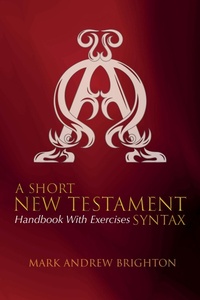
A Short New Testament Syntax
Handbook with Exercises
Published on 11. April 2018
126 pages
978-1-5326-4557-0 (ISBN)
Description

Second year students of New Testament Greek need to review grammatical terminology and categories of syntax. Although reference Grammars have been published for researchers, they are cumbersome for this purpose. This handbook is written for these students. It provides concise descriptions for the major categories of New Testament syntax and is accompanied by a dictionary of grammatical terms and translation exercises.
More details
Other editions
Additional editions
Book
04/2018
Wipf & Stock Publishers
€18.30
Shipment within 3-4 weeks
Book
04/2018
Wipf & Stock Publishers
€37.50
Shipment within 3-4 weeks
Person
Mark Andrew Brighton is a Professor of Biblical Languages and Literature at Concordia University in Irvine, California. He is the author of The Sicarii in Josephus's Judean War (2009).
Content
- Intro
- Title Page
- Preface
- Chapter 1: Grammatical Terminology
- Chapter 2: Noun Cases
- A. Vocative
- B. Nominative
- C. Genitive
- D. Dative
- E. Accusative
- Chapter 3: Syntax of the Greek Article
- A. Articles with Nouns
- B. Articles as Pronouns
- C. Articles as Substantives
- D. Articles as Syntactical Markers
- Chapter 4: Tenses of the Verb
- A. Tense Aspect
- B. Tenses in the Indicative
- C. Tenses in Indirect Statements
- Chapter 5: Voices of the Verb
- A. Active Voice
- B. Middle Voice
- C. Passive Voice
- D. Middle Only Verbs (Deponent)
- Chapter 6: Indicative Mood
- A. Independent Clauses
- B. Conditional Statements
- C. With ?t?
- Chapter 7: Subjunctive Mood
- A. Hortatory
- B. Deliberative
- C. Prohibitions
- D. ??a Plus Subjunctive
- E. Future More Vivid Constructions
- F. Present General Constructions
- G. Fear Clauses
- Chapter 8: Optative Mood
- A. Wishes
- B. Potential
- C. Future Less Vivid Formulas
- D. Dependent Clauses in Secondary Sequence
- Chapter 9: Infinitive
- A. Without the Article
- B. With the Article
- C. Prepositions with the Articular Infinitive
- Chapter 10: Imperatives and Prohibitions
- A. Direct Command
- B. Entreaty
- C. Prohibitions
- Chapter 11: Participles
- A. Attributive
- B. Predicate
- C. Supplementary
- D. Noun Clause
- E. Genitive Absolute
- F. Tenses of the Participle
- Chapter 12: Conditional Statements
- A. Simple Conditions (First Class Conditions)
- B. Future More Vivid (Third Class Conditions)
- C. Future Less Vivid (Fourth Class Conditions)
- D. Present General (Third Class Conditions)
- E. Present Contrary to Fact (Second Class Conditions)
- F. Past Contrary to Fact (Second Class Conditions)
- Chapter 13: Uses of ?? and µ?
- A. General Usage
- B. Double Negatives
- C. In Questions
- D. Emphatic Negative
- Chapter 14: Aramaic Constructions
- A. ?a? ????et? (????et? d?)
- B. ?a?
- C. ?d??
- Chapter 15: Translation and Composition Exercises
- Grammar Review-Emphasizing the Present Indicative
- Grammar Review: Emphasizing the Imperfect and Aorist Indicative
- Grammar Review: Emphasizing Strong Verbs
- Noun Cases
- Verb Tenses and Voices
- Subjunctive
- Participles
- Infinitive
- Conditional Statements
