

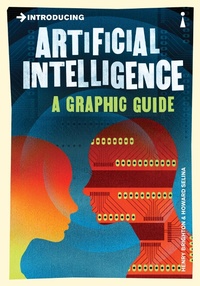
Introducing Artificial Intelligence
A Graphic Guide
Published on 3. September 2015
176 pages
978-1-78578-009-7 (ISBN)
Description

Half a century of research has resulted in machines capable of beating the best human chess players, and humanoid robots that can interact. But can machines really think? Is the mind just a complicated computer program?
Introducing Artificial Intelligence focuses on the issues behind one of science's most difficult problems.
More details
Other editions
Additional editions
Book
05/2012
Icon Books
€11.50
Shipment within 3-4 weeks
Persons
Content
- Intro
- Cover
- Title Page
- Copyright
- Contents
- Artificial Intelligence
- Defining the AI Problem
- What Is an Agent
- AI as an Empirical Science
- Alien-AI Engineering
- Solving the AI Problem
- Ambition Within Limits
- Taking AI to its Limits: Immortality and Transhumanism
- Super-Human Intelligence
- Neighbouring Disciplines
- AI and Psychology
- Cognitive Psychology
- Cognitive Science
- AI and Philosophy
- The Mind-Body Problem
- Ontology and Hermeneutics
- A Positive Start
- Optimism and Bold Claims
- Intelligence and Cognition
- Mimicry of Life
- Complex Behaviour
- Is Elsie Intelligent?
- Clever Hans: A Cautionary Tale
- Language, Cognition and Environment
- Two Strands Concerning the Al Problem
- Al's Central Dogma: Cognitivism
- What is Computation?
- The Turing Machine
- The Brain as a Computing Device
- Universal Computation
- Computation and Cognitivism
- The Machine Brain
- Functionalist Separation of Mind from Brain
- The Physical Symbol Systems Hypothesis
- A Theory of Intelligent Action
- Could a Machine Really Think?
- The Turing Test
- The Loebner Prize
- Problems with the Turing Test
- Inside the Machine: Searle's Chinese Room
- Searle's Chinese Room
- One Answer to Searle
- Applying Complexity Theory
- Is Understanding an Emergent Property?
- Machines Built From the Right Stuff
- AI and Dualism
- The Brain Prosthesis Experiment
- Roger Penrose and Quantum Effects
- Penrose and Gödel's Theorem
- Quantum Gravity and Consciousness
- Is AI Really About Thinking Machines?
- Tackling the Intentionality Problem
- Investigating the Cognitivist Stance
- Beyond Elsie
- Cognitive Modelling
- A Model Is Not an Explanation
- The Nematode
- Really Understanding Behaviour
- Reducing the Level of Description
- Simplifying the Problem
- Decompose and Simplify
- The Module Basis
- The Micro-World
- Early Successes: Game Playing
- Self-Improving Program
- Representing the Game Internally
- Brute Force "Search Space" Exploration
- Infinite Chess Spaces
- Getting By With Heuristics
- Deep Blue
- Lack of Progress
- Giving Machines Knowledge
- Logic and Thought
- The CYC Project and Brittleness
- Can the CYC Project Succeed?
- A Cognitive Robot: Shakey
- Shakey's Environment
- Sense-Model-Plan-Act
- Limited to Plan
- New Shakey
- Shakey's Limitations
- The Connectionist Stance
- Biological Influences
- Neural Computation
- Neural Networks
- The Anatomy of a Neural Network
- Biological Plausibility
- Parallel Distributed Processing
- Parallel vs. Serial Computation
- Robustness and Graceful Degradation
- Machine Learning and Connectionism
- Learning in Neural Networks
- Local Representations
- Distributed Representations
- Complex Activity
- Interpreting Distributed Representations
- Complementary Approaches
- Can Neural Networks Think?
- The Chinese Gym
- The Symbol Grounding Problem
- Symbol Grounding
- Breaking the Circle
- The Demise of AI?
- New AI
- Micro-Worlds are Unlike the Everyday World
- The Problems of Conventional AI
- The New Argument from Evolution
- The Argument from Biology
- Non-Cognitive Behaviour
- The Argument from Philosophy
- Against Formalism
- No Disembodied Intelligence
- Agents in the Real World
- The New AI
- The Second Principle of Situatedness
- The Third Principle of Bottom-Up Design
- Behaviour-Based Robotics
- Behaviours as Units of Design
- The Robot Genghis
- Behaviour by Design
- Collections of Agents
- The Talking Heads Experiment
- Categorizing Objects
- The Naming Game
- A Feedback Process
- Self-Organization in Cognitive Robots
- The Future
- The Near Future
- The Nearer Future
- The Sony Dream Robot
- All Singing, All Dancing
- The SDR is a Serious Robot
- Future Possibilities
- Moravec's Prediction
- AI: A New Kind of Evolution?
- Evolution Without Biology
- A Forecast
- Mechanized Cognition
- The Future Meeting of the Paths
- Further Reading
- The Author and Artist
- Acknowledgements
- Index
