

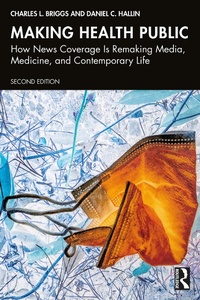
Making Health Public
How News Coverage Is Remaking Media, Medicine, and Contemporary Life
2nd Edition
Published on 13. August 2024
310 pages
978-1-040-09207-1 (ISBN)
Description

This book examines the relationship between media and medicine. Drawing on insights from anthropology, linguistics, and media studies, it considers the fundamental role of news coverage in constructing wider cultural understandings of health and disease. The authors advance the notion of 'biomediatization' and demonstrate how health knowledge is co-produced through connections between dispersed sites of knowledge making and through multiple forms of expertise.
The chapters offer an innovative combination of media content analysis and ethnographic data on the production and circulation of health news, drawing on work with journalists, clinicians, health officials, medical researchers, marketers, and audiences. New to this edition are new case studies, in particular about the COVID-19 pandemic. The first case study looks at pharmaceutical and biotech news, and how journalists portray the flow of information across the boundaries between science and business. The next two case studies examine pandemic news, beginning with the 2009 H1N1 "swine flu" pandemic and continuing to the COVID-19 pandemic. The final case study examines the treatment of race and racism in health news, looking at the ways it interacts with cultural constructions of health citizenship, and the forces that have produced a shift from deracialization of health news to a much stronger focus on race and racism in contemporary health news.
This book is ideal for undergraduate students and scholars across the social sciences, health sciences, cultural studies, and journalism.
The chapters offer an innovative combination of media content analysis and ethnographic data on the production and circulation of health news, drawing on work with journalists, clinicians, health officials, medical researchers, marketers, and audiences. New to this edition are new case studies, in particular about the COVID-19 pandemic. The first case study looks at pharmaceutical and biotech news, and how journalists portray the flow of information across the boundaries between science and business. The next two case studies examine pandemic news, beginning with the 2009 H1N1 "swine flu" pandemic and continuing to the COVID-19 pandemic. The final case study examines the treatment of race and racism in health news, looking at the ways it interacts with cultural constructions of health citizenship, and the forces that have produced a shift from deracialization of health news to a much stronger focus on race and racism in contemporary health news.
This book is ideal for undergraduate students and scholars across the social sciences, health sciences, cultural studies, and journalism.
Reviews / Votes
"This fresh, vivid, and surprising book will change how you think about the massive circulation of news about health and disease. Drawing on extensive knowledge and research, Briggs and Hallin show how the tight suturing of biomedicine and the media powerfully affects our culture, our politics, and our identities."Steven Epstein, Northwestern University, USA
"This new edition of Making Health Public further confirms its originality and unique contributions. Like the rest of the book, the two new chapters bring up important insights for the study of questions at the intersection of public health, journalism studies, and political communication."
Silvio R. Waisbord, George Washington University, USA
More details
Edition
2nd edition
Language
English
Place of publication
London
United Kingdom
Publishing group
Taylor & Francis Ltd
Target group
College/higher education
Professional and scholarly
Illustrations
7 Tables, black and white; 25 Halftones, black and white; 25 Illustrations, black and white
ISBN-13
978-1-040-09207-1 (9781040092071)
Copyright in bibliographic data and cover images is held by Nielsen Book Services Limited or by the publishers or by their respective licensors: all rights reserved.
Schweitzer Classification
Other editions
Additional editions
Charles L. Briggs | Daniel C. Hallin
Making Health Public
How News Coverage Is Remaking Media, Medicine, and Contemporary Life
Book
08/2024
2nd Edition
Routledge
€206.90
Shipment within 10-20 days
Charles L. Briggs | Daniel C. Hallin
Making Health Public
How News Coverage Is Remaking Media, Medicine, and Contemporary Life
Book
08/2024
2nd Edition
Routledge
€60.70
Shipment within 10-20 days

Charles L. Briggs
Making Health Public
How News Coverage Is Remaking Media, Medicine, and Contemporary Life
Book
07/2024
Taylor & Francis
Unfortunately, price unknown
Available (delivery time upon request)
Persons
Charles L. Briggs is Distinguished Professor of Anthropology at UC Berkeley. He is a Fellow of the American Academy of Arts and Sciences and the John Simon Guggenheim Foundation. His work combines linguistic and medical anthropology with socio-cultural anthropology and folkloristics.
Daniel C. Hallin is Distinguished Professor of Communication, Emeritus, at the University of California, San Diego, and is a Fellow of the International Communication Association. His work concerns journalism, political communication, and the comparative analysis of media systems.
Daniel C. Hallin is Distinguished Professor of Communication, Emeritus, at the University of California, San Diego, and is a Fellow of the International Communication Association. His work concerns journalism, political communication, and the comparative analysis of media systems.
Content
Introduction
Part I - Toward a Framework for Studying Biomediatization
Chapter 1 - Biocommunicability: Cultural Models of Knowledge about Health
Chapter 2 - The Daily Work of Biomediatization
Chapter 3 - What Does this Mean "For the Rest of Us?": Frames, Voices, and the Journalistic Mediation of Health and Medicine
Part II - Biomediatization Up Close: Four Case Studies
Chapter 4 - Finding the "Buzz," Patrolling the Boundaries: Reporting Pharma and Biotech
Chapter 5 - "You Have to Hit It Hard, Hit It Early": Biomediatizing the 2009 H1N1 Epidemic
Chapter 6 - "We're All in this Together"?: Biomediatization of the COVID-19 Pandemic
Chapter 7 - "We Have to Put that Four-Letter Word, 'Race,' on the Table": Voicing and Silencing Race and Ethnicity in News Coverage of Health
Chapter 8 - Conclusion
Part I - Toward a Framework for Studying Biomediatization
Chapter 1 - Biocommunicability: Cultural Models of Knowledge about Health
Chapter 2 - The Daily Work of Biomediatization
Chapter 3 - What Does this Mean "For the Rest of Us?": Frames, Voices, and the Journalistic Mediation of Health and Medicine
Part II - Biomediatization Up Close: Four Case Studies
Chapter 4 - Finding the "Buzz," Patrolling the Boundaries: Reporting Pharma and Biotech
Chapter 5 - "You Have to Hit It Hard, Hit It Early": Biomediatizing the 2009 H1N1 Epidemic
Chapter 6 - "We're All in this Together"?: Biomediatization of the COVID-19 Pandemic
Chapter 7 - "We Have to Put that Four-Letter Word, 'Race,' on the Table": Voicing and Silencing Race and Ethnicity in News Coverage of Health
Chapter 8 - Conclusion
