

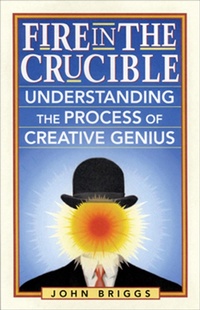
Fire in the Crucible
Understanding the Process of Creative Genius
Published on 23. June 2023
455 pages
978-1-60925-657-9 (ISBN)
Description

The co-author of
Looking Glass Universe probes the nature of creativity and reveals the strategies and tactics of some of our greatest creative minds.
What makes geniuses different from the rest of us? What is the difference between a prodigy and a genius? Are geniuses born or made? What is creative vision and where does it come from? What are the secrets of talent? And why do great creators seem to have so many oppositions in their personalities?
In this mind-expanding investigation of creativity, John Briggs reveals that there is no special trait of genius. Geniuses are not necessarily smarter or more talented than other people, but they give their attention to subtle nuances, contradictory feelings and perceptions that others experience and ignore. By focusing on sensory nuances, geniuses create themselves.
Fire in the Crucible offers a compelling exploration of the roots of creativity and genius. Drawing on the lives and work of extraordinary scientists, artists, writers, composers, and inventors, Briggs shows how creative individuals exploit doubt and uncertainty, and the mental strategies and tactics they employ when they work. "In asking about creativity," he writes, "we are really asking about what is best, what is deepest in life." Fire in the Crucible draws the reader into an eye-opening journey through the inner workings of some of the greatest creative minds of all time-and allows us to understand more deeply the nature of creativity in our own lives and work.
Praise for Fire in the Crucible
"His refreshingly open-ended approach brings us closer to the elusive nature of genius." - Publishers Weekly
"An exuberant voyage through the brains and minds of creative individuals, chock-full of intriguing scientific discoveries and puzzling paradoxes." -Howard Gardner, Harvard University, author of Multiple Intelligences
What makes geniuses different from the rest of us? What is the difference between a prodigy and a genius? Are geniuses born or made? What is creative vision and where does it come from? What are the secrets of talent? And why do great creators seem to have so many oppositions in their personalities?
In this mind-expanding investigation of creativity, John Briggs reveals that there is no special trait of genius. Geniuses are not necessarily smarter or more talented than other people, but they give their attention to subtle nuances, contradictory feelings and perceptions that others experience and ignore. By focusing on sensory nuances, geniuses create themselves.
Fire in the Crucible offers a compelling exploration of the roots of creativity and genius. Drawing on the lives and work of extraordinary scientists, artists, writers, composers, and inventors, Briggs shows how creative individuals exploit doubt and uncertainty, and the mental strategies and tactics they employ when they work. "In asking about creativity," he writes, "we are really asking about what is best, what is deepest in life." Fire in the Crucible draws the reader into an eye-opening journey through the inner workings of some of the greatest creative minds of all time-and allows us to understand more deeply the nature of creativity in our own lives and work.
Praise for Fire in the Crucible
"His refreshingly open-ended approach brings us closer to the elusive nature of genius." - Publishers Weekly
"An exuberant voyage through the brains and minds of creative individuals, chock-full of intriguing scientific discoveries and puzzling paradoxes." -Howard Gardner, Harvard University, author of Multiple Intelligences
More details
Other editions
Additional editions
Book
07/2004
Phanes Press,U.S.
€24.00
Shipment within 3-4 weeks
Person
John Briggs is a professor of English of Western Connecticut State University, has taught at the New School for Social Research in New York, and holds a doctorate in aesthetics and psychology. He is the author of Fractals: The Patterns of Chaos, and co-author, with physicist F. David Peat, of Turbulent Mirror: An Illustrated Guide to Chaos Theory and the Science of Wholeness, and Seven Life Lessons of Chaos.
Content
- Cover
- Title Page
- Copyright Page
- Dedication Page
- Table of Contents
- Acknowledgments
- Prologue
- Introduction Smoke from the Fire-A Parable Some Prejudices and Premises Sources Genius Preliminarily Defined
- Part 1: Vision and the Prima Materia
- Overview
- Chapter 1: Qualities of Mind-Einstein's Compass Hidden Themes Where the Needle Pointed
- Chapter 2: Subtle Vibrations-The Light Through the Window Other Cases of Nuance
- Chapter 3: The Open Brain-Nuance Cycles The Possibility Cloud A Caveat: Edison's Game
- Chapter 4: As Above, So Below-Part Prologue to the Whole The Whole Truth At the Center of Things The Work as a Whole: the Individual-Universal Equation
- Chapter 5: Contraries-Some Polar Chemistry Ambivalence Negative Capability
- Chapter 6: Omnivalence-The Hunger of 'More' Creators and Mystics A Myth of Creativity
- Part 2: The Distilling Agents
- Overview
- Chapter 7: Quicksilver-What Measure of Genius: the Search for the Brainpower Secret In the Prodigy Lab Lab Lessons
- Chapter 8: Mercurial Maps-The Many-Intelligences Approach Of Talents and Feedback Three Funny Things About Talent What Goes Around Comes Around
- Chapter 9: Insight Architecture-Buttresses of Light Thinking Like a Mirror The Creative Mind's Sorting Processes Panoramic Images
- Chapter 10: The Absorbing Flame-On the Hot Side of Mercury Two Apparent Paradoxes of Absorption Absorption: Its Nature and Nurture Child's Play, Courage and Other Conundrums
- Chapter 11: To Burn with One's Time-Fires of Heaven No, Earth Some Trips Around the Sulphuric Mobius Strip Co-incidence Twists History and the Individual: Which Distills Which?
- Chapter 12: Madness and the Mirror-Maker's Nightmare-How Dangerous Is It? On the Edge of Reality
- Part 3: The Great Work
- Overview
- Chapter 13: Constructing the Egg-Crystallizing The Unfolding Context The Daily Obsessions
- Chapter 14: Germinations from Salt-The Final Reagent The Whole of the Virus Different Germ Experiences Two Examples
- Chapter 15: More Salt Grains to Stone-Turning Over a Few Germs The Birth of a Painting Tales of Two Composers Where Was the Germ for Relativity?
- Chapter 16: Companions in Quest-The Myth of the Lone Creator Indirect and Domestic Collaborations Direct Collaborations Dance to the Grail
- Epilogue
- Notes
- Index
- Back Cover
