

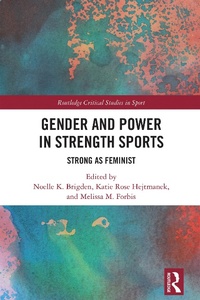
Gender and Power in Strength Sports
Strong As Feminist
1st Edition
Published on 5. May 2023
242 pages
978-1-000-87282-8 (ISBN)
Description

This book explores strength sports as a site of political contestation and a platform for insurgent gender practices. It contributes to our understanding of key themes in the study of sport, such as feminism, power, the body and identity.
Drawing together interdisciplinary work spanning political science, sociology, gender studies, and biological and cultural anthropology, the book argues that in the face of ongoing embodied precarity, strength sports have become a complex form of both resistance to, and reproduction of, patriarchy. This argument also challenges traditional understandings and definitions of "strength." Covering recreational-level participation and elite athletics, across experiential/individual, local, national, transnational, and global scales, the book explores diverse topics such as the pregnant strength athlete, the status of trans women in strength sports, and the gendered dimensions of online fitness communities during the COVID-19 pandemic. In so doing, it traces power dynamics and the interplay among multiple oppressions.
Showcasing important empirical and activist research, this book is fascinating reading for anybody with an interest in women's sport, women's studies, gender studies, the sociology of sport, strength and conditioning, feminist politics, or cultural studies.
Drawing together interdisciplinary work spanning political science, sociology, gender studies, and biological and cultural anthropology, the book argues that in the face of ongoing embodied precarity, strength sports have become a complex form of both resistance to, and reproduction of, patriarchy. This argument also challenges traditional understandings and definitions of "strength." Covering recreational-level participation and elite athletics, across experiential/individual, local, national, transnational, and global scales, the book explores diverse topics such as the pregnant strength athlete, the status of trans women in strength sports, and the gendered dimensions of online fitness communities during the COVID-19 pandemic. In so doing, it traces power dynamics and the interplay among multiple oppressions.
Showcasing important empirical and activist research, this book is fascinating reading for anybody with an interest in women's sport, women's studies, gender studies, the sociology of sport, strength and conditioning, feminist politics, or cultural studies.
More details
Series
Edition
1. Auflage
Language
English
Place of publication
London
United Kingdom
Publishing group
Taylor & Francis Ltd
Target group
College/higher education
Illustrations
6 Tables, black and white; 11 Halftones, black and white; 11 Illustrations, black and white
ISBN-13
978-1-000-87282-8 (9781000872828)
Copyright in bibliographic data and cover images is held by Nielsen Book Services Limited or by the publishers or by their respective licensors: all rights reserved.
Schweitzer Classification
Other editions
Additional editions
Noelle K. Brigden | Katie Rose Hejtmanek | Melissa M. Forbis
Gender and Power in Strength Sports
Strong As Feminist
Book
10/2024
1st Edition
Routledge
€65.10
Shipment within 10-20 days
Noelle K. Brigden | Katie Rose Hejtmanek | Melissa M. Forbis
Gender and Power in Strength Sports
Strong As Feminist
Book
05/2023
1st Edition
Routledge
€196.30
Shipment within 10-20 days
Persons
Noelle K. Brigden is Associate Professor of political science at Marquette University, USA, where she teaches courses on human security, international migration, the global politics of street gangs, international relations, body politics, and peace & trauma in Central America. She is the 2022 IPF World Masters Classic Powerlifting Champion for the 47kg weight class and has achieved US national powerlifting records.
Katie Rose Hejtmanek is Associate Professor of anthropology, and children and youth studies at Brooklyn College, CUNY, USA. Her research investigates cultural processes of self-transformation in a mental institution for children, CrossFit gyms, and strength sports collectives. She competes in Olympic weightlifting, winning her age and weight class at the IWF Masters World Championships in 2022.
Melissa M. Forbis is a cultural anthropologist with a research focus on social movements, Indigenous rights, and gender in Latin America. Her current research examines sports practices and social change. Her teaching includes courses on the anthropology of sport, and gender and sexuality at New York University and Brooklyn College, CUNY, USA. She is a three-time competitor at IPF World Masters Powerlifting Championships and is a Trauma-Informed Weightlifting-certified strength coach.
Katie Rose Hejtmanek is Associate Professor of anthropology, and children and youth studies at Brooklyn College, CUNY, USA. Her research investigates cultural processes of self-transformation in a mental institution for children, CrossFit gyms, and strength sports collectives. She competes in Olympic weightlifting, winning her age and weight class at the IWF Masters World Championships in 2022.
Melissa M. Forbis is a cultural anthropologist with a research focus on social movements, Indigenous rights, and gender in Latin America. Her current research examines sports practices and social change. Her teaching includes courses on the anthropology of sport, and gender and sexuality at New York University and Brooklyn College, CUNY, USA. She is a three-time competitor at IPF World Masters Powerlifting Championships and is a Trauma-Informed Weightlifting-certified strength coach.
Content
List of Contributors
Acknowledgments
Introduction - Strong A(s) F(eminist)
Interlude 1: Bulky Is Not the Worst Thing a Woman Can Be
Part I: The Public Body
1. Strength Over Gender? Discussing and Presenting the Ambivalent Female Strength in the CrossFit Games 2019
2. Lingering Muscles, Latent "Threats": Contesting the Exceptional and Threatening Status of Trans Women in Strength Sports
3. Fit to Mother: Risk and Self-Care in the Pregnant Strength Athlete
Interlude 2: Deep Analogies and the Power of Heavy Lifting
Part II: The Disciplined Body
4. Women's Empowerment through Strength Sports-and Its Limits: The Case of the German American Turners, 1880s-1920s
5. On Death and Fitness: Hero Workouts, US Militarism, and the Necrosociality of CrossFit
Interlude 3: "Be Careful, If You Lift too Heavy Your Boobs Will Shrink"
Part III: The Social Body
6. Transformative Writing and Naming: Gimnasio Elba y Celina
7. Between My Breaths: CrossFit As A Depathologizing Healing Strategy for Sexual Trauma Survivors
8. 'I Exercise with Others in About 6-7 Online Fitness Communities': Women's Exercise Routine and Resilience During COVID-19 Stay-at-Home Orders
Epilogue - Judging the Lift: Are Strength Sports Insurgent or Reactionary Practices?
Index
Acknowledgments
Introduction - Strong A(s) F(eminist)
Interlude 1: Bulky Is Not the Worst Thing a Woman Can Be
Part I: The Public Body
1. Strength Over Gender? Discussing and Presenting the Ambivalent Female Strength in the CrossFit Games 2019
2. Lingering Muscles, Latent "Threats": Contesting the Exceptional and Threatening Status of Trans Women in Strength Sports
3. Fit to Mother: Risk and Self-Care in the Pregnant Strength Athlete
Interlude 2: Deep Analogies and the Power of Heavy Lifting
Part II: The Disciplined Body
4. Women's Empowerment through Strength Sports-and Its Limits: The Case of the German American Turners, 1880s-1920s
5. On Death and Fitness: Hero Workouts, US Militarism, and the Necrosociality of CrossFit
Interlude 3: "Be Careful, If You Lift too Heavy Your Boobs Will Shrink"
Part III: The Social Body
6. Transformative Writing and Naming: Gimnasio Elba y Celina
7. Between My Breaths: CrossFit As A Depathologizing Healing Strategy for Sexual Trauma Survivors
8. 'I Exercise with Others in About 6-7 Online Fitness Communities': Women's Exercise Routine and Resilience During COVID-19 Stay-at-Home Orders
Epilogue - Judging the Lift: Are Strength Sports Insurgent or Reactionary Practices?
Index
