

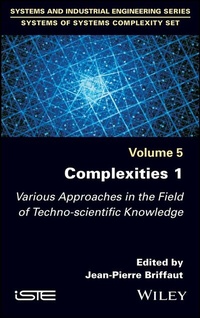
Complexities 1
Description

Over the course of the twentieth century, a science of complexity has emerged in an ever-increasing number of fields (computer science, artificial intelligence, engineering, among others), and has now become an integral part of everyday life. As a result, everyone is confronted with increasingly complex situations that need to be understood and analyzed from a global perspective, to ensure the sustainability of our common future.
Complexities 1 analyzes how complexity is understood and dealt with in the fields of cybersecurity, medicine, mathematics and information. This broad spectrum of disciplines shows that all fields of knowledge are challenged by complexity. The following volume, Complexities 2, examines the social sciences and humanities in relation to complexity.
More details
Other editions
Additional editions
Person
Jean-Pierre Briffaut is Honorary Director of Studies at the Institut Mines-Télécom, France. A member of the Institut Fredrik Bull, he is in charge of a working group on the complexity of systems of systems.
Content
Philippe KOURILSKY
Preface xiii
Jean-Pierre BRIFFAUT
Chapter 1 The Complexity of Cybersecurity 1
Thierry BERTHIER and Thomas ANGLADE
1.1 Formal approach to the complexity of cybersecurity 1
1.2 Cybersecurity in real life: Advanced persistent threats, computer networks, defense teams and complex log data 27
1.3 User and entity behavior analysis as a way of reducing complexity 39
1.4 Conclusion and future work 47
1.5 References 48
Chapter 2 Complexity and Biology: When Historical Perspectives Intersect with Epistemological Analyses 51
Céline CHERICI
2.1 Complexity throughout the history of thoughs on living 53
2.2 The living: Between potentialities and actualizations 64
2.3 Reductionist biotechnologies? 73
2.4 References 82
Chapter 3 Two Complexities: Information and Structure Content 87
Jean-Paul DELAHAYE
3.1 The simple, the random and the structured: A triangle of concepts key to a complete understanding 87
3.2 Calculation, the key to the solution 88
3.3 Thought experiment 89
3.4 Mathematical definition 90
3.5 Random complexity and structural complexity 91
3.6 Recent progress 92
3.7 Less undecidability 93
3.8 Experimentation 94
3.9 Appendices 95
3.10 References 99
Chapter 4 Leveraging Complexity in Oncology-A Data Narrative 101
Xosé M FERNÁNDEZ
4.1 Large collaborative research initiatives-the Human Genome Project 104
4.2 Human cell atlas - unraveling complexity 105
4.3 From bench to bedside 107
4.4 The battle with cancer 109
4.5 Health economics - cost is another matter 112
4.6 From molecules to medicine 115
4.7 Artificial intelligence 117
4.8 The fourth paradigm 120
4.9 Modeling the complexity of cancer 121
4.10 References 124
Chapter 5 Complexity or Complexities of Information: The Dimensions of Complexity 129
Jacques PRINTZ
5.1 Introduction 129
5.2 A brief historical overview 130
5.3 The phenomenology of complexity in systems engineering 131
5.4 The four dimensions of complexity 138
5.5 The term "simplexity": A remark on Richard Feynman's Nobel lecture 142
5.6 Computational volume: Remarks on the first quantification of complexity 144
5.7 References 151
List of Authors 153
Index 155
2
Complexity and Biology: When Historical Perspectives Intersect with Epistemological Analyses
The term "complexity" refers to the behavior of a system whose components interact with each other in a way that is difficult to predict. Beyond the reductionist breakthroughs that mark the history of biology, can we describe living phenomena as complex? When Hooke, in the 17th century, popularized the use of the microscope and highlighted the common structure of plants and animals, in so doing, did he reveal a complex world?
The subject of complexity in biology can be considered according to two themes, for which we will try to provide some answers. Indeed, complexity, from an epistemological point of view, refers, on the one hand, to the historical construction of the way in which we look at living beings and, on the other hand, from a scientific point of view, to the fact that our knowledge of the internal mechanics of living beings can be better described.
Therefore, our way of understanding biology could be conceived as a reading grid that remains dependent on a discourse that, for the sake of scientificity, seeks to reject outside its explanatory principles the arguments of teleology. This approach would be likely to lock biology into aporias marked by the eviction of concepts useful to the understanding of the world.
However, reducing biological complexity to the limits of our understanding does not permit us to understand life as the result of multiple processes that go from the microscopic scale to the subject taken as a macrocosm. Life is as complex as the set of physicochemical phenomena at the basis of vital organizations. From this point of view, biology cannot be reduced to a constructivist conception, according to which all our knowledge would depend on the way in which our understanding formalizes it. Moreover, the knowledge we have is not neutral. On the contrary, it is impregnated with representations of great historical profoundness, which sometimes seem incompatible with each other. Therefore, we approach conceptual couples, such as invariance and variability and chance and necessity.
Within living systems, complexity as a phenomenon seems to emerge in stages. Therefore, to speak of complexity implies evoking a functioning by interaction between scales of life or a biology conceived in terms of Russian nesting dolls or nested systems. Two major principles seem to intervene in a repetitive manner: the accumulation of identically replicated elements and then their arrangement in more complex sets of which these elements form parts. Chapouthier (2018) proposed to qualify these sets with the term mosaic:
In a mosaic, in the artistic sense of the term, the whole, the "totality" represented, leaves a certain autonomy of appearance to the tesserae that compose it and which retain their form, their color or their brilliance, in the same way that an organ leaves a certain autonomy of function to the cells that compose it, as with the organs that constitute an organism, an animal society to the individuals that form it, etc. (p. 4, author's translation)
This artistic metaphor makes it possible to highlight a dual approach necessary to the biological sciences toward the microscopic and the distanciation needed for the understanding of the macroscopic. Indeed, if getting closer to a mosaic allows us to observe and describe the units, the tesserae, moving away from it gives us an overall view that would be lost by the meticulous description of the parts. Both at the present scientific level and throughout history, such a ballet seems to take place, through which scientists either approach the smallest components of the living world or seek a perspective closer to the macroscopic scale.
Therefore, we provide philosophical elements to reflect on the problem of complexity through the lenses of biology, epistemology and the history of biology.
In the context of the constitution of molecular biology, the following question can be asked: would it be possible for modern biology, autonomous as a science of the living, to continually escape technical and physicochemical reductionism? Does not living matter exceed, in the knowledge that we can have of it as a whole, the limits of studies on the mechanisms that govern its parts?
First, we must recall some of the stages of biological complexity from the history of life sciences in order to highlight the interdependence of the way we look at it with the representations at work during this process of knowledge acquisition; then, in a second step, we explore the incessant game that life plays between potentialities and actualizations in order to understand to what extent biological knowledge cannot do without the concepts of invariance and potential. Finally, we examine the links between theoretical biology and contemporary biotechnologies, asking whether the relationships that bind them are not situated at the heart of a dichotomy between experimental techniques that work on the reduction of biological phenomena and a theoretical biology whose terms and principles never cease to overload them.
2.1. Complexity throughout the history of thought on living
2.1.1. The roots of thinking on complexity
From the teleological and integrative approach that Aristotle proposes on the formation of life, an idea emerges according to which the progressive development of organized structures is due to the phenomena of complexification that have occurred in a form that has the ability to repeat itself while acquiring new parts and then new functions.
If, already in Aristotle, we find the representation of a continuous interweaving of different levels of the functional complexity of the living through the interplay of plant, animal and rational souls, then we can consider that a conceptual weaving between form and function, integration and expression, but also an emergent understanding of the different forms progressively taken by the living, has been in place since antiquity. Aristotle appears as the thinker of a biology that shows a concern for an integrative explanation of life as a functional whole. This movement of reading nature implies numerous difficulties concerning the identification, classification and apprehension of the convergences and divergences that exist between species:
However, in the hierarchy of beings, the progression is made by imperceptible gaps. Among these forms that slide one over the other, it is very difficult to decide where each domain begins and ends. A sponge, who will say if it is a plant or an animal? And a coral, is it really a stone? (Jacob 1976, p. 31, author's translation)
In Aristotle (2009), we find two types of classifications - one by groups divided into subgroups, and a second more integrative and based on the concept of plural souls, where the most complex level encompasses the previous ones:
The soul is the cause or source of the living body. The terms cause and source have many senses. But the soul is the cause of its body [.]. It is (a) the source or origin of movement, it is (b) the end, it is (c) the essence of the whole living body. That it is the last, is clear; for in everything the essence is identical with the ground of its being, and here, in the case of living things, their being is to live, and of their being and their living the soul in them is the cause or source.
This entanglement of forms is visible until the 16th century, when possibilities directed by God, the soul or the cosmos still predominate. In the 17th century, a scientific project involving the deciphering and reading of nature by the human understanding was developed, proposing a reduction in its foundations and putting in continuous correlation the worlds of the inorganic and the organic, the second being founded on the first:
Philosophy is written in this grand book, the universe, which stands continually open to our [p. 238] gaze. But the book cannot be understood unless one first learns to comprehend the language and read the letters in which it is composed. It is written in the language of mathematics, and its characters are triangles, circles, and other geometric figures without which it is humanly impossible to understand a single word of it; without these, one wanders about in a dark labyrinth. (Galilei 1968, p. 232)
The explanatory power determines the value of the reductionist hypothesis. Indeed, on the condition that the complexity of nature, notably visible through its polymorphism, is reduced to the simplicity of the elements that compose it, it is a question of trying to understand it while giving leave to a universe marked by finalist discourses. It is thus not a question of possessing knowledge of all things, but of choosing signifiers likely to become consensual and which permit the internal exploration of phenomena. Until the 18th century, the concept of the living is rooted in the inanimate by virtue of the physicochemical unity of the laws of reading the world. Therefore, the reductionist reading grid, based on the resolution of the apparent complexity by the simplicity that underlies it, becomes a source of new knowledge.
In order to shed light on a mechanics that seems inaccessible outside of a finalist way of thinking, and in order to reach an objective truth, Descartes established as a methodological principle the fact of dissociating the object not only from the subject that observes it, but also from a natural tendency to conceive of the living through the prism of a pre-established harmony of the world. By reducing complex mechanisms, sets of organs or complete organisms to...
