

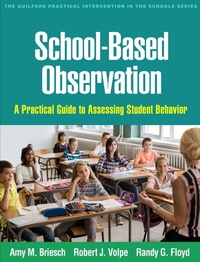
School-Based Observation
A Practical Guide to Assessing Student Behavior
Published on 16. January 2018
270 pages
978-1-4625-3355-8 (ISBN)
Description

School psychologists, behavior specialists, school counselors, school social workers, special educators, teachers, administrators, and child clinical psychologists working with children ages 4-17 (grades PreK-12); graduate students in these areas. May serve as a text in graduate-level school psychology and special education courses.
More details
Other editions
Additional editions
Amy M. Briesch | Robert J. Volpe | Randy G. Floyd
School-Based Observation
A Practical Guide to Assessing Student Behavior
Book
03/2018
1st Edition
Guilford Press
€42.00
Shipment within 15-20 days
Persons
Amy M. Briesch, PhD, is Associate Professor in the Department of Applied Psychology at Northeastern University. Her primary research interests include the role of student involvement in intervention design and implementation, and the development of feasible and psychometrically sound measures for the assessment of student behavior in multi-tiered systems of support. She was a recipient of the Lightner Witmer Award for early-career scholarship in school psychology from Division 16 (School Psychology) of the American Psychological Association, and is an Associate Editor of the Journal of School Psychology and an elected member of the Society for the Study of School Psychology. Dr. Briesch has authored over 50 publications, including the books Direct Behavior Rating: Linking Assessment, Communication, and Intervention; Evidence-Based Strategies for Effective Classroom Management; and School-Based Observation: A Practical Guide to Assessing Student Behavior.
Robert J. Volpe, PhD, is Professor in the Department of Applied Psychology at Northeastern University and Co-Director of the Center for Research in School-based Prevention. His research focuses on behavioral assessment in school-based problem-solving models, and evaluating classroom interventions for students with emotional and behavior problems. Dr. Volpe is former President of the Society for the Study of School Psychology and serves on the advisory board of Journal of School Psychology and on the editorial boards of School Psychology Review and Journal of Attention Disorders. He has authored or coauthored over 130 journal articles, books, and book chapters. His books include Daily Behavior Report Cards: An Evidence-Based System of Assessment and Intervention, Effective Math Interventions: A Guide to Improving Whole-Number Knowledge, and School-Based Observation: A Practical Guide to Assessing Student Behavior.
Randy G. Floyd, PhD, is Professor and Chair in the Department of Psychology at the University of Memphis. His research focuses on understanding the measurement properties of psychological assessment techniques and reducing error in measurement. He is a past editor of the Journal of School Psychology and currently serves on the editorial boards of the Journal of Psychoeducational Assessment, the Journal of School Psychology, School Psychology International, and School Psychology Review. Dr. Floyd is a Fellow of the American Psychological Association Division 16 (School Psychology) and an elected member of the Society for the Study of School Psychology. He has authored or coauthored more than 80 publications, including Assessing Intelligence in Children and Adolescents: A Practical Guide and School-Based Observation: A Practical Guide to Assessing Student Behavior.
Robert J. Volpe, PhD, is Professor in the Department of Applied Psychology at Northeastern University and Co-Director of the Center for Research in School-based Prevention. His research focuses on behavioral assessment in school-based problem-solving models, and evaluating classroom interventions for students with emotional and behavior problems. Dr. Volpe is former President of the Society for the Study of School Psychology and serves on the advisory board of Journal of School Psychology and on the editorial boards of School Psychology Review and Journal of Attention Disorders. He has authored or coauthored over 130 journal articles, books, and book chapters. His books include Daily Behavior Report Cards: An Evidence-Based System of Assessment and Intervention, Effective Math Interventions: A Guide to Improving Whole-Number Knowledge, and School-Based Observation: A Practical Guide to Assessing Student Behavior.
Randy G. Floyd, PhD, is Professor and Chair in the Department of Psychology at the University of Memphis. His research focuses on understanding the measurement properties of psychological assessment techniques and reducing error in measurement. He is a past editor of the Journal of School Psychology and currently serves on the editorial boards of the Journal of Psychoeducational Assessment, the Journal of School Psychology, School Psychology International, and School Psychology Review. Dr. Floyd is a Fellow of the American Psychological Association Division 16 (School Psychology) and an elected member of the Society for the Study of School Psychology. He has authored or coauthored more than 80 publications, including Assessing Intelligence in Children and Adolescents: A Practical Guide and School-Based Observation: A Practical Guide to Assessing Student Behavior.
Content
I. Key Concepts of Direct Observation
1. The Role of Direct Observation in School-Based Settings
2. Foundations of Direct Observation
3. Obtaining Trustworthy Results from Observation: The Basic Principles of Psychological Measurement
4. Improving Data Quality: Suggested Guidelines for Training Observers and Conducting Observations
II. Use of Specific Observation Codes
5. Conducting Observations in Classroom Settings
6. Observing the Classroom Environment
7. Extending Observations to Non-Classroom Settings
8. Using Observation to Support Functional Assessment
9. Thinking Outside of the Box: Creating a Novel or Hybrid Coding Scheme
III. Using Assessment Data to Inform Decision Making and Intervention
10. Interpreting and Sharing Observation Results
Appendix A. Measurement Standards Used in Evaluating Systematic Observation Codes
Appendix B. Glossary of Operational Definition
Appendix C. Reproducible Coding Forms
1. The Role of Direct Observation in School-Based Settings
2. Foundations of Direct Observation
3. Obtaining Trustworthy Results from Observation: The Basic Principles of Psychological Measurement
4. Improving Data Quality: Suggested Guidelines for Training Observers and Conducting Observations
II. Use of Specific Observation Codes
5. Conducting Observations in Classroom Settings
6. Observing the Classroom Environment
7. Extending Observations to Non-Classroom Settings
8. Using Observation to Support Functional Assessment
9. Thinking Outside of the Box: Creating a Novel or Hybrid Coding Scheme
III. Using Assessment Data to Inform Decision Making and Intervention
10. Interpreting and Sharing Observation Results
Appendix A. Measurement Standards Used in Evaluating Systematic Observation Codes
Appendix B. Glossary of Operational Definition
Appendix C. Reproducible Coding Forms
