

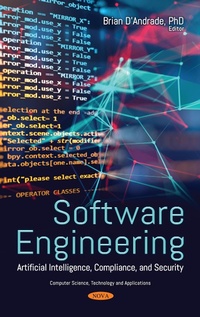
Software Engineering: Artificial Intelligence, Compliance, and Security
Published on 21. December 2020
249 pages
978-1-5361-9063-2 (ISBN)
Description

Information security is important in every aspect of daily life. This book examines four areas where risks are present: artificial intelligence (AI), the internet of things (IoT), government and malware. The authors channel their experience and research into an accessible body of knowledge for consideration by professionals. AI is introduced as a tool for healthcare, security and innovation. The advantages of using AI in new industries are highlighted in the context of recent developments in mechanical engineering, and a survey of AI software risks is presented focusing on well-publicized failures and US FDA regulatory guidelines. The risks associated with the billions of devices that form the IoT grow with the availability of such devices in consumer products, healthcare, energy infrastructure and transportation. The risks, software engineering risk mitigation methods and standards promoting a level of care for the manufacture of IoT devices are examined because of their importance for software developers. Strategic insights for software developers looking to do business with the US federal government are presented, considering threats to both public and private sectors as well as governmental priorities from recent executive and legislative branch actions. Finally, an analysis of malicious software that infects numerous computer systems each day and causes millions of dollars in damages every year is presented. Malicious software, or "malware," is software designed with hostile intent, but the damage may be mitigated with static and dynamic analyses, which are processes for studying how malware operates and analyzing potential impacts.
More details
Other editions
Additional editions
Book
12/2020
Nova Science Publishers Inc
€256.99
Shipment within 15-20 days
Content
- Intro
- Contents
- Preface
- Chapter 1
- Artificial Intelligence
- Abstract
- Introduction
- Machine Learning Algorithms
- Getting Started in ML
- AI in Mechanical Engineering
- Risk
- Regulations
- Risk Reduction
- References
- About the Authors
- Chapter 2
- Applications of Artificial Intelligence in Cybersecurity
- Abstract
- Introduction
- Applications of AI in Cybersecurity
- People Analytics
- Emerging Technology
- Further Research
- Applications of Cybersecurity in AI
- Adversarial Attacks
- Defending against Adversarial Attacks
- Implications for National Security
- References
- About the Author
- Chapter 3
- Software Security and the United States Government: A Strategic Primer for Executives and Developers
- Abstract
- Introduction
- Threat Landscape
- Governmental Priorities
- Congressional Influence on Governmental Priorities
- Governing Frameworks
- Guidance and Conclusion
- References
- About the Author
- Chapter 4
- Artificial Intelligence in Healthcare
- Abstract
- Introduction: Healthcare-Specific Background and Theory
- Performance Metrics
- Security and Privacy Considerations
- Specific Applications: Breast Cancer
- Specific Applications: Breast Pain
- Specific Applications: Novel Imaging
- Specific Applications: Wearables
- Future
- Conclusion
- References
- About the Authors
- Chapter 5
- Malware Analysis: A Look at Static and Dynamic Analysis Techniques
- Abstract
- Introduction
- Types of Malware Analysis
- Static Analysis
- Compilation
- Windows Executable Headers
- Data Directories
- Exports Directory
- Imports Directory
- Import Address Table
- Security Directory
- Debug Directory
- Tools
- Disassembly
- Dynamic Analysis
- Analysis Environment
- Analysis Configurations
- Bare Metal
- Hypervisors
- Emulators
- Volatile Memory Analysis
- Side Channel Analysis
- Dynamic Analysis Techniques
- Function Call Monitoring
- Run Time Analysis Techniques
- Information Flow Tracking
- Tracing
- Side-Channel Analysis
- References
- About the Authors
- Chapter 6
- Artificial Intelligence and the Food and Drug Administration
- Abstract
- Introduction: Food and Drug Administration Regulatory Framework for Artificial Intelligence and Machine Learning
- SaMD Pre-Specifications and Algorithm Change Protocol
- Good Machine Learning Practices
- FDA Software Regulation Pilot Programs
- Case for Quality
- Pre-Certification
- Examples of Post-Market Modifications and the Results
- Modifications to Performance Only
- Modifications to Inputs Only
- Modification to the Intended Use Only
- Modifications to Multiple Factors Simultaneously
- Conclusion
- References
- About the Authors
- Chapter 7
- Internet of Things Risks
- Abstract
- Introduction
- Applications
- Consumer Products
- Industrial Applications
- Healthcare
- Energy Infrastructure
- Transportation
- Risks
- Weak or Hardcoded Passwords
- Insecure Network Services
- Insecure Ecosystem Interfaces
- Lack of Secure Update Mechanism
- Use of Insecure or Outdated Components
- Insufficient Privacy Protection
- Insecure Data Transfer and Storage
- Lack of Device Management
- Insecure Default Settings
- Lack of Physical Hardening
- General Solution to the Top 10 IoT risks
- Software Engineering Principles to Mitigate Risks
- Software Requirements
- Software Design
- Software Construction
- Software Testing
- Software Maintenance
- Software Configuration Management
- Software Quality
- Conformance to Mitigate Risks
- Range of IoT Standards
- Consumer Reports Digital Standard
- Consumer Product Safety Commission Framework of Safety for the IoT
- ASTM F15.75 Guide for Ensuring the Safety of Consumer Connected Products
- ISO/IEC IoT Standards
- ISO/IEC Whitepaper, Smart and Secure IoT Platform
- Connectivity
- Processing
- Memory
- Sensing
- Actions
- Security
- ISO/IEC 30141 Reference Architecture for IoT
- Characteristics of IoT Systems
- IoT Conceptual Model
- IoT Reference Model
- IoT Reference Architecture Views
- IoT Trustworthiness
- UL 2900 Series
- ANSI/CAN/UL 2900-1:2017, Software Cybersecurity for Network-Connectable Products, Part 1: General Requirements
- Product Documentation Requirements (Sections 4-6)
- Software Security Risk Controls (Sections 7-11)
- Risk Management Process Requirements (Section 12)
- Vulnerability and Exploit Testing Methods (Sections 13-19)
- ANSI/CAN/UL 2900-2-1:2018, Software Cybersecurity for Network-Connectable Products, Part 2-1: Particular Requirements for Network Connectable Components of Healthcare Systems
- Documentation for Product Processes and Use (Sections 4-6)
- Security Controls (Sections 7-11)
- Product Assessment (Sections 12-19)
- Organizational Assessment (Section 20)
- UL 2900-2-2, Outline of Investigation for Software Cybersecurity for Network- Connectable Products, Part 2-2: Particular Requirements for Industrial Control Systems
- UL 2900-2-3, Outline of Investigation for Software Cybersecurity for Network-Connectable Products, Part 2-3: Particular Requirements for Security and Life Safety Signaling Systems
- UL List of IoT Security Top 20 Design Principles
- NIST
- NISTIR 8228, Considerations for Managing Internet of Things (IoT) Cybersecurity and Privacy Risks
- NISTIR 8259, Foundational Cybersecurity Activities for IoT Device Manufacturers
- NISTIR 8259A, NIST IoT Device Cybersecurity Capability Core Baseline
- NIST Framework for Improving Critical Infrastructure Cybersecurity
- Cloud Security Alliance
- CSA IoT Security Controls Framework
- Future-proofing the Connected World: 13 Steps to Developing Secure IoT Products
- Recommendations for IoT Firmware Update Processes
- Emerging Trends
- Device Information Integration
- Device Repurposing
- Device Modification
- Conclusion
- References
- About the Authors
- About the Editor
- Index
- Blank Page
