

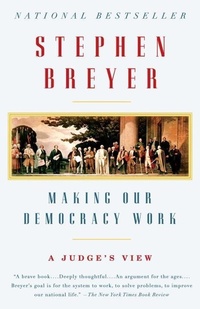
Making Our Democracy Work
A Judge's View
Published on 14. September 2010
288 pages
978-0-307-59426-6 (ISBN)
Description

The Supreme Court is one of the most extraordinary institutions in our system of government. Charged with the responsibility of interpreting the Constitution, the nine unelected justices of the Court have the awesome power to strike down laws enacted by our elected representatives. Why does the public accept the Court's decisions as legitimate and follow them, even when those decisions are highly unpopular? What must the Court do to maintain the public's faith? How can the Court help make our democracy work? These are the questions that Justice Stephen Breyer tackles in this groundbreaking book.
Today we assume that when the Court rules, the public will obey. But Breyer declares that we cannot take the public's confidence in the Court for granted. He reminds us that at various moments in our history, the Court's decisions were disobeyed or ignored. And through investigations of past cases, concerning the Cherokee Indians, slavery, and Brown v. Board of Education, he brilliantly captures the steps—and the missteps—the Court took on the road to establishing its legitimacy as the guardian of the Constitution.
Justice Breyer discusses what the Court must do going forward to maintain that public confidence and argues for interpreting the Constitution in a way that works in practice. He forcefully rejects competing approaches that look exclusively to the Constitution's text or to the eighteenth-century views of the framers. Instead, he advocates a pragmatic approach that applies unchanging constitutional values to ever-changing circumstances—an approach that will best demonstrate to the public that the Constitution continues to serve us well. The Court, he believes, must also respect the roles that other actors—such as the president, Congress, administrative agencies, and the states—play in our democracy, and he emphasizes the Court's obligation to build cooperative relationships with them.
Finally, Justice Breyer examines the Court's recent decisions concerning the detainees held at Guantánamo Bay, contrasting these decisions with rulings concerning the internment of Japanese-Americans during World War II. He uses these cases to show how the Court can promote workable government by respecting the roles of other constitutional actors without compromising constitutional principles.
Making Our Democracy Work is a tour de force of history and philosophy, offering an original approach to interpreting the Constitution that judges, lawyers, and scholars will look to for many years to come. And it further establishes Justice Breyer as one of the Court's greatest intellectuals and a leading legal voice of our time.
Today we assume that when the Court rules, the public will obey. But Breyer declares that we cannot take the public's confidence in the Court for granted. He reminds us that at various moments in our history, the Court's decisions were disobeyed or ignored. And through investigations of past cases, concerning the Cherokee Indians, slavery, and Brown v. Board of Education, he brilliantly captures the steps—and the missteps—the Court took on the road to establishing its legitimacy as the guardian of the Constitution.
Justice Breyer discusses what the Court must do going forward to maintain that public confidence and argues for interpreting the Constitution in a way that works in practice. He forcefully rejects competing approaches that look exclusively to the Constitution's text or to the eighteenth-century views of the framers. Instead, he advocates a pragmatic approach that applies unchanging constitutional values to ever-changing circumstances—an approach that will best demonstrate to the public that the Constitution continues to serve us well. The Court, he believes, must also respect the roles that other actors—such as the president, Congress, administrative agencies, and the states—play in our democracy, and he emphasizes the Court's obligation to build cooperative relationships with them.
Finally, Justice Breyer examines the Court's recent decisions concerning the detainees held at Guantánamo Bay, contrasting these decisions with rulings concerning the internment of Japanese-Americans during World War II. He uses these cases to show how the Court can promote workable government by respecting the roles of other constitutional actors without compromising constitutional principles.
Making Our Democracy Work is a tour de force of history and philosophy, offering an original approach to interpreting the Constitution that judges, lawyers, and scholars will look to for many years to come. And it further establishes Justice Breyer as one of the Court's greatest intellectuals and a leading legal voice of our time.
More details
Other editions
Additional editions
Book
09/2011
Vintage Books
€17.50
Shipment within 10-20 days

Book
09/2010
Knopf Publishing Group
€44.80
Article exhausted; check different version
Person
Stephen Breyer is an associate justice of the United States Supreme Court. He is a resident of Cambridge, Massachusetts, and Washington, D.C.
Content
- Intro
- Other Books by This Author
- Title Page
- Copyright
- Dedication
- Contents
- Author's Note
- Introduction
- Part 1 - The People's Trust
- Chapter One - Judicial Review: The Democratic Anomaly
- Chapter Two - Establishing Judicial Review: Marbury v. Madison
- Chapter Three - The Cherokees
- Chapter Four - Dred Scott
- Chapter Five - Little Rock
- Chapter Six - A Present-Day Example
- Part 2 - Decisions that Work
- Chapter Seven - The Basic Approach
- Chapter Eight - Congress, Statutes, and Purposes
- Chapter Nine - The Executive Branch, Administrative Action, and Comparative Expertise
- Chapter Ten - The States and Federalism: Decentralization and Subsidiarity
- Chapter Eleven - Other Federal Courts: Specialization
- Chapter Twelve - Past Court Decisions: Stability
- Part 3 - Protecting Individuals
- Chapter Thirteen - Individual Liberty: Permanent Values and Proportionality
- Chapter Fourteen - The President, National Security, and Accountability: Korematsu
- Chapter Fifteen - Presidential Power: Guantánamo and Accountability
- Conclusion
- Appendix A
- Appendix B: Background: The Court
- Acknowledgments
- Notes
- A Note About the Author
