

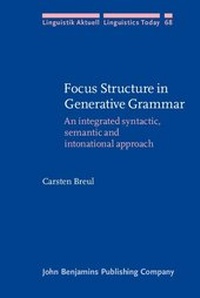
Focus Structure in Generative Grammar
An integrated syntactic, semantic and intonational approach
1st Edition
Published on 29. April 2004
X, 432 pages
978-90-272-9560-6 (ISBN)
Description

The notion of focus structure in this work refers to the distinction between categorical, thetic and identificational sentences. The central claim is that the syntactic representation of every sentence has to encode which of these types of focus structure is realized. This claim is discussed in great detail with respect to syntax, intonation and semantics within the framework of the Minimalist Program. It is shown that the incorporation of focus structure into syntax offers new perspectives for a solution of vexing problems in syntax and semantics. For example, fronting (preposing, 'topicalisation') is treated as a syntactic operation which clearly belongs to core grammar, i.e. is not optional or 'stylistic'; the semantic notion of quantifier raising is dispensed with in favour of a focus structural treatment of phenomena which gave rise to it. The book appeals to generative linguists and to functional linguists who do not believe in an unbridgeable gap between the formal and functional analysis of language.
More details
Other editions
Additional editions
Carsten Breul
Focus Structure in Generative Grammar
An integrated syntactic, semantic and intonational approach
Book
04/2004
John Benjamins Publishing Co
€137.80
Shipment within 10-15 days
Person
Content
- Focus Structure in Generative Grammar
- Editorial page
- Title page
- LCC page
- Table of contents
- Abbrevations
- 1. Introduction and overview
- 2. The syntactic framework and the FocP-hypothesis
- 2.1. Basic assumptions about phrase and clause structure
- 2.1.1. Phrase structure
- 2.1.2. Clause structure
- 2.2. The FocP-hypothesis
- 2.2.1. The syntactic and semantic-pragmatic perspectives
- 2.2.2. The intonational perspective
- 2.2.3. Where do the [±foc]-features come from?
- 3. A review of previous work
- 3.1. On information structure
- 3.2. On fronting (preposing, `topicalisation')
- 4. Information structure and focus structure
- 4.1. Focus structure as a component of information structure
- 4.2. Constraints on focus structure
- 4.2.1. A discourse constraint
- 4.2.2. A processing constraint
- 5. Features, checking theory and semantic implications
- 5.1. Features and checking theory
- 5.2. Semantic implications and applications
- 6. Intonational aspects of the FocP-hypothesis
- 6.1. The principles of i-focus projection
- 6.2. Supplementing the principles of i-focus projection
- 6.3. Pitch accents
- 6.4. Conclusion: The relation between i-focus and [±foc]-features
- 7. FocP-related English syntax
- 7.1. Introductory remarks
- 7.1.1. What is meant by `FocP-related syntax'?
- 7.1.2. Remarks on conditions of movement
- 7.1.3. Remarks on binding and co-reference
- 7.2. XP-movement to spec-Foc of root clauses
- 7.2.1. Declarative root clauses
- 7.2.2. Interrogative root clauses
- 7.2.3. Aux-support for downward-entailing fronted XPs in root clauses
- 7.2.4. Full inversion in root clauses
- 7.2.5. Multiple fronting in root clauses
- 7.2.6. Movement to root spec-Foc from an embedded clause
- 7.3. XP-movement to spec-Foc of embedded clauses
- 7.3.1. Embedded clauses and focus structure
- 7.3.2. Embedded declarative clauses
- 7.3.3. Embedded interrogative clauses
- 7.3.4. Relative clauses
- 7.3.5. Aux-support for downward-entailing fronted XPs in embedded clauses
- 7.4. XP-movement to both root and embedded spec-Foc
- 7.5. Mitigated that-trace effects
- 7.6. Conclusion
- 8. Semantic issues related to the FocP-hypothesis
- 8.1. The syntax-semantics/pragmatics interface
- 8.1.1. Context-dependent truth conditions
- 8.1.2. The (basically) Montagovian perspective
- 8.1.3. A (basically) Davidsonian revision
- 8.2. Conceptual and type-semantic considerations
- 8.2.1. Referentiality, (in)definiteness, and (non-)specificity
- 8.2.2. Type-semantic issues concerning non-nominal expressions in spec-Foc
- 8.2.3. Ambiguity and vagueness
- 8.3. Semantic effects of focus structure
- 8.3.1. Some more `plain' cases
- 8.3.2. Focus structure instead of QR
- 8.3.3. Some more cases with quantificational expressions involved
- 8.3.4. Weak crossover effects
- 8.4. Conclusion
- 9. Aspects of the syntax of languages other than English
- 9.1. Other languages in general
- 9.1.1. Constituent order variations in general
- 9.1.2. Cross-linguistic variations concerning topic and identificational height 8pt depth 3pt width 0ptto.23cmfocus XPs
- 9.2. German
- 9.2.1. Clause structure
- 9.2.2. Scrambling
- 9.2.3. Some specifically German types of XP-fronting (and related issues)
- 9.2.4. Some remaining problems and questions
- 9.3. Conclusion
- 10. Summary and general conclusion
- Notes
- References
- Appendix
- Name index
- Subject index
- The series Linguistik Aktuell/Linguistics Today
