

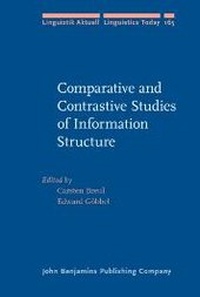
Comparative and Contrastive Studies of Information Structure
1st Edition
Published on 9. September 2010
XII, 306 pages
978-90-272-8784-7 (ISBN)
Description

This volume presents original comparative and contrastive research into various aspects of information structure (topic, focus, contrastivity, givenness, anaphoricity) as well as into forms and structures whose realisation depends on information-structural factors (clefts, dislocations, reflexives, null subjects, prosodic features, interrogatives) in a number of different languages (Catalan, English, French, Georgian, German, Hebrew, Hungarian). Each contribution emphasises differences or commonalities between the languages under investigation with respect to the realisation of information structural categories or with respect to the information structural implications of a given form or structure. The specific comparative-contrastive perspective of the volume makes a substantial contribution towards a better understanding of language specific and universal aspects of information structure. It raises significant questions and provides solutions for the formal representation and the functional properties of information structural categories.
More details
Other editions
Additional editions
Carsten Breul | Edward Goebbel
Comparative and Contrastive Studies of Information Structure
Book
09/2010
John Benjamins Publishing Co
€104.94
Shipment within 10-15 days
Persons
Content
- Comparative and Contrastive Studies of Information Structure
- Editorial page
- Title page
- LCC data
- Table of contents
- Preface
- List of contributors
- List of abbreviations
- Introduction
- References
- Contrastive topics and distributed foci as instances of sub-informativity
- 1. Introduction
- 2. Terminological remarks on information structural categories
- 3. Contrastive topics, distributed foci and sub-informativity
- 3.1 Three theories of contrastive topicicality
- 3.2 Sub-informativity
- 4. Types of sub-informativity
- 5. Lexical indicators of sub-informativity
- 6. Syntactic indicators of sub-informativity
- 6.1 Fronting in English
- 6.2 Movement to the Forefield in German
- 7. Prosodic indicators of sub-informativity
- 7.1 English: The fall-rise contour
- 7.1.1 Definition and representation
- 7.1.2 The function of the fall-rise
- 7.2 The German root contour
- 7.2.1 Definition and representation
- 7.2.2 The distribution of the root contour
- 7.3 Contrasts between English and German
- 8. Conclusions
- References
- Givenness and discourse anaphors
- 1. Introduction
- 2. Catalan dislocation and English deaccenting
- 3. Catalan and English contrasts
- 4. But English deaccenting ? Catalan Clitic Right Dislocation
- 5. Stress, focus and givenness
- 6. Phonetic form
- 7. Syntax - discourse - Phonetic Form
- 8. Conclusion
- References
- Constraints on subject-focus mapping in French and English
- 1. Focus structure across languages: Some examples
- 2. Constraints on the mapping from information structure to grammatical form
- 3. Mapping constraints and preferred clause structure in spoken French
- 4. Secondary predication constructions
- 4.1 Argument-focus constructions
- 4.2 Sentence-focus constructions
- 5. Concluding remarks
- References
- Wh-questions in French and English
- 1. Introduction
- 2. Form and function of French wh-questions
- 2.1 Statistics
- 2.2 Type 1: Wh in situ questions
- 2.3 Type 2: Wh fronted + SVO
- 2.4 Type 3: Wh fronted + subject-verb inversion
- 2.5 Type 4: Wh-fronting + est-ce que + SVO
- 2.6 Conclusion
- 3. The pragmatic functions of English wh-questions
- 4. The diachronic perspective
- 4.1 Word order change
- 4.2 Contributing factors
- 4.3 Wh-pronouns
- 5. Formal analysis
- 5.1 Syntactic optionality
- 5.2 Pronouns
- 5.2.1 Subject pronouns and interrogative syntax in French
- 5.2.2 Wh-pronouns in French
- 5.2.3 Northern Italian dialects
- 5.2.4 Wh-doubling" in French
- 5.2.5 Wh-pronouns in English
- 6. Conclusion
- References
- A comparative perspective on intensive reflexives
- 1. Introduction
- 2. Background
- 2.1 The intensive reflexive in English and Hebrew
- 2.2 Previous analyses
- 3. Intensive reflexives - monosemy
- 4. Intensive reflexive scope
- 4.1 Scope effects with intensive reflexives
- 4.2 Intensive reflexive scope and information status
- 5. Conclusion
- References
- Printed sources of data
- Focus types and argument asymmetries
- 1. Preliminaries
- 2. Strategies for expressing narrow focus
- 2.1 Focus in situ
- 2.2 Reordering
- 2.3 Cleft constructions
- 3. Method
- 4. Results
- 4.1 Georgian
- 4.2 Hungarian
- 4.3 American English
- 4.4 Québec French
- 5. Discussion
- 5.1 Summary of empirical findings
- 5.2 Interaction with grammatical possibilities
- 5.3 Minimality condition
- 5.4 Asymmetry of focused arguments
- 5.5 Asymmetry of focus types
- 6. Conclusions
- References
- Topicality in L1 acquisition
- 1. Introduction
- 2. The notion of topic in adult and early child speech
- 3. Previous research on child encoding of information
- 4. Subjects and subject omission in adult and child French and German
- 5. The analysis of the child speech data
- 5.1 The children included in the study
- 5.2 Methodology and characteristics of the study
- 5.3 Results of the study
- 5.3.1 The frequency of child subject omission and realization
- 5.3.2 The feature specification of child subject omission and realization
- 6. Discussion
- 7. Conclusion
- References
- Formal and functional constraints on constituent order and their universality
- 1. Introduction
- 2. Basic assumptions
- 3. Earlier approaches to discourse configurationality and word order
- 3.1. Subject-prominence vs. topic-prominence
- 3.2 Subject and topic positions in hierarchical phrase structure
- 3.3 Does the EPP approach yield a proper classification of languages?
- 3.4 Linearisation without functional phrases
- 4. Topicality, perspectivation, and linearisation
- 4.1 On the notion of topicality
- 4.2 Perspectivation'
- 5. Conclusion: Towards a model of interacting constraints on linearisation
- References
- On the foundations of the contrastive study of information structure
- 1. Introduction
- 2. Ontological and methodological aspects
- 2.1 The distinctive features of contrastive analysis in general
- 2.2 The distinctive features applied to contrastive information structure analysis
- 2.2.1 Tertium comparationis on the meaning/function side
- 2.2.2 Tertium comparationis on the form side
- 2.3 Relativising the methodological ideal
- 3. Examples of contrastive information structure analyses in the present volume
- 4. Conclusion
- References
- Subject index
- The series Linguistik Aktuell/Linguistics Today
