

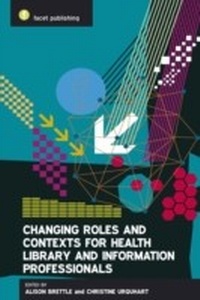
Changing Roles and Contexts for Health Library and Information Professionals
Description

This timely edited collection examines the evolving role of health professionals and explores the role they play in the context of where they work. It aims to encourage and inspire health information professionals worldwide to take on new opportunities and ensure their continued development and recognition as valuable assets in the changing health care environment.
Library and information professionals working in the health sector face many challenges. Rapid developments in information technology and the provision of information, coupled with organizational developments and the widespread adoption of evidence-based practice have ensured constant change for a number of years. How have library and information professionals met this challenge and how has this affected the roles they play? Will developments in services render the hospital librarian obsolete? Is there a need for academic health librarians amongst the Google generation of students?
The key topics covered in the book are:
- providing information
- facilitating access to information and managing knowledge
- building capacity
- undertaking research and evaluation
- supporting research and practice
- exploiting technology
- evidence-based practice.
Readership: Information workers and other health professionals, as well as students on librarianship and information studies courses.
All prices
More details
Other editions
Additional editions
Persons
Dr Alison Brettle is Research Fellow (Information), Salford Centre for Nursing, Midwifery and Collaborative Research, Institute of Health and Social Care Research, University of Salford.
Dr Christine Urquhart is Senior Lecturer, Department of Information Studies, University of Aberystwyth.
Content
Overview - Alison Brettle and Christine Urquhart
PART 1: CONTEXT
1. The changing context of health for library and information professionals
- The health context - Christine Urquhart
- Health library and information professionals in Europe - Suzanne Bakker
2. Changes in information generation and use
- Changes in information generation and use: the effects on NHS library staff roles - Jenny Turner and Louise Goswami
- Taking advantage of change: how health library and information professionals are shaping the higher education experience - Neil Ford
- Information generation and use: a primary care perspective - Sue Lacey Bryant
- Changes in information generation and use: reflections on the effects on academic and NHS information services - Christine Urquhart
3. Changing technology to meet clinicians' information needs
- Clinician's information needs - Nicholas R Hardiker
4. The influences of governance, consumers and evidence based practice
- What does information management for clinical governance involve? - Gareth Lawrence
- Consumer health information - Alison Yeoman
- Evidence based practice and what it means for health library and information professionals - Alison Brettle
- Not as easy as it seems: what health professionals can tell us about applying evidence in practice - Prudence Dalrymple
PART 2: ROLES
5. Skills, competencies an knowledge - Christine Urquhart6. The librarian as information provider and educator
- Higher education overview - Pat Spoor
- NHS overview - Debra Thornton
7. The librarian who analyses information and manages knowledge - Christine Urquhart8. The librarian within research and evidence based practice - Alison Brettle 9. The librarian as decision maker - Jackie CheeseboroughConclusion - Christine Urquhart and Alison Brettle
