

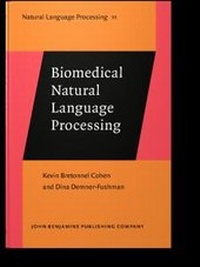
Biomedical Natural Language Processing
Fetal Cell Experiments from Cyberspace to China
1st Edition
Published on 27. February 2014
XI, 160 pages
978-90-272-7106-8 (ISBN)
Description

Biomedical Natural Language Processing is a comprehensive tour through the classic and current work in the field. It discusses all subjects from both a rule-based and a machine learning approach, and also describes each subject from the perspective of both biological science and clinical medicine. The intended audience is readers who already have a background in natural language processing, but a clear introduction makes it accessible to readers from the fields of bioinformatics and computational biology, as well. The book is suitable as a reference, as well as a text for advanced courses in biomedical natural language processing and text mining.
More details
Other editions
Additional editions
Kevin Bretonnel Cohen | Dina Demner-Fushman
Biomedical Natural Language Processing
Book
02/2014
John Benjamins Publishing Co
€100.70
Shipment within 10-15 days
Kevin Bretonnel Cohen | Dina Demner-Fushman
Biomedical Natural Language Processing
Book
02/2014
John Benjamins Publishing Co
€34.98
Shipment within 10-15 days
Persons
Content
- Biomedical Natural Language Processing
- Editorial page
- Title page
- LCC data
- Acknowledgments
- Table of contents
- List of figures
- 1. Introduction to natural language processing
- 1.1 Some definitions
- 1.1.1 Computational linguistics
- 1.1.2 Natural language processing
- 1.1.3 Text mining
- 1.1.4 Usage of these definitions in practice
- 1.2 Levels of document and linguistic structure and their relationship to natural language processin
- 1.2.1 Document structure
- 1.2.2 Sentences
- 1.2.3 Tokens
- 1.2.4 Stems and lemmata
- 1.2.5 Part of speech
- 1.2.6 Syntactic structure
- 1.2.7 Semantics
- 2. Historical background
- 2.1 Early work in the medical domain
- 2.2 The emergence of the biological domain
- 2.3 Clinical text mining
- 2.4 Types of users of biomedical NLP systems
- 2.5 Resources and tools
- US National Library of Medicine
- MEDLINE database
- Medical Subject Headings
- PubMed
- GENIA
- PubMed Central International
- 2.6 Legal and ethical issues
- 2.7 Is biomedical natural language processing effective?
- 3. Named entity recognition
- 3.1 Overview
- 3.2 The crucial role of named entity recognition in BioNLP tasks
- 3.3 Why gene names are the way they are
- 3.4 An example of a rule-based gene NER system: KeX/PROPER
- 3.5 An example of a statistical disease NER system
- 3.6 Evaluation
- 4. Relation extraction
- 4.1 Introduction
- 4.1.1 Protein-protein interactions as an information extraction target
- 4.2 Binarity of most biomedical information extraction systems
- 4.3 Beyond simple binary relations
- 4.4 Rule-based systems
- 4.4.1 Co-occurrence
- 4.4.2 Example rule-based systems
- 4.4.3 Machine learning systems
- 4.5 Relations in clinical narrative
- 4.5.1 MedLEE
- 4.6 SemRep
- 4.6.1 NegEX
- 4.7 Evaluation
- 5. Information retrieval/document classification
- 5.1 Background
- 5.1.1 Growth in the biomedical literature
- 5.1.2 PubMed/MEDLINE
- 5.2 Issues
- 5.3 A knowledge-based system that disambiguates gene names
- 5.4 A phrase-based search engine, with term and concept expansion and probabilistic relevance rankin
- 5.5 Full text
- 5.6 Image and figure search
- 5.7 Captions
- 5.7.1 Evaluation
- 6. Concept normalization
- 6.1 Gene normalization
- 6.1.1 The BioCreative definition of the gene normalization task
- 6.2 Building a successful gene normalization system
- 6.2.1 Coordination and ranges
- 6.2.2 An example system
- 6.3 Normalization and extraction of clinically pertinent terms
- 6.3.1 MetaMap UMLS mapping tools
- 7. Ontologies and computational lexical semantics
- 7.1 Unified Medical Language System (UMLS)
- 7.1.1 The Gene Ontology
- 7.2 Recognizing ontology terms in text
- 7.3 NLP for ontology quality assurance
- 7.4 Mapping, alignment, and linking of ontologies
- 8. Summarization
- 8.1 Medical summarization systems
- 8.1.1 Overview of medical summarization systems
- 8.1.2 A representative medical summarization system: Centrifuser
- 8.2 Genomics summarization systems
- 8.2.1 Sentence selection for protein-protein interactions
- 8.2.2 EntrezGene SUMMARY field generation
- 9. Question-answering
- 9.1 Principles
- 9.1.1 Question analysis and formal representation
- 9.1.1.1 Clinical questions
- 9.1.2 Formal representation of questions
- 9.1.3 Domain model-based question representation
- 9.1.3.1 Genomics and translational research questions
- 9.1.4 Answer retrieval
- 9.1.5 Answer extraction and generation
- 9.1.5.1 Reference answer formats for clinical questions
- 9.1.5.2 Entity-extraction approaches to answer generation
- 9.2 Applications
- 9.2.1 Question analysis and query formulation
- 9.2.2 Knowledge Extraction
- 9.2.2.1 Population Extractor
- 9.2.2.2 Problem Extractor
- 9.2.2.3 Intervention Extractor
- 9.2.2.4 Outcome Extractor
- 9.2.2.5 Clinical Task classification
- 9.2.2.6 Strength of Evidence classification
- 9.2.2.7 Document scoring and ranking
- 9.2.3 Question-Document frame matching (PICO score)
- 9.2.3.1 Answer generation
- 9.2.4 Semantic clustering
- Summary
- 10. Software engineering
- 10.1 Introduction
- 10.2 Principles
- 10.3 General software testing
- 10.3.1 Clean and dirty tests
- 10.3.2 Testing requires planning
- 10.3.3 Catalogues
- 10.3.4 How many tests are possible?
- 10.3.5 Equivalence classes
- 10.3.6 Boundary conditions
- 10.4 Code coverage
- 10.5 When your input is language
- 10.6 User interface evaluation
- 10.6.1 API interface usability
- 11. Corpus construction and annotation
- 11.1 Corpora in the two domains as driving forces of research
- 11.2 Who should build biomedical corpora?
- 11.3 The relationship between annotation of entities and annotation of linguistic structure
- 11.4 Commonly used biomedical corpora
- 11.4.1 GENIA
- 11.4.2 CRAFT
- 11.4.3 BioCreative gene mention corpora
- 11.4.4 AIMed
- 11.4.5 Word sense disambiguation
- 11.4.6 Clinical corpora
- 11.4.6.1 NLP Challenge
- 11.4.6.2 The MIMIC collection
- 11.5 Factors that contribute to the success of biomedical corpora
- References
- Index
